
The Role of a Built-In Check Valve in a Pump Control Switch
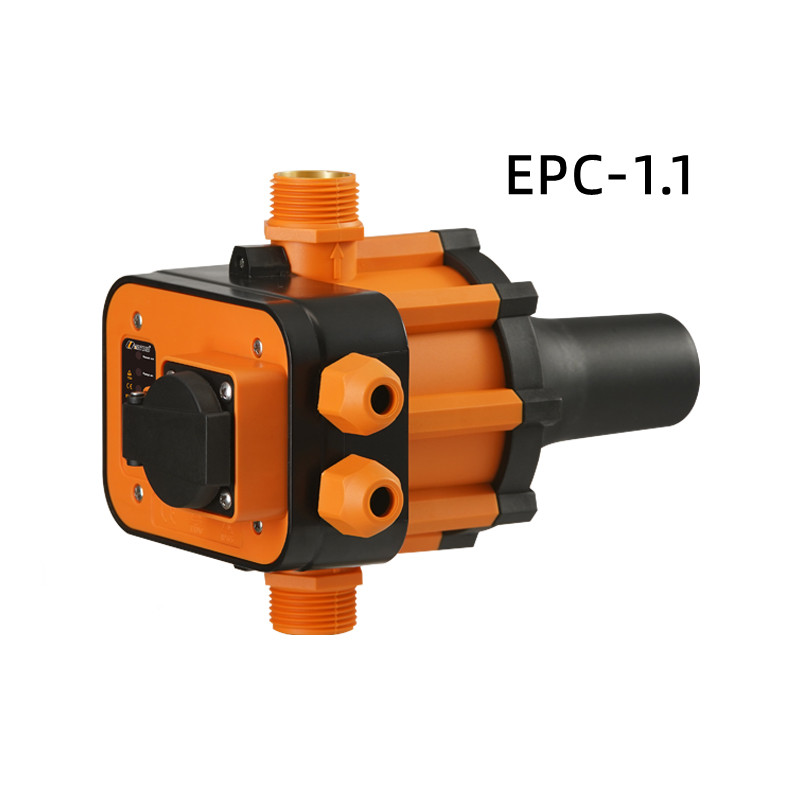
Monro Switch EPC-1.1 pump pressure control. The check valve sits inside the switch body, so no external non-return fitting is mounted at the outlet.
A built-in check valve is a one-way valve integrated into the hydraulic body of a pump control switch. It allows water to pass from the pump toward the outlet and closes against reverse flow, so water cannot travel back through the switch, the pump, or the suction line once the pump stops. Monro Switch — Zhejiang Monro Machinery & Electronic Co., Ltd., a pressure controller, pressure switch and float switch manufacturer based in Wenling City, Zhejiang Province, China — includes this component in the EPC-1.1 and the EPC-3 pump pressure controls.
Two things change for a buyer when that valve is already inside the switch. Backward flow, and the water hammer that follows a reversed water column, are blocked at the exact point where the hydraulic connection is made. And the installer no longer has to buy, thread and seal a separate non-return valve at the switch outlet. This explainer covers what the component does, why it prevents water hammer and backward flow, and how to check for it when specifying, installing or replacing a pressure control switch.
What a Built-In Check Valve Actually Does
A check valve has one job: it permits flow in a single direction and stops it in the other. Inside a pump control switch, that valve sits in the water path between the pump connection and the system outlet. While the pump is running, forward flow holds the valve open and the switch senses line pressure normally. When the pump stops, the pressure held by the downstream system pushes the valve closed, and the reverse path is shut.
Three practical functions follow from that single behaviour:
- Reverse-flow blocking. Water in the discharge line and the pressurised system cannot run back through the switch body and into the pump.
- Prime retention. With the reverse path closed, the pump casing and suction line are not drained by the system head after shutdown, which matters most on suction and self-priming installations.
- Hydraulic separation. The switch becomes the boundary between the pump side and the system side, so the non-return function sits where the threads are made up rather than somewhere else in the pipework.
Not every pressure control switch includes this element. On models without an integrated check valve, the non-return function has to be provided by an external fitting in the pipeline, and the switch housing itself has no non-return element at all. That difference is the reason this feature appears on premium models and not on entry-level ones.
Why Backflow and Water Hammer Are a Problem in Pump Systems
When a pump stops, the water column downstream keeps moving for a moment, and the static head of the system then pushes it back toward the pump. If there is no non-return element anywhere in that path, the reversed flow passes straight through the pressure control switch and the pump. Three failure patterns usually follow.
Loss of prime. On suction and self-priming pumps, reverse flow can empty the pump casing and the suction line. The pump then restarts without water, which is the condition dry-run protection is designed to catch. Where the check valve is integrated into the switch, this reverse path is closed at the pump connection instead of relying on a separate fitting further down the line.
Water hammer. When a moving column of water is suddenly stopped or forced to reverse, its kinetic energy turns into a pressure surge that travels back along the pipework. This is water hammer: it produces the banging heard in a pump room after shutdown, and it loads pipe joints, seals, the sensing element and the pump itself. A non-return element placed at the point where the switch and pump connect prevents the reverse acceleration that feeds the surge, which is precisely where the built-in check valve in the EPC-1.1 and EPC-3 works.
Pressure instability and short cycling. Backflow lowers system pressure quickly. The switch sees that pressure fall, closes its contacts and restarts the pump, so the system cycles more often than the operating setpoints would suggest. Settling the flow direction first is the conventional starting point before anyone adjusts starting pressure settings.
Where the check valve is an external fitting, the protection also depends on where that fitting is installed and how well its threads are sealed. A built-in valve removes both variables: the non-return element is part of the switch, and it is tested with the switch.
Industry Background: Where Non-Return Protection Sits Today
Pressure controls are a mature category with steady demand. Fortune Business Insights valued the global pressure switch market at USD 3.2 billion in 2025, and the same source projects growth to USD 5.13 billion by 2034. Market Research Future reported that electromechanical pressure switches accounted for approximately 62% of global market share in 2024, which reflects how much of the installed base still uses mechanical and electromechanical designs in residential, irrigation and light commercial water systems. These are exactly the installations where a small non-return component has an outsized effect, because the switch and the pump are usually connected directly with a single threaded joint.
From a regulatory angle, automatic electrical pressure sensing controls are covered by IEC 60730-2-6:2025, the current international standard for this product family. In trade documentation, water pump pressure switches are commonly classified under HS Code 853650, the heading for electrical switches for a voltage not exceeding 1,000 V.
The supplier behind the EPC-1.1 and EPC-3 is Zhejiang Monro Machinery & Electronic Co., Ltd., trading as Monro Switch. Officially established in 2010 and drawing on more than 20 years of manufacturing expertise in pressure controls and float switches, the company operates a 30,000 m² facility in Wenling City with around 200 employees and a 10-engineer R&D team. Annual output covers the EPC series at 2.88 million pieces, the KRS series at 3.24 million pieces and the FPS series at 0.6 million pieces, with roughly 90% of production exported to Asia, Europe, North and South America, and the Middle East and Africa. The company holds TÜV Rheinland safety certification R 50175890 for the EPC-10, EPC-12, EPC-14 and EPC-16 control units, CE-EMC certificates issued by TÜV Rheinland LGA Products GmbH, ISO 9001:2015 certification (20126Q00115R300), and UL listing E316396 for the KRS-4 pressure operated switch.
How the Built-In Check Valve Works Inside the EPC-1.1 and EPC-3
In both models the valve is part of the switch assembly rather than an accessory. Water enters through the threaded port, passes the non-return element, and reaches the pressure sensing chamber before leaving for the system. Nothing in the installation procedure changes; what changes is that the extra fitting, the extra thread and the extra sealing step disappear.
EPC-1.1: domestic water supply with an integrated non-return element
The EPC-1.1 is a pump pressure control positioned for domestic water supply. It operates at 220–240 V or 110–120 V, 50/60 Hz, with maximum power ratings of 1.1 kW, 1.5 kW and 0.75 kW. Starting pressure settings are 1.2 bar, 1.5 bar or 2.2 bar. The body is constructed from plastic and metal, protection rating is IP65, and the maximum working temperature is 55 °C. Connection threads are available in G1", G1 1/4", G1 1/2" and NPT1" — a wide thread menu for a unit whose check valve already handles the non-return duty.
EPC-3: the same principle across irrigation, water treatment and construction
The EPC-3 shares the same electrical platform: 220–240 V or 110–120 V, 50/60 Hz, starting pressure settings of 1.2 bar, 1.5 bar or 2.2 bar, IP65 protection and a 55 °C maximum working temperature, in a plastic and metal body. Maximum power ratings are 0.55 kW, 1.1 kW, 1.5 kW and 0.75 kW, and the standard connection thread is G1". Its intended fields of use are agriculture irrigation, water treatment and construction, and like the EPC-1.1 it carries the built-in check valve rather than requiring an external one.
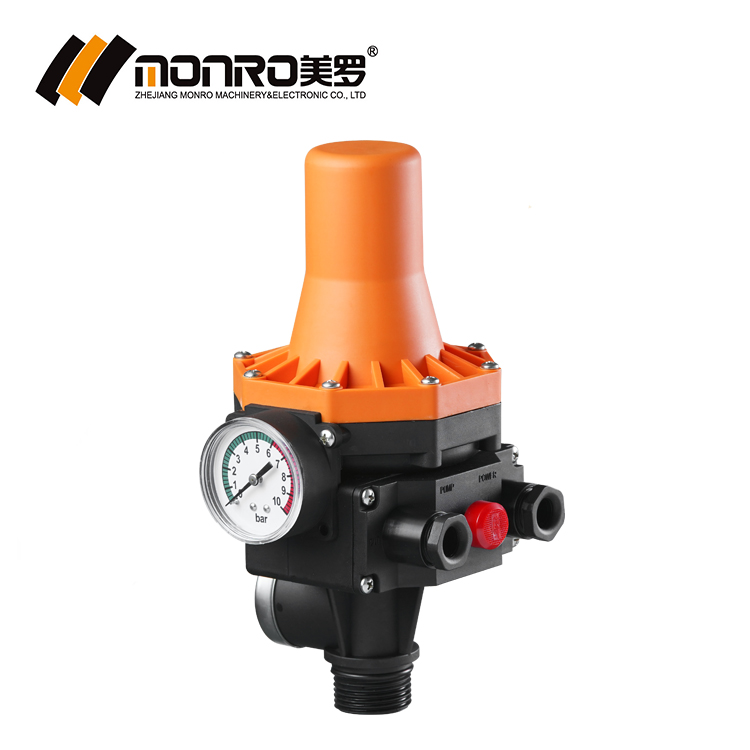
Monro Switch EPC-3 pump pressure control — IP65, 1.2/1.5/2.2 bar starting pressure settings, intended for agriculture irrigation, water treatment and construction.
Why an Integrated Valve Beats an External Installation
The engineering argument for integrating the check valve is the same argument that applies to any assembled function: fewer interfaces, fewer failure points, fewer things to get wrong on site.
- One less part to source. A separate check valve has to be specified, ordered and stocked as its own line item, with its own thread standard and its own dimensional limits.
- One less threaded joint. Every threaded connection is a potential leak path. Removing the external valve removes one joint from a pressurised line.
- Shorter installation. The fitter connects the switch to the pump, applies the wiring and seals the cable entry. There is no extra valve to orient, thread and seal.
- No orientation error. Because the valve and the housing are supplied as one unit, there is no separate component to install backwards.
- Function verified with the switch. Monro performs 100% testing on its products, so the check valve is validated as part of the switch, not as a loose item.
For a distributor or an OEM buyer, this also simplifies the bill of materials and the after-sales conversation: when a switch is replaced, the non-return function is replaced with it.
Step-by-Step: Installing and Verifying a Check-Valve-Equipped Switch
The installation sequence below applies to the EPC-1.1 and EPC-3, both of which already carry the check valve.
- Match the switch to the pump. Check the pump separately to confirm it operates normally, and verify that the parameters on the pump nameplate match the pressure controller. The pump head must be at least 0.8 bar higher than the controller's start-up pressure.
- Confirm you do not need a second check valve. On the EPC-1.1 and EPC-3, the non-return element is inside the switch body, so there is no need to add a separate check valve at the switch outlet.
- Install in the flow direction. Mount the pressure controller according to the direction indicated by the arrow on its housing.
- Wire the unit. Connect the controller's power cord to a separate plug wire, and wrap the connection securely with waterproof insulating tape to ensure proper sealing. Seal all wire joints.
- Fill the loop before power-up. After all electrical connections are complete, open the main outlet valve and all water faucets first, then connect the power supply. The pump pressure controller will then begin operation.
- Check one stop cycle. Let the pump run to its cut-out pressure and stop. With the pump off, system pressure should hold rather than fall away. If pressure drops quickly between cycles, that points back to reverse flow, and the non-return function is the first thing to inspect.
- Set the starting pressure correctly. Use the relationship between starting pressure and usable head. At a starting pressure of 1.2 bar, the maximum water use height is 1.2 × 10 m = 12 m, and the pump lift needs to be at least (1.2 + 0.8) × 10 m = 20 m.
Where a Built-In Check Valve Matters Most
Domestic water supply. The EPC-1.1 is intended for domestic applications. In a house or small building, a pressure loop that bleeds back through the switch between cycles forces the pump to restart repeatedly. Removing the reverse path keeps the loop stable and quiet, and it is the reason this model appears in domestic booster discussions.
Agriculture irrigation. The EPC-3 is intended for agriculture irrigation, water treatment and construction. In irrigation, long discharge lines hold a large volume of water; when the pump stops, that volume wants to return. A non-return element inside the switch keeps the catchment side from draining back through the pump, so the next start does not begin from an empty line.
Water treatment and construction. The same EPC-3 platform is used in water treatment and on construction sites, where pumps are started and stopped frequently and where an extra leak point in the pipework is a real maintenance cost.
A field example. A retail client in China has used Monro pressure controls for two years on a water supply system, with 50 pieces applied across agriculture irrigation, water treatment and construction duties. The recorded result was reliable automatic pressure control for the water supply system, with the highlight being automatic pump start/stop control. On installations of that type, the built-in check valve is part of what keeps the start/stop behaviour predictable.
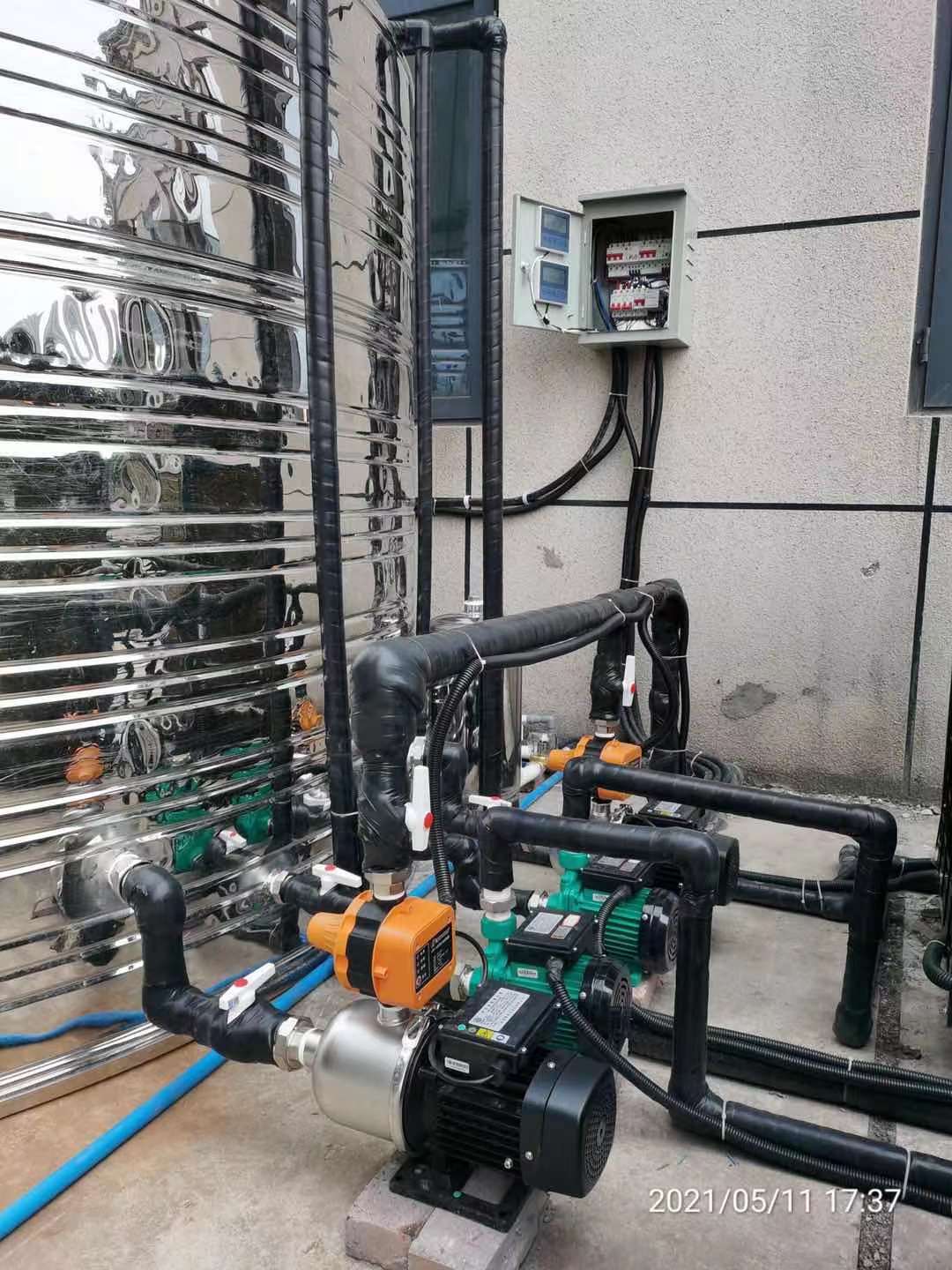
Reference installation: automatic pump start/stop pressure control on a water supply system.
EPC-1.1 vs EPC-3: Specification Comparison
Both models carry the built-in check valve. The differences below are the ones that decide which unit goes into which system.
| Parameter | EPC-1.1 | EPC-3 |
|---|---|---|
| Built-in check valve | Yes | Yes |
| Rated voltage | 220–240 V / 110–120 V | 220–240 V / 110–120 V |
| Power frequency | 50/60 Hz | 50/60 Hz |
| Maximum power | 1.1 kW / 1.5 kW / 0.75 kW | 0.55 kW / 1.1 kW / 1.5 kW / 0.75 kW |
| Starting pressure setting | 1.2 bar, 1.5 bar, 2.2 bar | 1.2 bar, 1.5 bar, 2.2 bar |
| Connection thread | G1", G1 1/4", G1 1/2", NPT1" | G1" |
| Protection rating | IP65 | IP65 |
| Max. working temperature | 55 °C | 55 °C |
| Material | Plastic, metal | Plastic, metal |
| Intended application | Domestic water supply | Agriculture irrigation, water treatment, construction |
FAQ: The Built-In Check Valve in Practice
Does a switch with a built-in check valve still have to meet pressure control standards?
Yes. The check valve is a mechanical element inside the housing; the product as a whole remains an automatic electrical pressure sensing control. IEC 60730-2-6:2025 is the current international standard for this family of controls, and Monro's EPC units are certified against EN 60730-1 and EN 60730-2-6. TÜV Rheinland safety certification R 50175890 covers the EPC-10, EPC-12, EPC-14 and EPC-16 control units. CE-EMC certificate AE 505724390001, issued by TÜV Rheinland LGA Products GmbH, covers the EPC-1, EPC-2, EPC-2.1, EPC-3, EPC-3P, EPC-4, EPC-5 and EPC-15 units together with CEWP-111B. The manufacturing system is certified to ISO 9001:2015 under certificate 20126Q00115R300, and the KRS-4 pressure operated switch holds UL listing E316396 for the North American market. Buyers sourcing EPC-1.1 or EPC-3 volumes should still confirm the exact certificate copy that applies to their order.
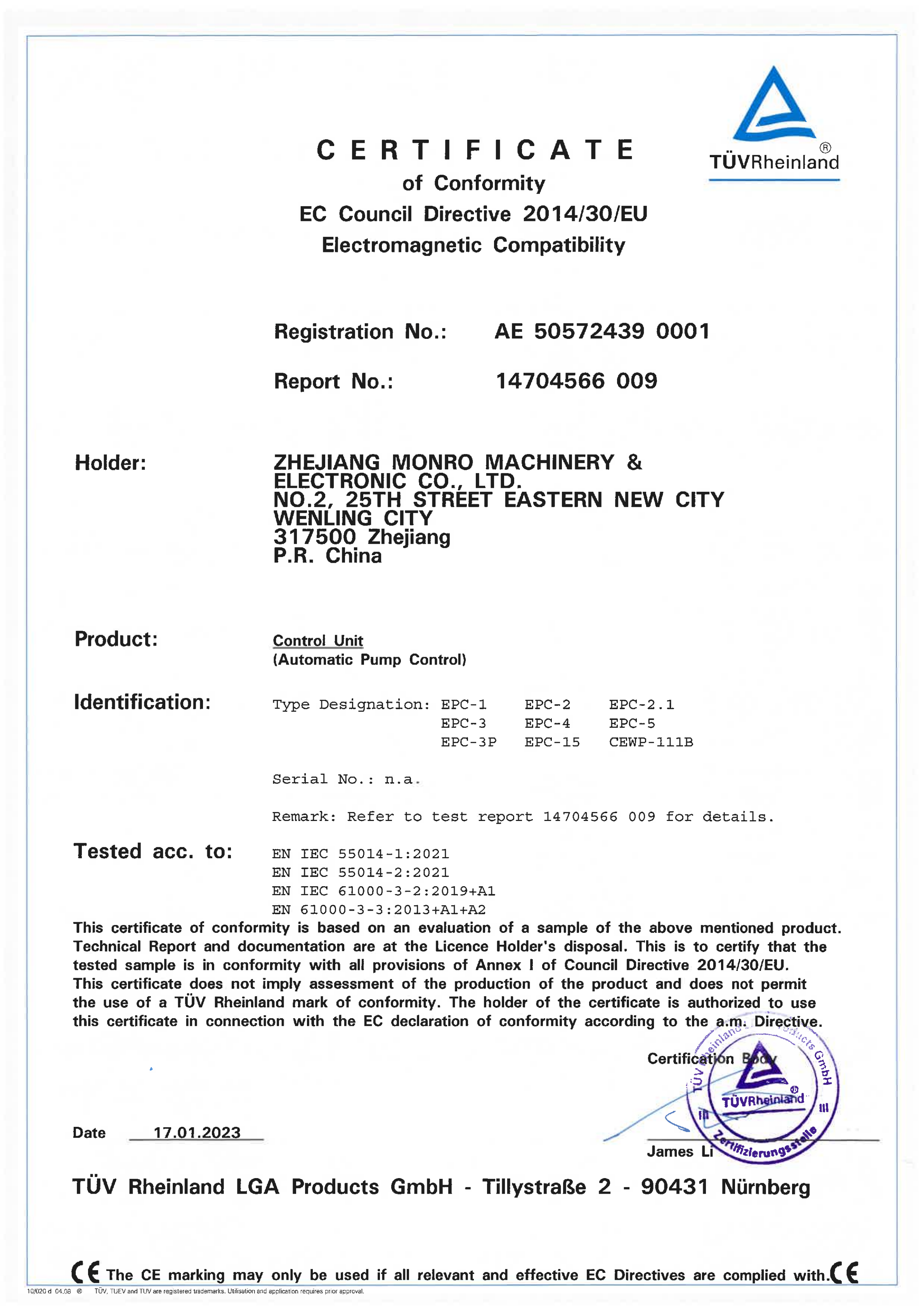
CE-EMC Certificate of Conformity AE 505724390001 issued by TÜV Rheinland LGA Products GmbH, covering EPC-1, EPC-2, EPC-2.1, EPC-3, EPC-3P, EPC-4, EPC-5, EPC-15 and CEWP-111B.
Which Monro models include the built-in check valve?
The EPC-1.1 and the EPC-3. Both are pump pressure controls operating at 50/60 Hz with 1.2 bar, 1.5 bar or 2.2 bar starting pressure settings and IP65 protection. The EPC-1.1 is positioned for domestic water supply and offers a wider thread menu of G1", G1 1/4", G1 1/2" and NPT1"; the EPC-3 uses a G1" connection and is intended for agriculture irrigation, water treatment and construction. Because the valve is inside the housing, the specification that changes for the buyer is not an extra part number but the fact that the hydraulic connection is completed in one step.
How does an integrated valve affect the cost of ownership?
Compare installed cost rather than unit price alone. An external check valve is a separate part with its own supply line, plus an additional threaded joint and the labour to seal it. Integrating the valve into the EPC-1.1 or EPC-3 removes that part and that joint. On the commercial side, the Monro order minimum is 204 pcs with a standard lead time of 45 days, and OEM customization is available on cable length, cable material, brand, colour box and colour, so a private-label programme can be built around the same platform.
Can a buyer validate the check valve before committing to volume?
Yes, through sample evaluation. Monro performs 100% testing on its products, so a sample of the EPC-1.1 or EPC-3 can be bench-tested for two things: that forward flow passes freely through the switch, and that reverse flow is blocked with the pump off. The same sample can be checked against the intended pump for power rating, thread size and starting pressure setting. Sample requests are handled directly by the factory.
What is the lead time and how much capacity is behind it?
Standard lead time is 45 days, with a minimum order quantity of 204 pcs. Monthly capacity is 180,000 pcs for automatic pump control (EPC series), 250,000 pcs for pressure switches (KRS series) and 30,000 pcs for float switches and liquid level controls (FPS and STSW series). Products carry a one-year warranty with remote after-sales support. To move from specification to a firm quotation, send the model, thread and starting pressure setting you need to sale@monro-switch.com or reach the sales team on WhatsApp at +86 13586289715, and request an EPC-1.1 or EPC-3 sample alongside the quotation.
Conclusion: A Small Component That Decides System Behaviour
The built-in check valve is not a cosmetic addition to a pump control switch. It is the element that separates the pump side from the system side, blocks backward flow at the point of connection, and removes the reverse acceleration that produces water hammer. In the Monro EPC-1.1 and EPC-3, that function is delivered inside the switch, so the installer threads one component instead of two and the buyer carries one part number instead of two.
For a domestic booster loop, the EPC-1.1 combines the integrated valve with IP65 protection, 1.2/1.5/2.2 bar starting pressure settings and a choice of G1", G1 1/4", G1 1/2" or NPT1" threads. For irrigation, water treatment and construction duty, the EPC-3 applies the same principle with a G1" connection and power ratings from 0.55 kW to 1.5 kW. When you evaluate pressure control switches, ask the question directly: does the non-return function live inside the switch, or is it still an external item on the drawing?

Zhejiang Monro Machinery & Electronic Co., Ltd. — pressure controller manufacturing in Wenling City, Zhejiang Province, China.
Next step
Review the full EPC series specifications, thread options and certification list in the Monro Switch catalogue, then request an EPC-1.1 or EPC-3 sample for bench validation.
Catalogue: Monro catalogue 2025 (PDF) | Email: sale@monro-switch.com | WhatsApp: +86 13586289715 | Website: www.monroswitch.com
Zhejiang Monro Machinery & Electronic Co., Ltd. — No.2, 25th Street, Eastern New City, Wenling City, Zhejiang Province, China.
Have Questions or Need More Details?
Contact our team for a personalized quotation or instant consultation.
Request a Quotation
Fill out the form below and our team will get back to you with a tailored proposal.
WhatsApp Direct Chat
Prefer to chat in real-time? Message us on WhatsApp for instant assistance & quick answers.
- Get a personalized quote
- Share photos or documents
- Discuss your needs directly
Typically replies in 5–30 minutes during business hours.