
Solving Intermittent Water Pressure in Multi-Story Homes: An Application Guide for Integrated Pump Controllers
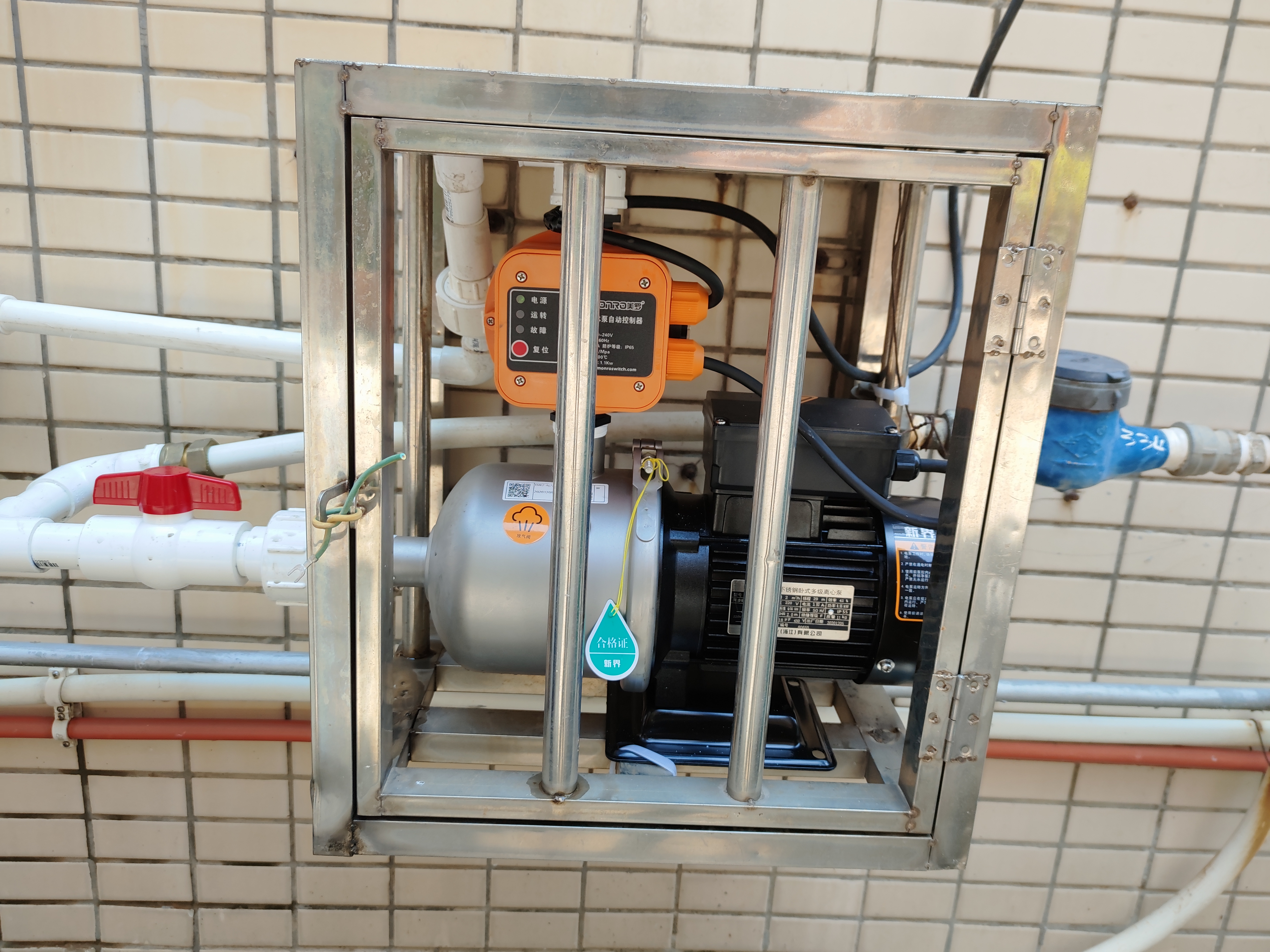
Intermittent water pressure in a multi-story home rarely shows up as a permanently weak tap. It shows up as a drop: someone is showering upstairs, a kitchen tap opens downstairs, and the shower loses force. For contractors and installers retrofitting domestic water systems, this is usually a control problem rather than a pipework problem.
This guide works through that problem directly. It explains what causes the drop, how an integrated pump controller removes most of the risk, and how to install the EPC-1.1 and EPC-3 controllers from Monro Switch on an existing tank-and-pump setup. The focus is on retrofit work in occupied homes rather than new-build systems.
Monro Switch is the brand of ZHEJIANG MONRO MACHINERY & ELECTRONIC CO.,LTD, a pressure controller and float switch manufacturer based in Wenling City, Zhejiang Province, China, whose products are exported to Asia, Europe, North and South America, the Middle East and Africa.
What “Intermittent Water Pressure” Actually Means
Intermittent water pressure is a pressure state that changes with the number of outlets in use, rather than staying consistently low or consistently high. It behaves predictably: one tap open, pressure is fine; a second tap opens, both drop.
Three conditions usually combine to produce it:
- Vertical height. Water pressure falls roughly 0.1 bar for every metre of rise. Monro Switch states the same relationship in the opposite direction: a starting pressure setting of 1.2 bar corresponds to a maximum water use height of 1.2 × 10 m = 12 metres.
- A shared riser. One vertical pipe serving every floor carries the flow for every outlet at once. The more outlets that draw simultaneously, the larger the friction loss and the deeper the pressure drop at the top of the building.
- A narrow-range pressure control switch. When a booster pump is governed by a mechanical pressure switch that only opens and closes across a fixed differential, any flow change can push the line pressure below the cut-in threshold. Pressure collapses, the pump starts, pressure surges back.
The third condition is the one an integrated pump controller is able to control. The first two belong to pipe sizing and building design.
Why Multi-Story Buildings Amplify the Problem
Height and outlet count multiply each other rather than adding up. A single-storey home with three outlets has a short riser and a small static loss. The same three outlets spread over three floors share a much longer riser, and the topmost outlet loses the full static head.
This is where the starting pressure calculation becomes a retrofit decision. Using the Monro Switch conversion, a controller set to start at 1.2 bar serves a maximum water use height of 12 metres, and the pump head must be at least (1.2 + 0.8) × 10 m = 20 metres. Change the controller without checking the pump head and the pump will run close to its limit while the top-floor outlet still feels soft.
Industry Background: Where the Pressure Control Switch Market Stands
According to Fortune Business Insights, the global pressure switch market was valued at USD 3.2 billion in 2025 and is projected to grow from USD 3.38 billion in 2026 to USD 5.13 billion by 2034. By product type, Market Research Future reports that electromechanical pressure switches accounted for approximately 62% of the global market in 2024, with solid-state electronic pressure switches taking the remaining 38%.
That 62/38 split matters for retrofit work. Electromechanical switches populate the installed base of domestic booster pumps because they are inexpensive and simple. Electronic controllers bundle pressure sensing, switching logic and enclosure protection into one housing, which is why they tend to be the part that installers reach for when a homeowner complains about pressure fluctuation.
On the standards side, IEC 60730-2-6:2025 is the current international standard covering automatic electrical pressure sensing controls for household and similar use. Any buyer specifying a pump controller for a residential market should be checking against that standard line, not against a generic switch specification. In trade terms, water pump pressure switches are commonly classified under HS Code 853650, which covers electrical switches for a voltage not exceeding 1000 volts.
How an Integrated Pump Controller Removes the Fluctuation
An integrated pump controller combines the pressure sensor and the motor switching function in one enclosure, replacing the old combination of a standalone mechanical pressure switch and a separate contactor. Controllers in this family start and stop the pump automatically in response to system pressure changes: the pump activates at the preset low-pressure setpoint and deactivates at the high-pressure setpoint. Fewer wiring joints and fewer failure points are the immediate retrofit benefit.
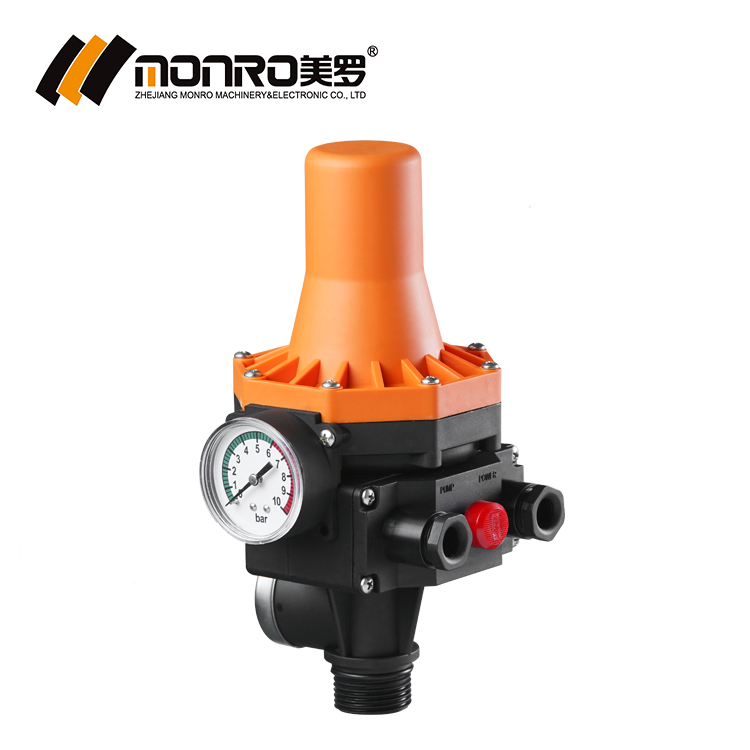
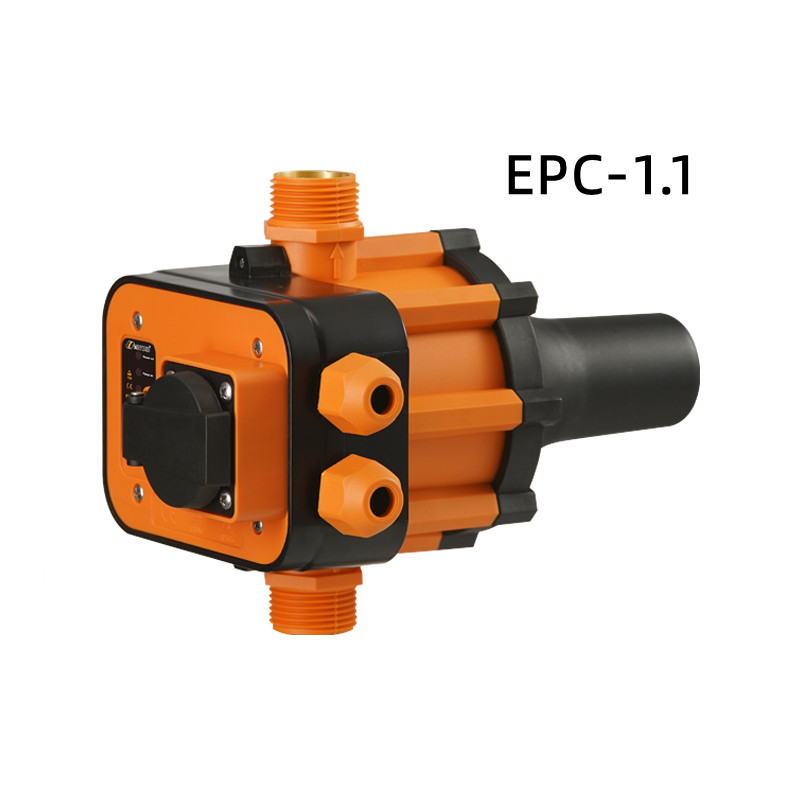
The EPC-1.1 from Monro Switch is the compact option for this type of installation. Its registered application field is Domestic. It accepts 220–240 V or 110–120 V at 50/60 Hz, handles maximum power ratings of 1.1 kW, 1.5 kW and 0.75 kW, and offers starting pressure settings of 1.2 bar, 1.5 bar and 2.2 bar. Its protection rating is IP65 and its maximum working temperature is 55 °C. Connection thread options cover G1", G1 1/4", G1 1/2" and NPT1", which is useful when an older building still runs imperial pipework. The body is constructed from plastic and metal.
The EPC-3 uses the same three starting pressure settings and the same 220–240 V / 110–120 V, 50/60 Hz electrical specification. Its maximum power ratings are 0.55 kW, 1.1 kW, 1.5 kW and 0.75 kW. The connection thread is G1", the protection rating is IP65, and the maximum working temperature is 55 °C. It is also built from plastic and metal, and its declared application areas are agriculture irrigation, water treatment and construction.
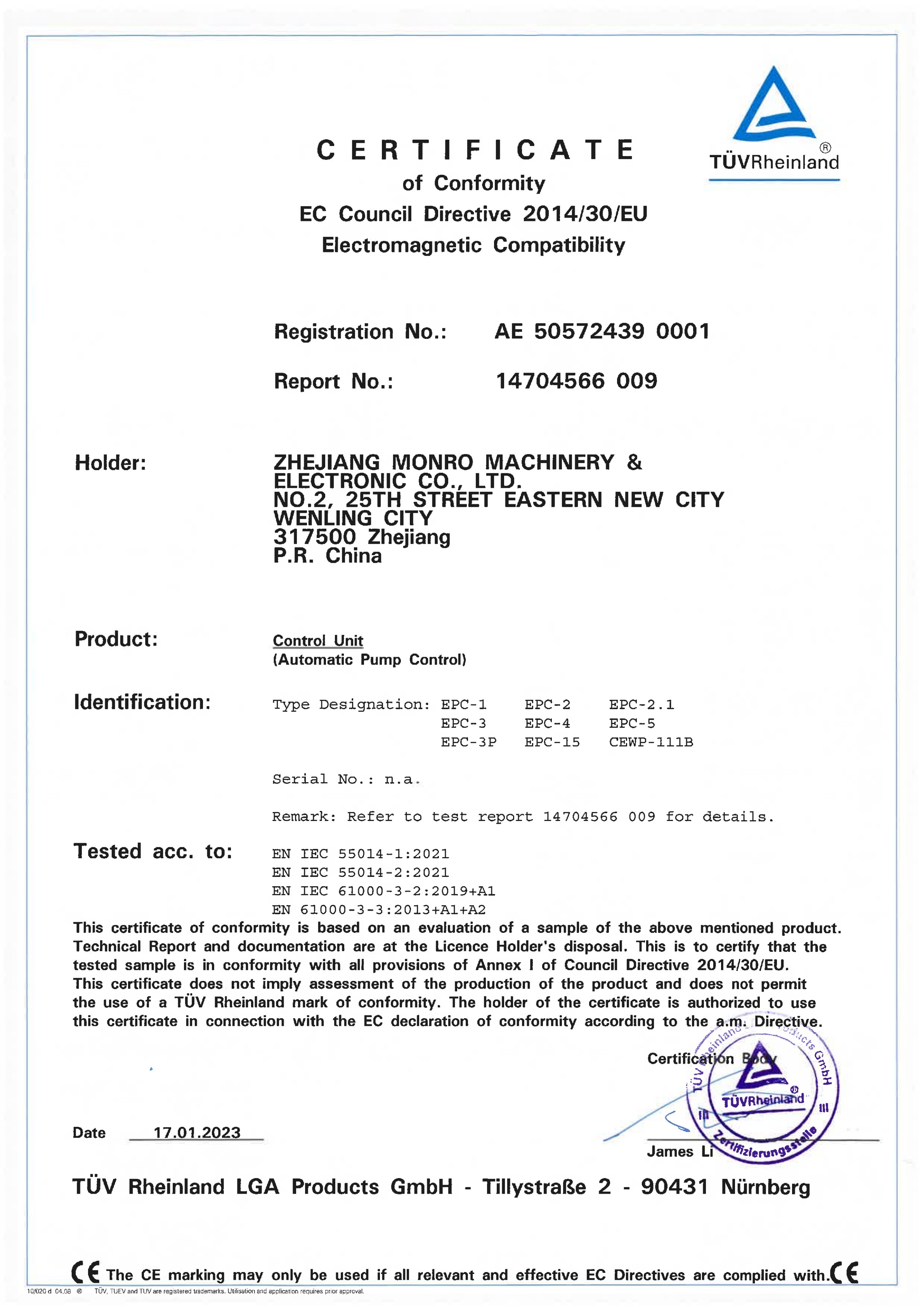
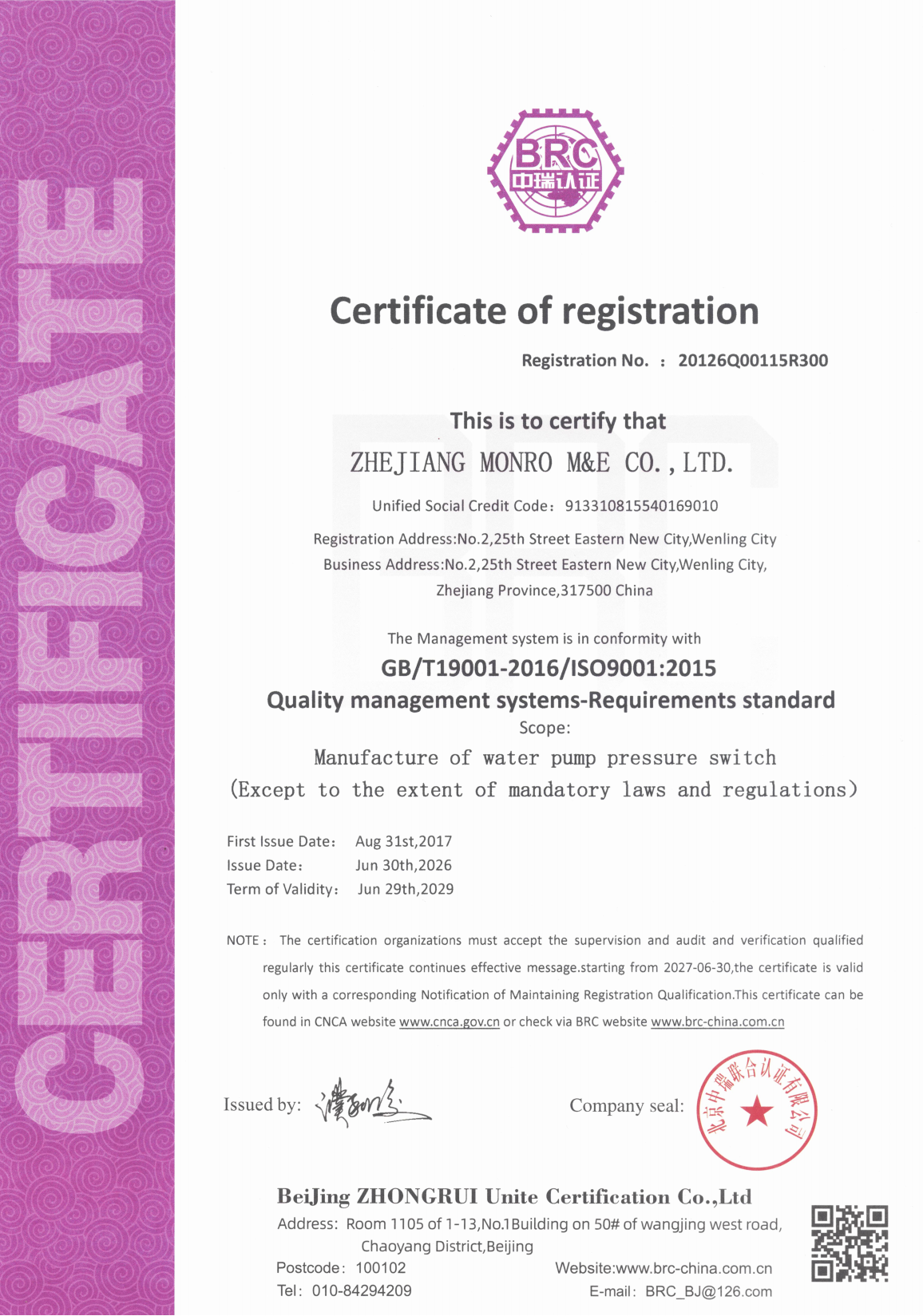
Compliance coverage differs between the two. The EPC-3 is listed under CE‑EMC Certificate of Conformity AE505724390001, issued by TÜV Rheinland LGA Products GmbH under Directive 2014/30/EU and tested to EN IEC 55014‑1:2021, EN IEC 55014‑2:2021, EN 61000‑3‑2:2019+A1 and EN 61000‑3‑3:2013+A1+A2. That certificate scope covers EPC‑1, EPC‑2, EPC‑2.1, EPC‑3, EPC‑3P, EPC‑4, EPC‑5, EPC‑15 and CEWP‑111B. The EPC‑1.1 appears among the related products listed under the manufacturer’s ISO 9001:2015 system certificate 20126Q00115R300, which covers the manufacture of water pump pressure switches.
Where a Built-in Check Valve and Dry-Run Protection Apply
Some installations need a controller to do more than switch on pressure. The EPC-10 from Monro Switch incorporates a built-in check valve, run-dry protection and a pressure gauge. Its starting pressure is adjustable from 0.5–9.3 bar and its stopping pressure from 0.7–9.5 bar, with a maximum working pressure of 10 bar and an IP65 protection rating.
The built-in check valve prevents water from flowing back through the controller, which matters where the roof tank sits above the pump set. Run-dry protection stops the pump from continuing to run once the water source has emptied. For a home with an unstable supply or a pump intake that can lose prime, a controller at the EPC-10 level is the appropriate choice. Where the supply is stable and the pressure drop is purely a function of simultaneous outlet use, the EPC-1.1 or EPC-3 covers the requirement.
Step-by-Step: Retrofitting an Existing Domestic Water System
The installation sequence below follows the manufacturer’s published operating guidance for this controller family. It assumes the pump itself is already in place and only the control element is being replaced.
Step 1 — Verify the pump before touching the controller
Check the pump separately to confirm it operates normally, and verify that the parameters on the pump nameplate match those of the pressure controller. The pump head must be at least 0.8 bar higher than the controller’s start-up pressure. Working back from the Monro Switch conversion, a start-up pressure of 1.2 bar requires a pump head of at least 20 metres.
Step 2 — Install the controller in the direction of the arrow
Install the pressure controller according to the direction indicated by the arrow on its housing. The arrow marks the direction of flow. A controller fitted against the arrow will not sense system pressure correctly and the pump will not start on demand.
Step 3 — Run a dedicated supply and seal every joint
Connect the power cord of the controller to a separate plug wire, then wrap the connection securely with waterproof insulating tape to ensure proper sealing. The published operating guidance lists sealing all wire joints with waterproof tape as a required safety step. An IP65 enclosure protects the housing from water ingress, but it does not protect an exposed splice.
Step 4 — Open every outlet before energising
After all electrical connections are complete, first open the main outlet valve and all water faucets, then connect the power supply. The water pump pressure controller will then begin operation. Starting the controller with the outlets open lets the system purge air instead of relying on the controller to restart against trapped pressure.
Step 5 — Set the starting pressure against the real building height
Match the starting pressure to the highest outlet in the building. Using the published conversion factor of 10 metres per bar, the three available settings on the EPC-1.1 and EPC-3 line up as follows: 1.2 bar for a maximum water use height of 12 metres, 1.5 bar for 15 metres, and 2.2 bar for 22 metres. Select the setting that clears the top outlet with margin, then confirm the pump head still exceeds it by at least 0.8 bar.
EPC-1.1 vs EPC-3: Which Fits a Multi-Story Home
Both models are compact pump pressure controls with the same start-up pressure range and the same IP65 enclosure. The decision between them comes down to power handling, declared application and thread flexibility.
| Parameter | EPC-1.1 | EPC-3 |
|---|---|---|
| Product type | Pump pressure control | Pump pressure control |
| Declared application | Domestic | Agriculture irrigation, water treatment, construction |
| Rated voltage | 220–240 V / 110–120 V | 220–240 V / 110–120 V |
| Power frequency | 50/60 Hz | 50/60 Hz |
| Maximum power | 1.1 kW / 1.5 kW / 0.75 kW | 0.55 kW / 1.1 kW / 1.5 kW / 0.75 kW |
| Starting pressure settings | 1.2 bar / 1.5 bar / 2.2 bar | 1.2 bar / 1.5 bar / 2.2 bar |
| Connection thread | G1", G1 1/4", G1 1/2", NPT1" | G1" |
| Protection rating | IP65 | IP65 |
| Maximum working temperature | 55 °C | 55 °C |
| Body material | Plastic, metal | Plastic, metal |
| Certificate coverage | Listed under ISO 9001:2015 certificate 20126Q00115R300 | Listed under CE‑EMC certificate AE505724390001 (TÜV Rheinland) |
Which Residential Scenario Fits Which Controller
Three retrofit patterns account for most of the demand in multi-story residential work, and each maps to a different controller.
- Two-storey house, one or two outlets in use at a time, roof tank supply. The EPC-1.1 at a 1.2 bar starting pressure is the natural match. Its domestic application designation and 0.75 kW power rating suit a standard household booster pump, and the G1 1/4" and NPT1" thread options reduce the risk of an adapter being needed on older pipework.
- Three-storey house or small apartment block with several simultaneous outlets. The EPC-3 widens the power envelope down to 0.55 kW and up to 1.5 kW, which helps where a single controller has to serve a small group of dwellings. A 1.5 bar or 2.2 bar starting pressure setting is typically needed to clear the top outlet.
- Home with an unstable or draw-down water source. A controller with a built-in check valve and run-dry protection — the EPC-10 configuration, with a 0.5–9.3 bar starting pressure range and a 0.5–9.5 bar stopping pressure range — is the safer specification. It protects the pump during periods when the source runs low.
The EPC series is not the only product family in this programme. The manufacturer’s mechanical pressure controls in the KRS series and its float switches in the FPS series cover the same wider water supply picture, including models with CUL (U.S. and Canada) approval such as the KRS‑4 under UL Listed certification E316396 for pressure operated switches.
Frequently Asked Questions
What certifications should be verified for the EPC-1.1 and EPC-3?
The EPC-3 is listed under CE‑EMC Certificate of Conformity AE505724390001, issued by TÜV Rheinland LGA Products GmbH under Directive 2014/30/EU, tested to EN IEC 55014‑1:2021, EN IEC 55014‑2:2021, EN 61000‑3‑2:2019+A1 and EN 61000‑3‑3:2013+A1+A2. The EPC-1.1 appears among the related products listed under the manufacturer’s ISO 9001:2015 system certificate 20126Q00115R300 covering water pump pressure switch manufacture. UL Listed certification E316396 in this range applies to pressure operated switches, model KRS‑4, and does not extend to the EPC models.
How do I choose an automatic pump controller for a multi-story home?
Match the controller to the pump motor power first, then set the starting pressure to suit the pump lift and the maximum water use height in the building. Using the published example, a starting pressure of 1.2 bar gives a maximum water use height of 1.2 × 10 m = 12 metres, and the pump lift must be at least (1.2 + 0.8) × 10 m = 20 metres. Both the EPC-1.1 and the EPC-3 provide starting pressure settings of 1.2 bar, 1.5 bar and 2.2 bar, so the choice is driven by power rating and thread size rather than by pressure range.
Can an integrated controller be fitted to existing pipework without re-plumbing?
In most cases yes, provided the connection thread matches. The EPC-1.1 offers G1", G1 1/4", G1 1/2" and NPT1" thread options, which covers both metric and imperial connections found in older buildings. The EPC-3 uses a G1" connection. Both are 220–240 V / 110–120 V, 50/60 Hz devices, so an existing domestic supply voltage is generally compatible. The one condition that cannot be skipped is the pump head check: the pump must still deliver at least 0.8 bar more than the controller’s start-up pressure.
What are the minimum order quantity and lead time for these controllers?
The manufacturer’s standard minimum order quantity is 204 pcs with a 45-day lead time, and every product is 100% tested before shipment. Monthly capacity is 180,000 pcs for automatic pump controllers in the EPC series, 250,000 pcs for pressure switches in the KRS series, and 30,000 pcs for float switches and liquid level controls in the FPS and STSW series. After-sales support covers remote technical assistance and a one-year warranty.
How can a distributor validate performance before ordering in volume?
Start from a documented reference installation. A retail customer in China supplied a domestic water system with 50 pcs and ran the installation for two years, reporting reliable automatic pressure control for the water supply system with automatic pump start/stop as the core function. Because every unit is 100% tested before it leaves the factory, the practical validation step is to confirm the start-up pressure setting against the actual building height at the point of installation. Full model specifications are available in the Monro catalogue 2025, and technical questions can go directly to sale@monro-switch.com.
Conclusion
Intermittent water pressure in a multi-story home is usually the visible result of a narrow-band pressure control switch responding to flow changes it was never designed to smooth out. Replacing that switch with an integrated pump controller removes the mechanical differential from the equation and lets the pump start and stop against the pressure the building actually needs.
For a two-storey domestic retrofit, the EPC-1.1 covers the requirement with a 1.2 bar starting pressure, IP65 protection and flexible thread options. For buildings with more simultaneous outlets, the EPC-3 widens the power envelope to 0.55–1.5 kW while keeping the same three start-up pressure settings. Where the water source itself is unreliable, a controller at the EPC-10 level adds a built-in check valve and run-dry protection.

Next Step
If you are specifying controllers for a domestic retrofit programme, the fastest route is to check the start-up pressure against your building height first and then confirm the model. Download the full Monro catalogue 2025 for complete EPC, KRS and FPS specifications, or contact the sales team at sale@monro-switch.com for model selection and quotation. Monro Switch can be reached on WhatsApp at +86 13586289715 and at www.monroswitch.com.
About Monro Switch
ZHEJIANG MONRO MACHINERY & ELECTRONIC CO.,LTD, trading as Monro Switch, is located in Wenling City, Zhejiang Province, China. Officially established in 2010, the company draws on more than 20 years of manufacturing expertise in pressure controls and float switches and currently offers more than 40 models of pressure controllers for water pump systems and air compressors. Its 30,000 m² facility employs 200 people, including a 10-engineer R&D team. Annual output is 2.88 million pcs for the EPC series, 3.24 million pcs for the KRS series and 0.6 million pcs for the FPS series, with 90% of production exported to Asia, Europe, North and South America, the Middle East and Africa. The company operates an ISO 9001:2015 quality management system, holds TUV (Germany) and CE (Europe) certifications, and has select models approved under the CUL (U.S. and Canada) standard.
Contact: No.2, 25th Street, Eastern New City, Wenling City, Zhejiang Province, China. Email: sale@monro-switch.com. Tel / WhatsApp: +86 13586289715.
Have Questions or Need More Details?
Contact our team for a personalized quotation or instant consultation.
Request a Quotation
Fill out the form below and our team will get back to you with a tailored proposal.
WhatsApp Direct Chat
Prefer to chat in real-time? Message us on WhatsApp for instant assistance & quick answers.
- Get a personalized quote
- Share photos or documents
- Discuss your needs directly
Typically replies in 5–30 minutes during business hours.