
Ranking Pump Pressure Switches by Application Fit: EPC-1.1, EPC-2, EPC-2.1, EPC-3
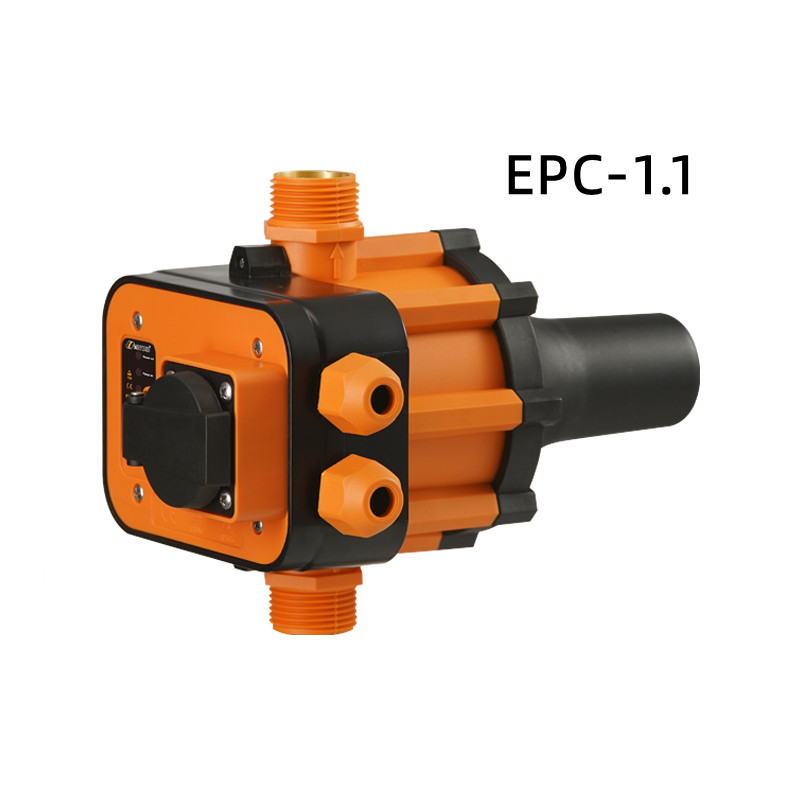
Quick answer: ranked by application fit, the EPC-1.1 is the strongest choice for domestic and residential water supply; the EPC-3 leads for agriculture irrigation, water treatment and construction work where pipeline pressure has to be read on site; the EPC-2.1 fits compact installations built around 90-degree porting; and the EPC-2 is the practical option for standard R1-inch threaded replacement projects.
All four controllers are pump pressure switches from the Monro Switch EPC series. They share one operating principle: the controller automatically starts and stops the pump in response to system pressure changes, activating the pump at the preset low-pressure setpoint and deactivating it at the high-pressure setpoint. What separates them is everything around that principle — the protection rating of the housing, the hydraulic connection options, the features built into the body, and the type of water system each model is documented for.
This article ranks the four models by application fit rather than by a generic idea of a “best” switch. The criteria are applied in a fixed order: how closely the documented electrical and pressure range matches a defined water system, the stated protection rating, the installation and service features built into the housing, and the industry the model data lists. Price is deliberately excluded because no price data is available for these models in the source material used here, and a cost ranking built on assumption would mislead buyers.
If the underlying selection logic matters more to you than a shortlist, Monro’s guidance “HOW TO CHOOSE AN AUTOMATIC PUMP CONTROLLER?” reduces the problem to two questions: does the controller match the motor power of the water pump, and does its starting pressure suit the pump lift and the maximum water use height? Those two questions run through the entire ranking below.
What Goes Wrong When a Pressure Control Switch Does Not Fit the System
A pump pressure switch is specified by a short list of values: the motor power it can switch, the cut-in (starting) pressure, the maximum working pressure of the circuit, and the protection rating of the enclosure against water and dust. When one of them is mismatched to the system, the failure is predictable rather than random.
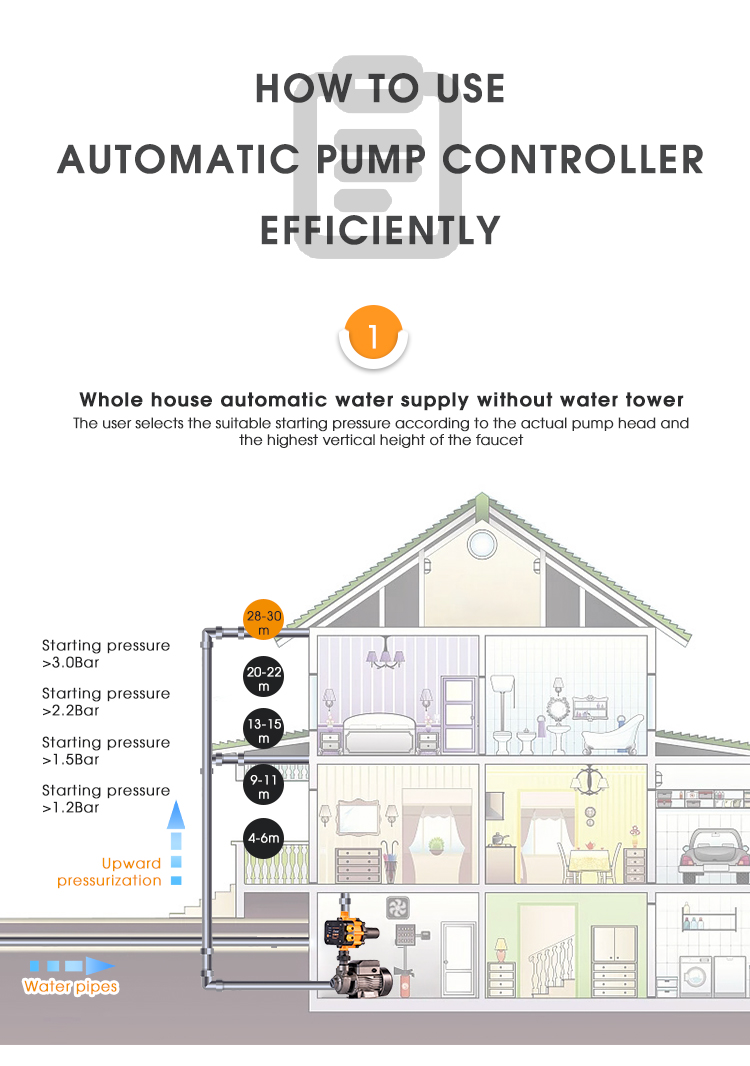
- Water never reaches the top of the building. The maximum height at which water can be used above the controller is set by the starting pressure: a 1.2 bar starting pressure corresponds to a maximum water use height of 1.2 × 10 m = 12 m. Choose a starting pressure below the height you actually need and upper-floor outlets stay weak regardless of how large the pump is.
- The controller asks for more pressure than the pump can deliver. The pump head must be at least 0.8 bar higher than the controller’s start-up pressure. At a 1.2 bar setting, the pump lift therefore has to be at least (1.2 + 0.8) × 10 m = 20 m.
- The pump runs dry. Where the water source can empty — a tank, a well or a cistern — a controller without run-dry protection keeps the pump running against no water. The EPC-1.1, EPC-2.1 and EPC-3 all list built-in run-dry protection among their documented features.
- The enclosure rating does not match the room. IP44 and IP65 are not interchangeable in a wet or dusty pump room, and the rating is stated per model rather than per series.
- The hydraulic connection does not match the pipework. The four models in this shortlist use three different connection conventions — G1-inch and larger, R1-inch, and a mixed G/NPT set — so the thread belongs inside the model decision, not in an adapter bought afterwards.
- Nobody can verify the pressure on site. Where maintenance staff need to read pipeline pressure directly, a controller without a gauge requires a separate instrument. The EPC-3 carries a built-in pressure gauge for real-time pressure monitoring.
None of these problems is solved by buying a “better” model in the abstract. They are solved by matching the model to the application, which is exactly what the ranking below does.
Where Pump Pressure Switches Stand in 2026
The pressure switch category is mature but still growing. Fortune Business Insights values the global pressure switch market at USD 3.2 billion in 2025 and projects growth from USD 3.38 billion in 2026 to USD 5.13 billion by 2034. Within that market, segmentation published by Market Research Future puts electromechanical pressure switches at approximately 62% of global market share in 2024, with solid-state electronic pressure switches accounting for the remaining 38%.
Two structural facts matter for the models ranked here. First, the electronic share is the segment that carries run-dry protection, automatic restart and adjustable starting pressure — the features that decide whether a domestic water system stays reliable. Second, the technical baseline is set by standardisation: IEC 60730-2-6:2025 is the current international standard for automatic electrical pressure sensing controls for household and similar use, and water pump pressure switches are commonly traded under HS Code 853650.
Supply in this category comes from manufacturers who build both mechanical and electronic controls. The EPC series is produced by Zhejiang Monro Machinery & Electronic Co., Ltd. (Monro Switch), a family-owned manufacturer based in Wenling City, Zhejiang Province, China. Officially established in 2010, the company reports more than 20 years of manufacturing expertise in pressure controls and float switches. Its factory covers 30,000 square metres and employs approximately 200 staff, supported by a 10-engineer R&D team. The catalogue covers more than 40 models of pressure controllers for water pump systems and air compressors, and reported annual output reaches 2.88 million pieces for the EPC series. Roughly 90% of production is exported to Asia, Europe, North and South America, the Middle East and Africa. The quality management system is certified to ISO 9001:2015, products hold TUV (Germany) and CE (Europe) certifications, and selected models are also approved under the CUL standard for the United States and Canada.

That production base is why the four models below can be ranked on documented specification instead of marketing language: the specifications exist, and they are consistent across the series.
The Ranked Shortlist: Four EPC Models by Application Fit
The ranking uses four documented criteria, applied in this order: (1) how closely the model’s documented voltage, power and pressure range matches a defined water system; (2) the protection rating stated for the model; (3) the installation and service features built into the housing — gauge, wiring socket, port angle, connection options; and (4) the industry listed in the model data. Each entry also notes where the model is the wrong answer, because a ranking without limits is only a brochure.
Rank 1 EPC-1.1 — Best fit for domestic and residential water supply
The EPC-1.1 is a pump pressure control switch designed for domestic applications, and it is the only model in this shortlist whose listed industry is Domestic. It also offers the widest hydraulic connection choice of the four, which is what puts it first for residential work.
Verified specification highlights:
- Rated voltage 220-240V or 110-120V, power frequency 50/60 Hz, with triple voltage capability of 110V, 230V or 110-240V.
- Maximum power options of 0.75 kW, 1.1 kW or 1.5 kW.
- Starting pressure settings of 1.2 bar, 1.5 bar or 2.2 bar; an adjustable version covers 1.5 to 3.0 bar, and both adjustable and non-adjustable versions are available.
- Connection threads: G1-inch, G1 1/4-inch, G1 1/2-inch and NPT1-inch.
- Protection rating IP65, maximum working temperature 55°C, plastic and metal construction.
- Built-in check valve, built-in run-dry protection, constant pressure at constant flow, and a built-in socket that simplifies wiring.
- Compatible with surface or submersible pumps.
Why it ranks first: three of the four criteria point the same way. The EPC-1.1 pairs IP65 protection with the largest verified connection set in the shortlist, including NPT1-inch for North American pipe standards. The adjustable version lets an installer fine-tune the cut-in point between 1.5 and 3.0 bar on site, and the domestic designation matches household water supply. The built-in socket shortens installation time, which matters when a plumber is paid by the visit.
Where it is not the right answer: the EPC-1.1 is documented for domestic media with a maximum working temperature of 55°C. For hotter or heavier duty, other models in the Monro range — such as the EPC-16 or EPC-17, documented with a 60°C maximum working temperature — sit at that level.
Rank 2 EPC-3 — Best fit for irrigation, water treatment and construction, where pressure is verified on site
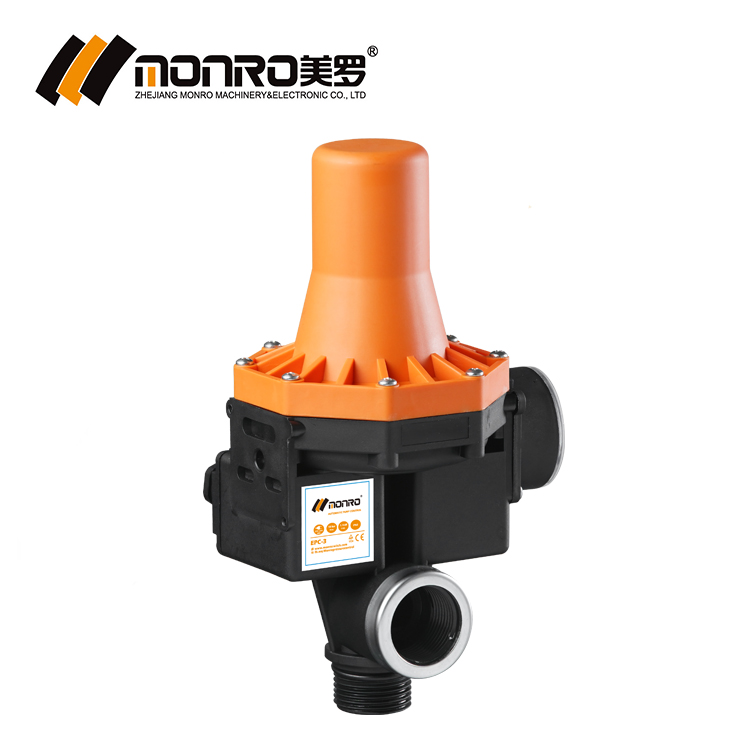
The EPC-3 is a pump pressure switch designed for agriculture irrigation, water treatment and construction. Its distinguishing feature is a built-in pressure gauge for real-time pressure monitoring, and that single feature is why it leads the three field-oriented models here.
- Rated voltage 220-240V or 110-120V at 50/60 Hz; maximum power options of 0.55 kW, 0.75 kW, 1.1 kW or 1.5 kW — the widest power coverage in this shortlist, alongside the EPC-2.1.
- Starting pressure settings of 1.2 bar, 1.5 bar or 2.2 bar.
- Connection thread G1-inch; protection rating IP65; maximum working temperature 55°C; plastic and metal construction.
- Built-in pressure gauge, built-in check valve, built-in run-dry protection, constant pressure at constant flow, triple voltage capability.
- Compatible with surface or submersible pumps.
Why it ranks second: on a farm, at a treatment plant or on a construction site, the first question after a pressure complaint is what the pipeline pressure actually is. A gauge inside the controller answers that without a separate instrument, and IP65 allows the unit to stay where the work happens. Add four power options from 0.55 kW to 1.5 kW and the EPC-3 becomes the default recommendation for field service.
Where it is not the right answer: the EPC-3 is documented with a single G1-inch connection thread. A site built on R1-inch or larger pipework should instead look at the EPC-1.1 for its wider thread set, or the R1-inch threaded EPC-2.1 and EPC-2.
Rank 3 EPC-2.1 — Best fit for compact installations and dry plant rooms
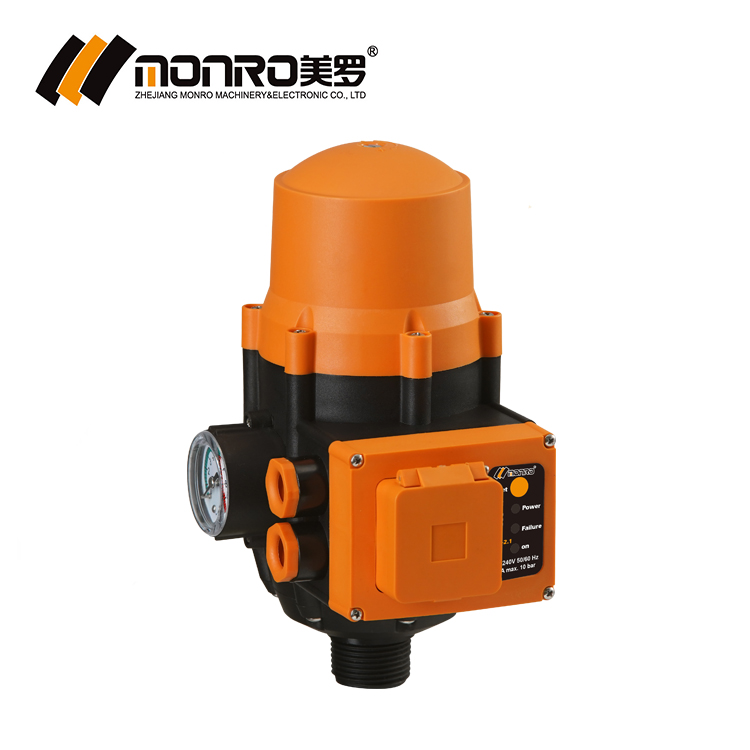
The EPC-2.1 is a pump pressure switch intended for agriculture irrigation, water treatment and construction, with a layout built for tight spaces: the inlet and outlet sit at 90 degrees to each other.
- Rated voltage 220-240V or 110-120V at 50/60 Hz; maximum power options of 0.55 kW, 0.75 kW, 1.1 kW or 1.5 kW.
- Starting pressure settings of 1.2 bar, 1.5 bar or 2.2 bar; optional adjustable and non-adjustable versions, with the adjustable version covering 1.5 to 3.0 bar.
- Connection thread R1-inch; protection rating IP44; maximum working temperature 55°C; plastic and metal construction.
- Built-in check valve, built-in run-dry protection, constant pressure at constant flow, triple voltage capability, and a built-in socket that makes wiring easier and faster.
- Compatible with surface or submersible pumps.
Why it ranks third: the 90-degree port layout and the built-in socket are real installation advantages in cabinets and compact plant rooms, and the 0.55 kW option reaches small pumps that the EPC-2 does not cover. It sits below the EPC-3 mainly on protection rating: IP44 suits dry, indoor positions rather than wash-down or outdoor enclosure work.
Where it is not the right answer: any position exposed to direct spray, standing water or heavy dust should use an IP65 model — the EPC-1.1, EPC-2 or EPC-3 — instead of the IP44-rated EPC-2.1.
Rank 4 EPC-2 — Best fit for standard R1-inch replacement work
The EPC-2 is a pump pressure switch designed for agriculture irrigation, water treatment and construction, with an R1-inch connection thread and power coverage from 0.75 kW to 1.5 kW. It ranks fourth here because the model data used for this shortlist documents fewer built-in features for it than for the other three models.
- Rated voltage 220-240V or 110-120V at 50/60 Hz.
- Maximum power options of 0.75 kW, 1.1 kW or 1.5 kW.
- Starting pressure settings of 1.2 bar, 1.5 bar or 2.2 bar.
- Connection thread R1-inch; maximum working temperature 55°C; plastic and metal construction.
- Listed industry coverage: agriculture irrigation, water treatment, construction.
Why it still belongs on the list: R1-inch pipework is common in replacement work, and the EPC-2 covers the 0.75–1.5 kW band with the same 1.2, 1.5 and 2.2 bar starting pressure settings as the rest of the series. Where the pipework is R1-inch and the pump sits inside that power range, it is the direct match and the simplest order.
Before ordering: the model data provided for this article does not document a protection rating, check valve, run-dry protection or pressure gauge for the EPC-2 in the same way it does for the EPC-1.1, EPC-2.1 and EPC-3. Buyers who need those features should confirm the exact configuration of the EPC-2 variant they are ordering, or select one of the three models above.
Five Checks Before You Order Any of These Models
The sequence below follows Monro’s published installation and selection guidance for automatic pump controllers. Working through it in order prevents the mismatch failures described earlier.
- Verify the pump separately, then compare nameplates. Check that the pump operates normally on its own and that the parameters on the pump nameplate match those of the pressure controller. The pump head must be at least 0.8 bar higher than the controller’s start-up pressure.
- Set the starting pressure from the highest point water has to reach. Maximum water use height = starting pressure × 10 m. At 1.2 bar, water can be used up to 12 m above the controller, and the pump lift must be at least 20 m. The four models here all offer 1.2, 1.5 and 2.2 bar settings.
- Match the controller’s maximum power to the motor. The EPC-1.1 and EPC-2 cover 0.75 kW to 1.5 kW; the EPC-2.1 and EPC-3 extend coverage down to 0.55 kW with the same 1.5 kW ceiling. All four accept 220-240V or 110-120V at 50/60 Hz.
- Match the environment and the pipework. Choose IP65 (EPC-1.1, EPC-3) for wet or dusty positions and IP44 (EPC-2.1) for dry indoor ones, then confirm the thread: G1-inch, G1 1/4-inch, G1 1/2-inch or NPT1-inch on the EPC-1.1, or R1-inch on the EPC-2 and EPC-2.1.
- Install and commission in the documented sequence. Install the controller in the direction of the arrow on its housing. Connect the power cord to a separate plug wire and wrap the joint with waterproof insulating tape. After all electrical connections are complete, open the main outlet valve and all faucets first, then connect the power supply.
Safety note from the same guidance: seal every wire joint with waterproof tape before energising the system, and always confirm the pump head against the controller’s start-up pressure. These are the two steps installers most often skip, and both of them cause repeat service calls.
Which Model Fits Which Water System
The table below converts the ranking into a decision rule. It maps four common water system situations to the model that fits with the least compromise.
| Application | Recommended model | Why this model |
|---|---|---|
| Domestic and residential water supply, clean water medium, application working pressure range 0.5–10 bar | EPC-1.1 | Listed for domestic applications, IP65, four connection options including NPT1-inch, adjustable 1.5–3.0 bar version, built-in socket and run-dry protection |
| Agriculture irrigation, water treatment or construction site where pressure is checked on site | EPC-3 | Built-in pressure gauge for real-time monitoring, IP65, four power options from 0.55 kW to 1.5 kW, check valve and run-dry protection |
| Cabinet or compact plant room with 90-degree pipe routing, dry indoor position | EPC-2.1 | Inlet and outlet at 90 degrees, built-in socket for faster wiring, 0.55 kW option, adjustable 1.5–3.0 bar version |
| Standard replacement on R1-inch pipework with a 0.75–1.5 kW pump | EPC-2 | R1-inch thread plus the same 1.2, 1.5 and 2.2 bar starting pressure settings used across the series |
Two limitations apply across the whole table. These models are intended for clean water medium, and the documented maximum working temperature for all four is 55°C. Systems handling dirty water, sea water or hot media fall outside the documented operating conditions of this shortlist.
Comparison Table: Verified Specifications
| Specification | EPC-1.1 | EPC-2 | EPC-2.1 | EPC-3 |
|---|---|---|---|---|
| Rank by application fit (this article) | 1 | 4 | 3 | 2 |
| Best-fit application | Domestic and residential water supply | Standard R1-inch replacement in irrigation, water treatment, construction | Compact installations with 90-degree porting in dry locations | Irrigation, water treatment, construction with on-site pressure checks |
| Rated voltage | 220-240V / 110-120V | 220-240V / 110-120V | 220-240V / 110-120V | 220-240V / 110-120V |
| Power frequency | 50/60 Hz | 50/60 Hz | 50/60 Hz | 50/60 Hz |
| Maximum power options | 0.75 / 1.1 / 1.5 kW | 0.75 / 1.1 / 1.5 kW | 0.55 / 0.75 / 1.1 / 1.5 kW | 0.55 / 0.75 / 1.1 / 1.5 kW |
| Starting pressure settings | 1.2 / 1.5 / 2.2 bar | 1.2 / 1.5 / 2.2 bar | 1.2 / 1.5 / 2.2 bar | 1.2 / 1.5 / 2.2 bar |
| Adjustable starting pressure version | Yes — 1.5 to 3.0 bar | Not stated | Yes — 1.5 to 3.0 bar | Not stated |
| Connection thread | G1-inch, G1 1/4-inch, G1 1/2-inch, NPT1-inch | R1-inch | R1-inch | G1-inch |
| Protection rating | IP65 | Not stated | IP44 | IP65 |
| Maximum working temperature | 55°C | 55°C | 55°C | 55°C |
| Material | Plastic and metal | Plastic and metal | Plastic and metal | Plastic and metal |
| Built-in run-dry protection | Yes | Not stated | Yes | Yes |
| Built-in check valve | Yes | Not stated | Yes | Yes |
| Built-in pressure gauge | Not stated | Not stated | Not stated | Yes |
| Built-in wiring socket | Yes | Not stated | Yes | Not stated |
| Port angle | Not stated | Not stated | Inlet and outlet at 90 degrees | Not stated |
| Triple voltage capability (110V / 230V / 110-240V) | Yes | Not stated | Yes | Yes |
| Surface or submersible pump compatibility | Yes | Not stated | Yes | Yes |
| Listed industry | Domestic | Agriculture irrigation, water treatment, construction | Agriculture irrigation, water treatment, construction | Agriculture irrigation, water treatment, construction |
“Not stated” means the value is not confirmed in the model data used for this article; the cell is left blank rather than estimated. No price figures appear anywhere in this comparison because none are available for these models in the source data used here.
FAQ: Model Choice, Certification and Supply
Are these pump pressure switches certified for export markets?
Monro operates a quality management system certified to ISO 9001:2015. The products hold TUV (Germany) and CE (Europe) certifications, and selected models are also approved under the CUL standard for the United States and Canada. At the standard level, IEC 60730-2-6:2025 is the current international standard for automatic electrical pressure sensing controls for household and similar use, and water pump pressure switches are commonly traded under HS Code 853650. Because certification coverage differs by model, confirm which certificate applies to the exact SKU you are ordering rather than to the series as a whole.
How do I work out the right starting pressure for a pump controller?
Monro’s published guidance “HOW TO CHOOSE AN AUTOMATIC PUMP CONTROLLER?” uses two checks: match the controller to the motor power of the water pump, and set the starting pressure according to pump lift and maximum water use height. The formula is maximum water use height = starting pressure × 10 m. At a 1.2 bar starting pressure, water can be used up to 12 m above the controller, and the pump lift must be at least (1.2 + 0.8) × 10 m = 20 m. The pump head must also be at least 0.8 bar higher than the controller’s start-up pressure.
What is the practical difference between the EPC-1.1, EPC-2, EPC-2.1 and EPC-3?
All four share the same electrical and pressure baseline: 220-240V or 110-120V at 50/60 Hz, starting pressure settings of 1.2, 1.5 or 2.2 bar, plastic and metal construction, and a 55°C maximum working temperature. They differ in application designation, protection rating, connection and accessories. The EPC-1.1 is listed for domestic use with IP65, four thread options and an adjustable 1.5–3.0 bar version. The EPC-3 adds a built-in pressure gauge and carries IP65 with a G1-inch thread. The EPC-2.1 uses R1-inch threads, 90-degree porting and IP44 protection. The EPC-2 is the R1-inch model documented for standard replacement work in irrigation, water treatment and construction.
Who manufactures these pressure control switches?
The EPC series is manufactured by Zhejiang Monro Machinery & Electronic Co., Ltd., trading as Monro Switch, in Wenling City, Zhejiang Province, China. The company was officially established in 2010 and reports over 20 years of manufacturing experience in pressure controls and float switches. Its 30,000 square metre factory employs approximately 200 staff with a 10-engineer R&D team, and its catalogue covers more than 40 models of pressure controllers for water pump systems and air compressors, with reported annual EPC series output of 2.88 million pieces. About 90% of production is exported to Asia, Europe, North and South America, the Middle East and Africa. The website is www.monroswitch.com.
Can I test a model before placing a volume order?
Sample and quotation requests are handled directly by the Monro Switch sales team, so the fastest route is to send the pump nameplate data — power, voltage and lift — together with the maximum water use height and the pipe thread. With those four inputs, the sales team can confirm the correct model and starting pressure setting before a sample ships. Contact details and the full product range are listed at the end of this article.
Conclusion: Match the Switch to the Job, Not the Other Way Round
The ranking in this article is a fit ranking, and it changes as soon as the application changes. For domestic and residential water supply, the EPC-1.1 leads because it combines IP65 protection, four connection options including NPT1-inch, an adjustable 1.5–3.0 bar version and a built-in wiring socket. For irrigation, water treatment and construction work where someone has to read the pressure on site, the EPC-3 leads on the strength of its built-in gauge and the same IP65 rating. The EPC-2.1 answers a different problem — compact 90-degree installations in dry positions — while the EPC-2 remains the direct R1-inch replacement for 0.75–1.5 kW pumps.
Whichever model you shortlist, the two checks from the selection guidance decide the outcome: match the controller to the motor power of the pump, and set the starting pressure so that both the maximum water use height and the 0.8 bar pump-head margin are satisfied.

Next step: confirm a model against your pump before you order
Send the pump nameplate data — power, voltage and lift — together with the maximum water use height and your pipe thread, and the Monro Switch sales team will confirm which EPC model and which starting pressure setting fits your system. Sample requests and quotations are handled directly by the sales team.
Email: sale@monro-switch.com · Tel / WhatsApp: +86 13586289715 · Website: www.monroswitch.com
Download the full product range: Monro catalogue 2025 (PDF)
Have Questions or Need More Details?
Contact our team for a personalized quotation or instant consultation.
Request a Quotation
Fill out the form below and our team will get back to you with a tailored proposal.
WhatsApp Direct Chat
Prefer to chat in real-time? Message us on WhatsApp for instant assistance & quick answers.
- Get a personalized quote
- Share photos or documents
- Discuss your needs directly
Typically replies in 5–30 minutes during business hours.