
EPC-1.1 Adjustable vs Fixed Pump Pressure Control Switch
Direct answer: the EPC-1.1 pump pressure control switch is available in an adjustable version with a starting-pressure range of 1.5–3.0 bar, and in non-adjustable versions fixed at 1.2 bar, 1.5 bar or 2.2 bar. Choose the adjustable version when the required cut-in pressure is not settled at the time of ordering — for example when one unit must serve sites with different building heights or different pump lifts. Choose a fixed version when the pump curve, riser height and installation pattern are already known and repeatable, because a locked setting removes field adjustment error and simplifies incoming inspection and replacement.
Monro Switch (Zhejiang Monro Machinery & Electronic Co., Ltd.) is a pressure controller manufacturer based in Wenling City, Zhejiang Province, producing the EPC series for water pump systems. The EPC-1.1 shares one hardware platform across both configurations: surface or submersible pump compatibility, IP65 protection, a 55°C maximum working temperature, G1″, G1 1/4, G1 1/2 and NPT1 thread options, 0.75 kW, 1.1 kW and 1.5 kW maximum power, 50/60 Hz operation, 110V, 230V or 110-240V triple voltage, a built-in check valve and run-dry protection. Only the starting-pressure arrangement changes — which is precisely why the two versions suit different buyers.
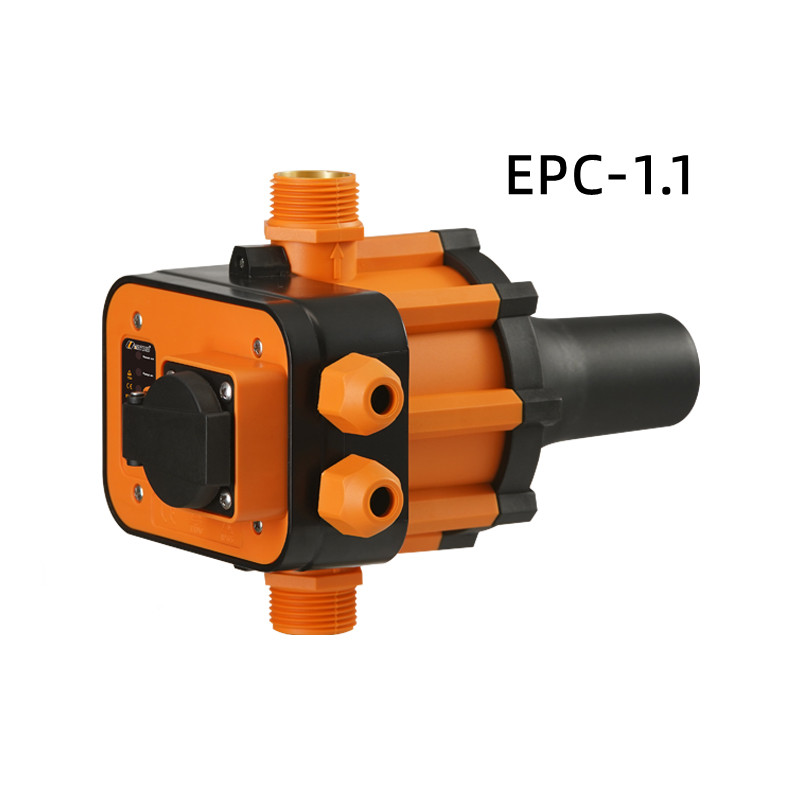
EPC-1.1 pump pressure control switch. The adjustable version sets starting pressure anywhere from 1.5 bar to 3.0 bar; fixed versions leave the factory at 1.2 bar, 1.5 bar or 2.2 bar.
Why the Adjustable or Fixed Decision Matters in Domestic Water Systems
A pressure control switch is the component that decides when a domestic water pump starts and stops. On the EPC-1.1, the controller activates the pump at the preset low-pressure setpoint and deactivates it at the high-pressure setpoint, responding automatically to system pressure changes. In that sequence, the starting pressure is the single value that most directly determines whether the household actually receives water at the tap.
Two failure patterns follow from a mismatched setting. If the start-up pressure is set above what the pump can build, the pump does not come on when taps open, and the system behaves as if there were no controller at all. If the start-up pressure is set too low relative to the building height, outlets on upper floors run weak while the pump cycles more often than the installation requires.
Monro publishes a simple selection rule that makes the consequence measurable: maximum water use height = starting pressure × 10 m, and pump lift must be at least the start-up pressure plus 0.8 bar. Using the manufacturer's own example, a 1.2 bar starting pressure corresponds to a maximum water use height of 12 m, and the pump needs a lift of at least (1.2 + 0.8) × 10 m = 20 m. Applied to the EPC-1.1 range, that rule produces the following picture:
- 1.2 bar fixed → up to 12 m of usable height, minimum pump lift about 20 m
- 1.5 bar fixed → up to 15 m of usable height, minimum pump lift about 23 m
- 2.2 bar fixed → up to 22 m of usable height, minimum pump lift about 30 m
- Adjustable 1.5–3.0 bar → up to 15–30 m of usable height, minimum pump lift about 23–38 m
The buying problem is that this arithmetic depends on site data that is often missing at the quotation stage. A distributor may not know the final floor count, an installer may be replacing a controller in a building whose pump was never documented, and an OEM customer may be building one SKU for several markets. That uncertainty, not product quality, is what separates the adjustable and fixed decision.
Industry Background: Where Pressure Controls Sit in Current Procurement
Pressure control switches are a mature but still sizable component category. Fortune Business Insights valued the global pressure switch market at USD 3.2 billion in 2025, with growth projected from USD 3.38 billion in 2026 to USD 5.13 billion by 2034. Market Research Future estimates that electromechanical pressure switches accounted for approximately 62% of the global market share in 2024, with solid-state electronic switches making up the remainder. Both figures describe a category where mechanical and electronic designs continue to coexist rather than one displacing the other.
The regulatory frame is equally stable. IEC 60730-2-6:2025 is the current international standard for automatic electrical pressure sensing controls used in, on, or in association with household appliances and similar equipment. Water pump pressure switches are commonly traded under HS Code 853650, which covers electrical switches for voltages not exceeding 1000 V.
Within that landscape, Monro Switch has manufactured pressure controls and float switches for more than 20 years, formally operating since 2010 from a 30,000 m² facility with around 200 employees and a 10-engineer R&D team. The company offers more than 40 models of pressure controllers for water pump systems and air compressors, exports about 90% of output to Asia, Europe, North and South America, the Middle East and Africa, and runs an ISO 9001:2015 quality management system. Annual output for the EPC series is 2.88 million pieces.
What the EPC-1.1 Provides in Both Configurations
Before comparing the two settings, buyers should confirm that the shared platform meets the installation. The EPC-1.1 specification is identical across the adjustable and fixed versions, apart from the starting-pressure arrangement.
| Parameter | EPC-1.1 specification |
|---|---|
| Pump compatibility | Surface pumps and submersible pumps |
| Starting pressure | Adjustable version: 1.5–3.0 bar. Non-adjustable versions: fixed at 1.2 bar, 1.5 bar or 2.2 bar |
| Protection rating | IP65 |
| Maximum working temperature | 55°C |
| Connection threads | G1″, G1 1/4, G1 1/2, NPT1 |
| Maximum motor power | 0.75 kW, 1.1 kW, 1.5 kW |
| Frequency | 50/60 Hz |
| Voltage options | 110V, 230V, or 110-240V triple voltage |
| Built-in check valve | Yes |
| Run-dry protection | Yes |
| Housing materials | Plastic and metal |
Three of these items carry more weight than the rest in domestic applications. First, surface or submersible pump compatibility means the same controller family can be specified for a shallow-well surface pump and for a borehole submersible pump, which reduces the number of controller part numbers a distributor needs to stock. Second, IP65 protection and a 55°C maximum working temperature define where the unit can be installed and what ambient conditions it tolerates. Third, the built-in check valve and run-dry protection address two of the most common field complaints in domestic boosting — backflow through the pump at shut-off, and pump operation without water.
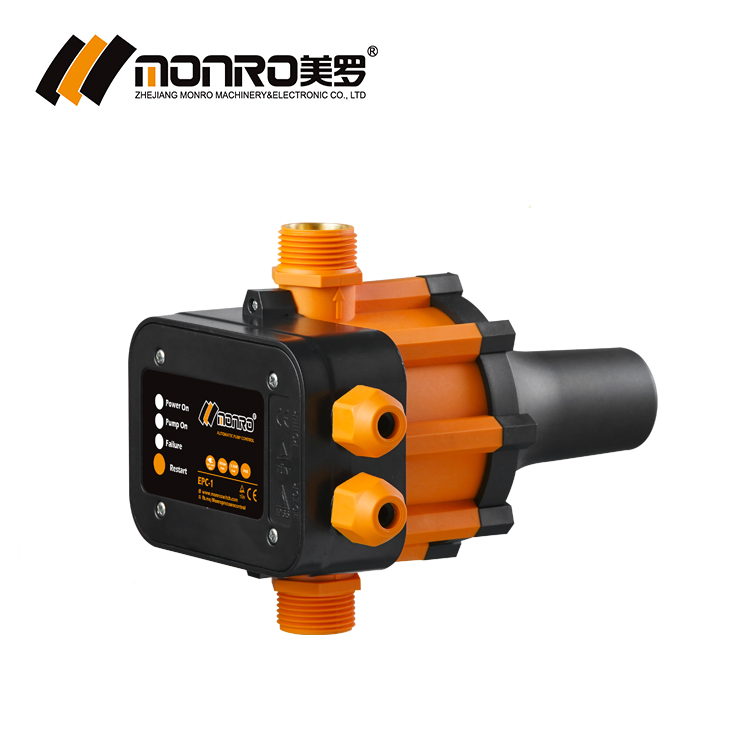
EPC series pump pressure switch. The EPC-1.1 platform combines a built-in check valve and run-dry protection in a single IP65 housing.
Adjustable 1.5–3.0 bar: When Field Adjustment Pays Off
The adjustable EPC-1.1 is the safer default when the final installation conditions are not yet fixed. Because the starting pressure can be set anywhere between 1.5 bar and 3.0 bar, one part number covers a usable height band of roughly 15 m to 30 m and a minimum pump lift requirement of roughly 23 m to 38 m. That band covers most low-rise and mid-rise domestic installations without a second SKU.
Situations where the adjustable version is the better buy
- The site survey is incomplete at order time. Distributors selling into new construction often quote before the riser height is finalised. An adjustable unit can be trimmed on site instead of being replaced.
- One SKU must serve several building types. A wholesaler supplying single-storey houses and three-storey houses can hold one adjustable EPC-1.1 rather than three fixed variants.
- Replacement and service work. When an installer replaces a failed controller in an existing system, the original setting may be unrecorded. Field adjustment restores a workable cut-in without a new part number.
- OEM and private-label programmes. A brand owner building a catalogue for several export markets can standardise on the adjustable version and let the local installer match the setting to the pump.
- Pump curves that are known but not identical. If incoming pumps vary within a narrow band, adjustment absorbs the variation at commissioning.
What the adjustable version demands in return
Adjustment moves a decision from the factory to the field, so the field must be equipped to make it. The installer needs to know the pump lift and the height of the highest outlet, and the setting must be verified after installation rather than assumed. Documenting the set value on the unit or in the handover record protects the next technician. Where installations are numerous, repetitive and inspected by third parties, that field step is an ongoing labour cost that a fixed version avoids entirely.
Fixed 1.2, 1.5 or 2.2 bar: When a Locked Setting Is the Simpler Choice
A non-adjustable EPC-1.1 removes the setting from the installation process. Each unit leaves the factory at 1.2 bar, 1.5 bar or 2.2 bar, and every unit of that part number behaves identically. For buyers whose system design is already settled, that consistency is the point.
Situations where a fixed version is the better buy
- Standardised housing projects. Where every dwelling in a development has the same floor height and the same pump, the fixed 1.5 bar or 2.2 bar version removes a commissioning step across hundreds of units.
- Single-storey and low-rise installations. A 1.2 bar fixed unit matches a usable height of about 12 m and a pump lift of about 20 m, which describes many shallow-well and ground-floor installations.
- Tamper resistance. Shared or semi-public water systems benefit from a controller that cannot be re-set by an unauthorised person.
- Incoming inspection and warranty handling. A locked setpoint makes goods-in checks faster and makes field failures easier to attribute, because the starting pressure is a known constant rather than a variable.
- Repeat replacement programmes. Utilities, housing operators and maintenance contractors replacing units on a fixed schedule can specify the exact setting once and reorder it without re-surveying each site.
What a fixed version cannot do
A fixed version cannot absorb a design change. If the pump is later replaced with a lower-lift model, or if an upper floor is added, the controller may no longer match the system, and the remedy is a different part number rather than an adjustment. Buyers who expect the installation to evolve should price that risk against the adjustable alternative.
Step-by-Step: Specifying and Commissioning an EPC-1.1
The following sequence applies to both configurations and uses Monro's published selection and installation guidance.
- Establish the maximum water use height. Measure from the controller to the highest outlet served. Divide by 10 to obtain the minimum starting pressure in bar. A 16 m rise implies at least 1.6 bar.
- Check the pump lift against the 0.8 bar margin. The pump head must be at least 0.8 bar higher than the controller's start-up pressure. A 1.5 bar setting therefore requires roughly 23 m of pump lift; a 2.2 bar setting requires roughly 30 m.
- Decide adjustable or fixed. If the height and pump are final and repeatable, select the fixed version closest to the requirement. If either value may change, or if one SKU must cover several sites, select the adjustable 1.5–3.0 bar version and set it at commissioning.
- Match power, voltage and thread. Confirm the pump motor does not exceed 0.75 kW, 1.1 kW or 1.5 kW as ordered, that the supply matches 110V, 230V or the 110-240V triple-voltage option, and that the connection is G1″, G1 1/4, G1 1/2 or NPT1 as required by the pipework.
- Verify the pump separately before wiring the controller. Run the pump on its own to confirm normal operation, and check that the nameplate parameters match the controller rating and that the head margin from step 2 is satisfied.
- Install in the direction of the arrow. The housing arrow indicates flow direction; the built-in check valve depends on correct orientation.
- Wire to a separate plug circuit and seal the joints. Connect the controller's power cord to a separate plug wire and wrap every joint with waterproof insulating tape.
- Commission with the system open. Open the main outlet valve and all faucets first, then connect power. The controller will begin its automatic start/stop cycle against an open system, which is the intended commissioning condition.
Application Scenarios
Single-family house with a borehole submersible pump
A two-storey house with roughly 6–7 m of rise typically needs a starting pressure around 1.2–1.5 bar, provided the submersible pump can build at least 20–23 m of head. Either a fixed 1.5 bar unit or an adjustable unit set to 1.5 bar works; the adjustable version is preferable if the pump model is not yet confirmed.
Multi-storey booster with a surface pump
As the outlet height rises, the required starting pressure rises with it. A 22 m outlet height points to a 2.2 bar setting and a pump capable of roughly 30 m of lift. Where the top-floor height is uncertain during quotation, the adjustable 1.5–3.0 bar version lets the installer finalise the setting once the riser is complete.
Distributor stock covering a mixed region
A distributor serving both low-rise and mid-rise housing can carry the adjustable EPC-1.1 as the primary line and a small quantity of the fixed 1.2 bar version for standardised low-rise contracts. That combination reduces total SKU count while keeping a locked option for repeat orders.
OEM supply for a private-label pump brand
A brand owner assembling a pump-and-control package for several markets can specify the adjustable version with customised cable length, cable material, brand marking, colour and colour-box packaging. Monro supports OEM production with these customisation options on the EPC series.
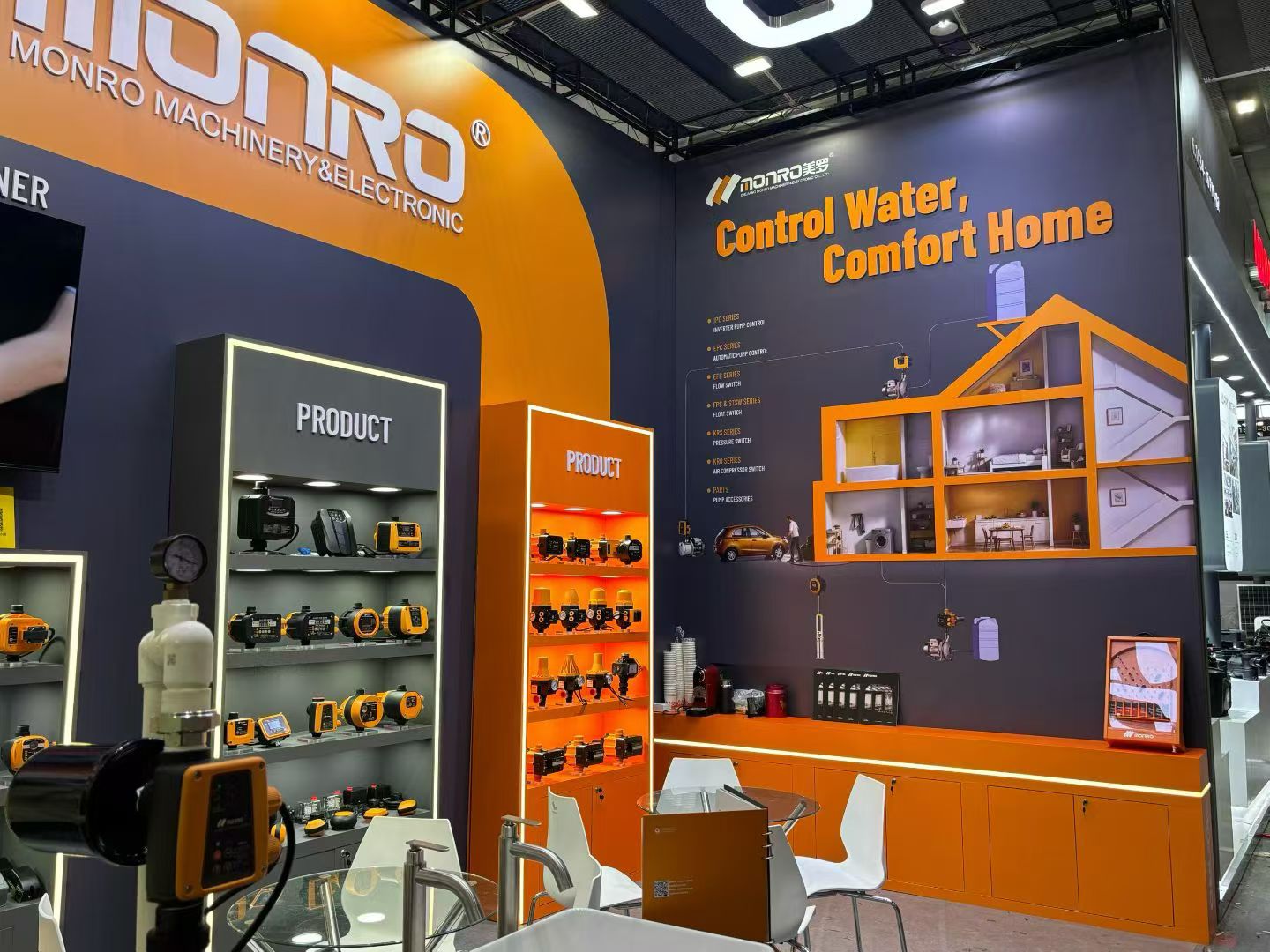
Monro Switch presents the EPC series at an industry exhibition. The EPC-1.1 sits within a range of more than 40 pressure controller models for water pump systems and air compressors.
Comparison Table: EPC-1.1 Configurations Side by Side
The table below converts each setting into the usable height and minimum pump lift implied by Monro's selection rule (starting pressure × 10 m for usable height; start-up pressure + 0.8 bar for minimum pump lift). Shared hardware is identical across all four columns.
| Decision factor | EPC-1.1 adjustable | EPC-1.1 fixed 1.2 bar | EPC-1.1 fixed 1.5 bar | EPC-1.1 fixed 2.2 bar |
|---|---|---|---|---|
| Starting pressure | 1.5–3.0 bar, set in the field | 1.2 bar, locked | 1.5 bar, locked | 2.2 bar, locked |
| Field adjustment | Yes | No | No | No |
| Maximum water use height covered | About 15–30 m | About 12 m | About 15 m | About 22 m |
| Minimum pump lift required | About 23–38 m | About 20 m | About 23 m | About 30 m |
| Typical fit | Mixed projects, retrofits, OEM catalogues | Single-storey and shallow-lift systems | Standard two-storey housing | Taller buildings with high outlets |
| SKU management | One part number across several sites | One part number per setting | One part number per setting | One part number per setting |
| Commissioning effort | Setting must be verified and documented | None beyond installation | None beyond installation | None beyond installation |
| Risk if the design changes | Re-set on site | Replace with another version | Replace with another version | Replace with another version |
| Shared platform | Surface or submersible pump compatibility; IP65; 55°C maximum working temperature; G1″, G1 1/4, G1 1/2 or NPT1 threads; 0.75 kW, 1.1 kW or 1.5 kW maximum power; 50/60 Hz; 110V, 230V or 110-240V; built-in check valve; run-dry protection; plastic and metal housing | |||
Sourcing Notes Before Ordering Either Version
Configuration is only one part of the purchase. Monro Switch runs OEM production with a monthly capacity of 180,000 pieces for the EPC series, a standard lead time of 45 days, a minimum order quantity of 204 pieces and 100% product testing. Customisation is available for cable length, cable material, brand marking, colour box and colour. After-sales support is provided remotely with a one-year warranty.
On compliance, the company's ISO 9001:2015 quality management system is certified under certificate 20126Q00115R300 by BeiJing ZHONGRUI Unite (GB/T19001-2016/ISO9001:2015, issued 2026-06-30, valid to 2029-06-29), and the EPC-1.1 appears within the scope of products covered by that certificate. Model-level certificates are issued per series rather than per configuration, so confirm the applicable document for the exact version and market before placing a regulated order.
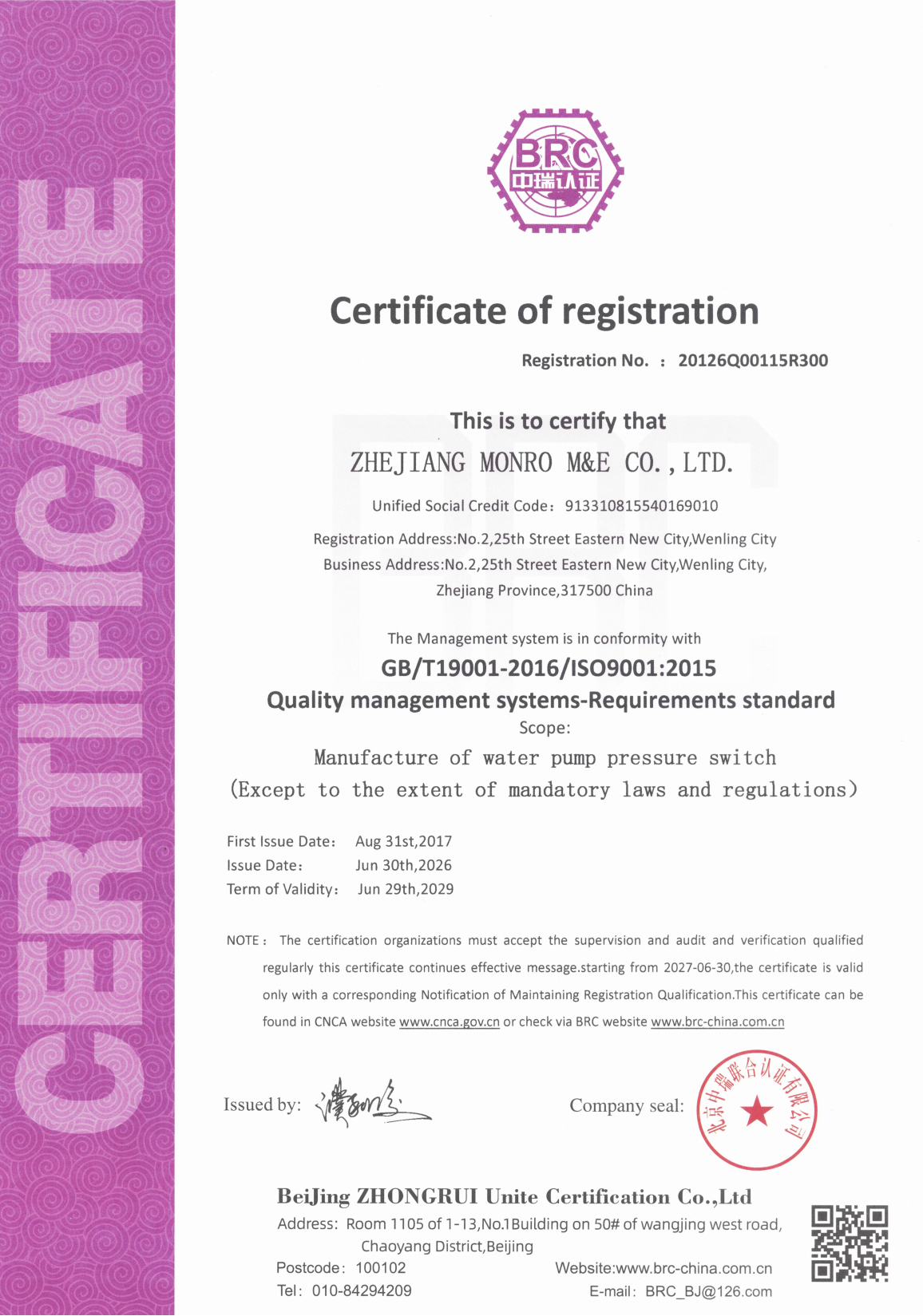
ISO 9001:2015 certificate 20126Q00115R300, issued to Monro Switch for the manufacture of water pump pressure switches, valid to 2029-06-29.
Frequently Asked Questions
Is the EPC-1.1 covered by certification for regulated markets?
Monro Switch operates an ISO 9001:2015 quality management system certified under certificate 20126Q00115R300 by BeiJing ZHONGRUI Unite, to GB/T19001-2016/ISO9001:2015, issued 2026-06-30 and valid to 2029-06-29; EPC-1.1 is listed within that certificate's product scope. Product-level certificates are issued per model group rather than per configuration — for example, TÜV Rheinland safety certificate R 50175890 covers EPC-10, EPC-12, EPC-14 and EPC-16, while CE-EMC certificate AE505724390001 covers EPC-1, EPC-2, EPC-2.1, EPC-3, EPC-3P, EPC-4, EPC-5 and EPC-15. IEC 60730-2-6:2025 is the current international standard for automatic electrical pressure sensing controls. Because certificate scope is model-specific, confirm the document that applies to the exact version and destination market before ordering.
What power, voltage and thread options does the EPC-1.1 support?
The EPC-1.1 accommodates pump motors up to 0.75 kW, 1.1 kW or 1.5 kW depending on the ordered rating, operates at 50/60 Hz, and is available with 110V, 230V or 110-240V triple voltage. Connection options are G1″, G1 1/4, G1 1/2 and NPT1. The unit is rated IP65, has a maximum working temperature of 55°C, and includes a built-in check valve and run-dry protection. It is compatible with both surface pumps and submersible pumps and is intended for clean water.
How should a buyer plan budget across adjustable and fixed versions?
Budget planning for the EPC-1.1 is driven less by the setting itself than by the number of part numbers a buyer must hold and the labour required at commissioning. Consolidating on the adjustable 1.5–3.0 bar version reduces SKU count and the risk of obsolete fixed stock, but adds a documented setting step on every installation. Standardising on fixed 1.2, 1.5 or 2.2 bar versions removes that step but requires one part number per setting and a replacement order if the system design changes. The standard minimum order quantity is 204 pieces and lead time is 45 days, both of which affect how much stock a mixed programme requires. Project pricing is quoted per configuration and volume.
Can I evaluate a sample before committing to a version?
Yes. Monro Switch maintains a sample showroom and supplies evaluation units so buyers can check housing fit, thread engagement, wiring arrangement and the setting mechanism before a production order. Requests can be sent to sale@monro-switch.com or raised through WhatsApp on +86 13586289715. When requesting a sample, specify the configuration (adjustable 1.5–3.0 bar or fixed at 1.2, 1.5 or 2.2 bar), the maximum power, voltage option and thread type, so the unit matches the intended installation.
What is the lead time and production capacity for an EPC-1.1 order?
Standard lead time is 45 days, with a monthly production capacity of 180,000 pieces for the EPC series and 100% product testing before shipment. Customisation of cable length, cable material, brand marking, colour box and colour is available on OEM orders, and after-sales support is provided remotely with a one-year warranty. Buyers planning a mixed adjustable and fixed programme should confirm quantities and settings early, since both affect scheduling.
Conclusion: Match the Setting to the Certainty You Have
The adjustable and fixed EPC-1.1 versions are not competing products; they answer two different levels of certainty. When the installation height, pump lift and site count are known, a fixed 1.2 bar, 1.5 bar or 2.2 bar unit delivers repeatable behaviour with no field adjustment and simpler inspection. When any of those variables is unresolved — or when one part number must serve several building types, retrofits or export markets — the adjustable 1.5–3.0 bar version keeps the decision open until commissioning.
Either way, the specification check is the same: usable height equals starting pressure × 10 m, and pump lift must exceed the start-up pressure by at least 0.8 bar. Confirming those two numbers before choosing a configuration prevents the most common domestic water system complaints — a pump that will not start, and upper floors that will not run.
Next Step
Review the full EPC series and thread, power and voltage options in the Monro Switch catalogue (PDF), or send your system details — outlet height, pump lift, motor power, voltage and thread — and Monro Switch will confirm whether the adjustable EPC-1.1 or a fixed setting fits the installation.
Email: sale@monro-switch.com | Tel / WhatsApp: +86 13586289715 | Website: www.monroswitch.com
Zhejiang Monro Machinery & Electronic Co., Ltd. — No.2, 25th Street, Eastern New City, Wenling City, Zhejiang Province, China.
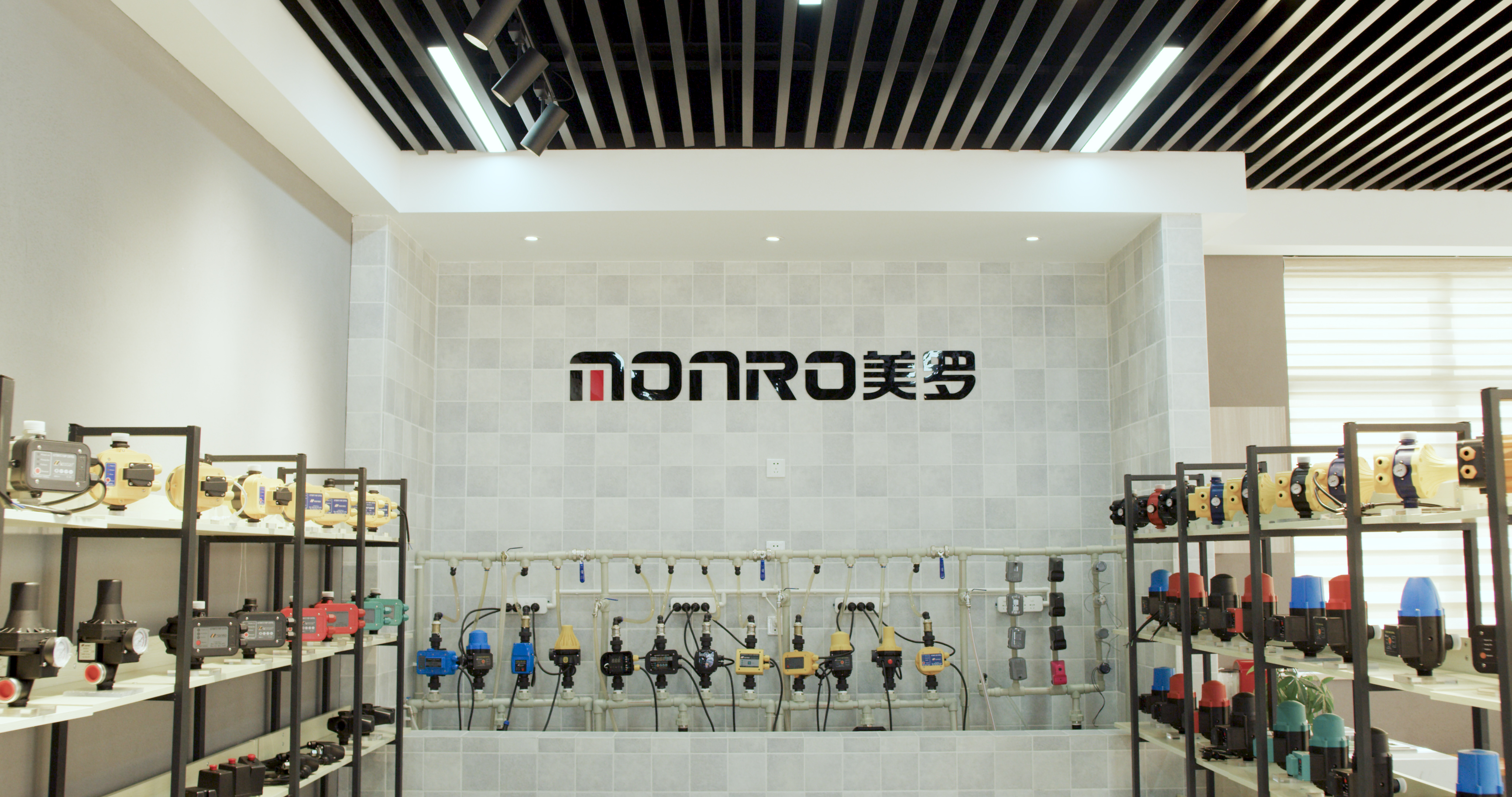
Monro Switch sample showroom. Evaluation units of the EPC-1.1 are available in both adjustable and fixed configurations.
Have Questions or Need More Details?
Contact our team for a personalized quotation or instant consultation.
Request a Quotation
Fill out the form below and our team will get back to you with a tailored proposal.
WhatsApp Direct Chat
Prefer to chat in real-time? Message us on WhatsApp for instant assistance & quick answers.
- Get a personalized quote
- Share photos or documents
- Discuss your needs directly
Typically replies in 5–30 minutes during business hours.