
Pressure Control Switch Partnership FAQ: EPC-1.1, EPC-2.1 & EPC-3 Long-Term Support
Pressure Control Switch Partnership FAQ: EPC-1.1, EPC-2.1 & EPC-3 Long-Term Support
Buyers who already run a pump programme ask a different set of questions than first-time buyers. They do not need another explanation of what a pressure control switch does; they need to know which model will still be supplied next year, which certificate covers which model, how spare units are planned, and who answers the technical question when a controller behaves differently on site than it did on the bench. This page answers those questions for three automatic pump control models from Monro Switch: EPC-1.1, EPC-2.1 and EPC-3.
In the published parameters, EPC-1.1 is listed for domestic applications, while EPC-2.1 and EPC-3 are listed for agriculture irrigation, water treatment and construction. All three run at 50/60 Hz, are offered with starting pressure settings of 1.2 bar, 1.5 bar and 2.2 bar, and share a maximum working temperature of 55 °C. The practical differences sit in thread type, protection rating and power options: EPC-1.1 offers G1", G1 1/4", G1 1/2" and NPT1" connections with IP65; EPC-2.1 uses R1" with IP44; EPC-3 uses G1" with IP65 and can be used with surface or submersible pumps.
Why a standardised switch family creates its own procurement questions
Once a pump programme is locked to one controller family, the risk profile changes. Single-unit quality stops being the main concern and continuity becomes the deciding factor. The same five questions recur in long-term partnership reviews:
- Model drift. Whether the model code quoted in year one still maps to the same thread, voltage and starting pressure in later batches.
- Variant ambiguity. Whether the thread callout, the voltage band (220–240 V or 110–120 V) and the power rating were written down, or only agreed verbally.
- Protection class mismatch. IP65 and IP44 versions of the same control concept are not interchangeable on a wet or exposed installation.
- Certificate scope. Whether the certificate presented covers the exact model being ordered, not merely the product family.
- After-sales latency. Who answers the technical question in week one of installation, and how service stock is planned for units already in the field.
Each of these is a documentation problem before it is a product problem, which is why the answers below are built from published model parameters and certificate scopes rather than from general claims.
Industry background: what these devices are and how they are classified
Pressure control switches fall under automatic electrical pressure sensing controls. IEC 60730-2-6:2025 is the current international standard for this product type, and automated pump controls are commonly traded under HS code 853650. For category context, Fortune Business Insights valued the global pressure switch market at USD 3.2 billion in 2025 — a figure that spans industrial verticals well beyond domestic water supply and is useful for scale, not for forecasting any single model family.
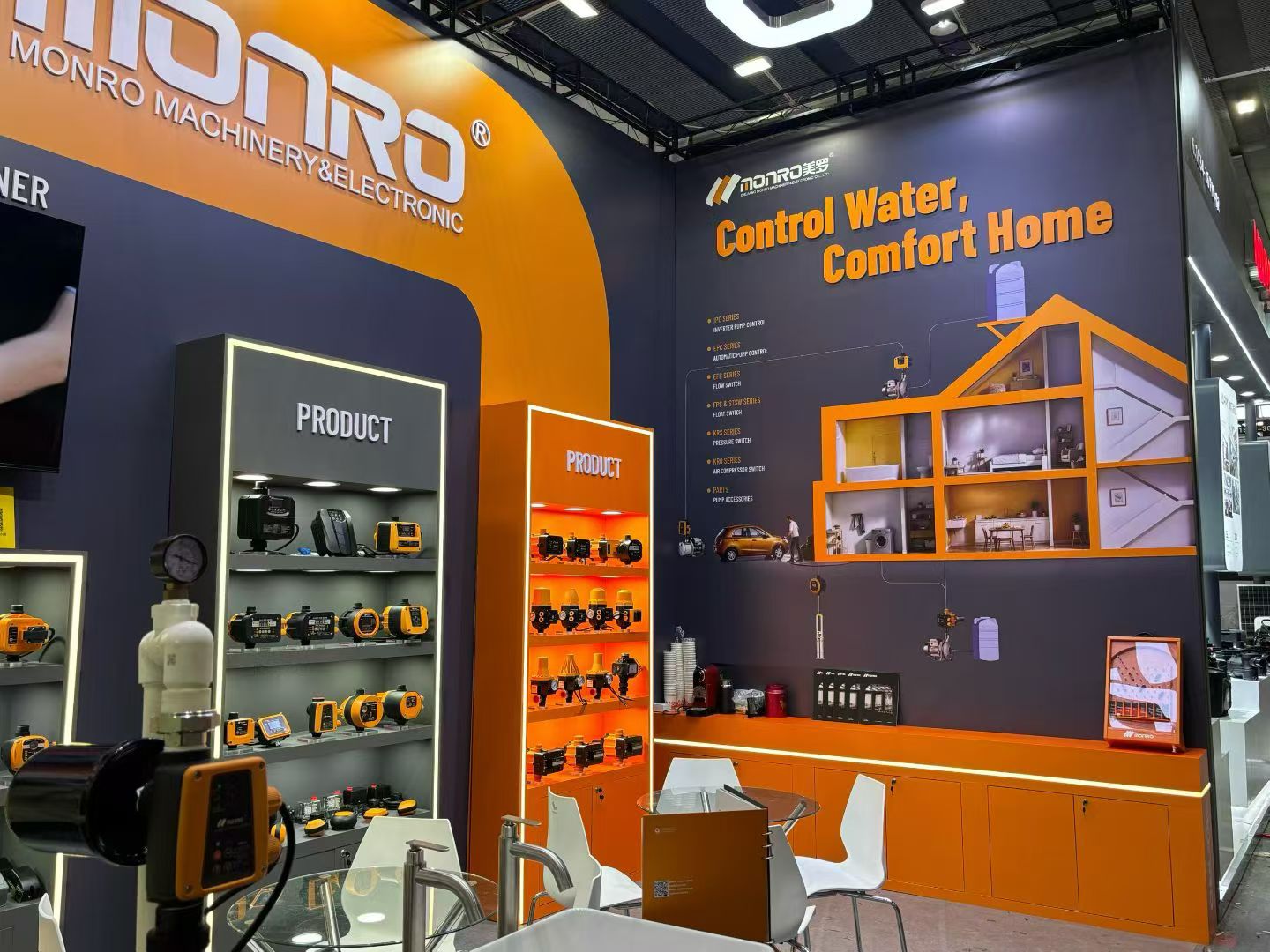
Monro Switch is the trading name of ZHEJIANG MONRO MACHINERY & ELECTRONIC CO.,LTD, a manufacturer of pump controllers, pressure switches and float switches based in Wenling City, Zhejiang Province, China. The company was established in 2010, operates a 30,000 m² facility with around 200 employees and a 10-engineer R&D team, and exports about 90% of its output to Asia, Europe, North and South America, the Middle East and Africa. Its catalogue covers more than 40 pressure controller models for water pump systems and air compressors.
What EPC-1.1, EPC-2.1 and EPC-3 are specified to do
The three models sit close together on paper, so the parameter table below is the most useful starting point for a partnership file. Every value is taken from Monro's published model parameters.
| Parameter | EPC-1.1 | EPC-2.1 | EPC-3 |
|---|---|---|---|
| Application listed | Domestic | Agriculture irrigation, water treatment, construction | Agriculture irrigation, water treatment, construction |
| Rated voltage | 220–240 V / 110–120 V | 220–240 V / 110–120 V | 220–240 V / 110–120 V |
| Power frequency | 50/60 Hz | 50/60 Hz | 50/60 Hz |
| Max. power | 1.1 kW / 1.5 kW / 0.75 kW | 0.55 kW / 1.1 kW / 1.5 kW / 0.75 kW | 0.55 kW / 1.1 kW / 1.5 kW / 0.75 kW |
| Starting pressure settings | 1.2 bar / 1.5 bar / 2.2 bar | 1.2 bar / 1.5 bar / 2.2 bar | 1.2 bar / 1.5 bar / 2.2 bar |
| Connection thread | G1", G1 1/4", G1 1/2", NPT1" | R1" | G1" |
| Protection rating | IP65 | IP44 | IP65 |
| Max. working temperature | 55 °C | 55 °C | 55 °C |
| Material | Plastic, metal | Plastic, metal | Plastic, metal |
Starting pressure: three fixed settings and one sizing rule
Each of the three models is offered with a starting pressure of 1.2 bar, 1.5 bar or 2.2 bar, selected at order. Monro's own selection guidance connects that number to the building: with a 1.2 bar starting pressure, the maximum water use height is about 12 m, and the pump lift should be at least about 20 m, calculated as (1.2 + 0.8) × 10 m. The general rule behind the example is that the pump head must be at least 0.8 bar above the controller's start-up pressure. In a repeat-order programme this is the most valuable line in the file, because a site that changed from a two-storey to a four-storey riser may need a different setpoint without needing a different controller family.
Adjustable versus non-adjustable versions
The EPC-1.1, EPC-2.1 and EPC-3 are specified with three discrete starting pressure values rather than a continuously variable range, which keeps an installed base consistent. Where a programme needs field adjustment, other models in the same range provide it: the EPC-7 is specified with an adjustable starting pressure from 1.2 to 2.5 bar, and mechanical KRS models such as KRS-2 are supplied with adjustable pressure ranges of 1.0–1.8 bar, 1.2–2.2 bar and 2.2–3.0 bar. A long-term agreement can therefore hold a fixed-setpoint baseline and an adjustable alternative side by side, instead of forcing every site onto one behaviour.
Thread options and why they belong in the file
EPC-1.1 carries the widest thread choice of the three: G1", G1 1/4", G1 1/2" and NPT1". EPC-3 uses G1" and EPC-2.1 uses R1". R and G are different thread forms and both appear inside the same family, so the callout on a purchase order should be matched against the mating fitting on site rather than carried over from the previous model code. A thread mismatch is a field failure that looks like a product fault, and it costs far more to resolve than the one line of specification that prevents it.
Voltage and power variants
All three models are rated for 220–240 V or 110–120 V at 50/60 Hz. Maximum power differs: EPC-1.1 is listed at 1.1 kW, 1.5 kW and 0.75 kW, while EPC-2.1 and EPC-3 add a 0.55 kW option, giving 0.55 kW, 1.1 kW, 1.5 kW and 0.75 kW. Because the low-power option exists on only two of the three models, a programme that mixes them across a product range should record the power rating per model, not per family.
Protection class: IP65 versus IP44
EPC-1.1 and EPC-3 carry an IP65 protection rating; EPC-2.1 carries IP44. Where the controller sits in a location exposed to water, the IP65 models remove a variable that a partnership would otherwise have to manage installation by installation. Where the enclosure is already protected, IP44 remains a valid choice — the point is that the rating should be a documented decision rather than a difference discovered after delivery.
Run-dry protection and built-in check valves
Run-dry protection and an integrated check valve are specified on selected EPC models rather than across the whole range. EPC-5.1 is described with a built-in check valve and built-in run-dry protection, and EPC-12P is described with a built-in check valve and run-dry protection, a maximum working pressure of 9.8 bar and an IP65 rating. The published parameters for EPC-1.1, EPC-2.1 and EPC-3 do not list either function. If a tender or internal standard requires run-dry protection or a built-in check valve, confirm the exact model variant before the baseline is locked; this is precisely the requirement that should never be read across from a family datasheet.
Certificate scope, model by model
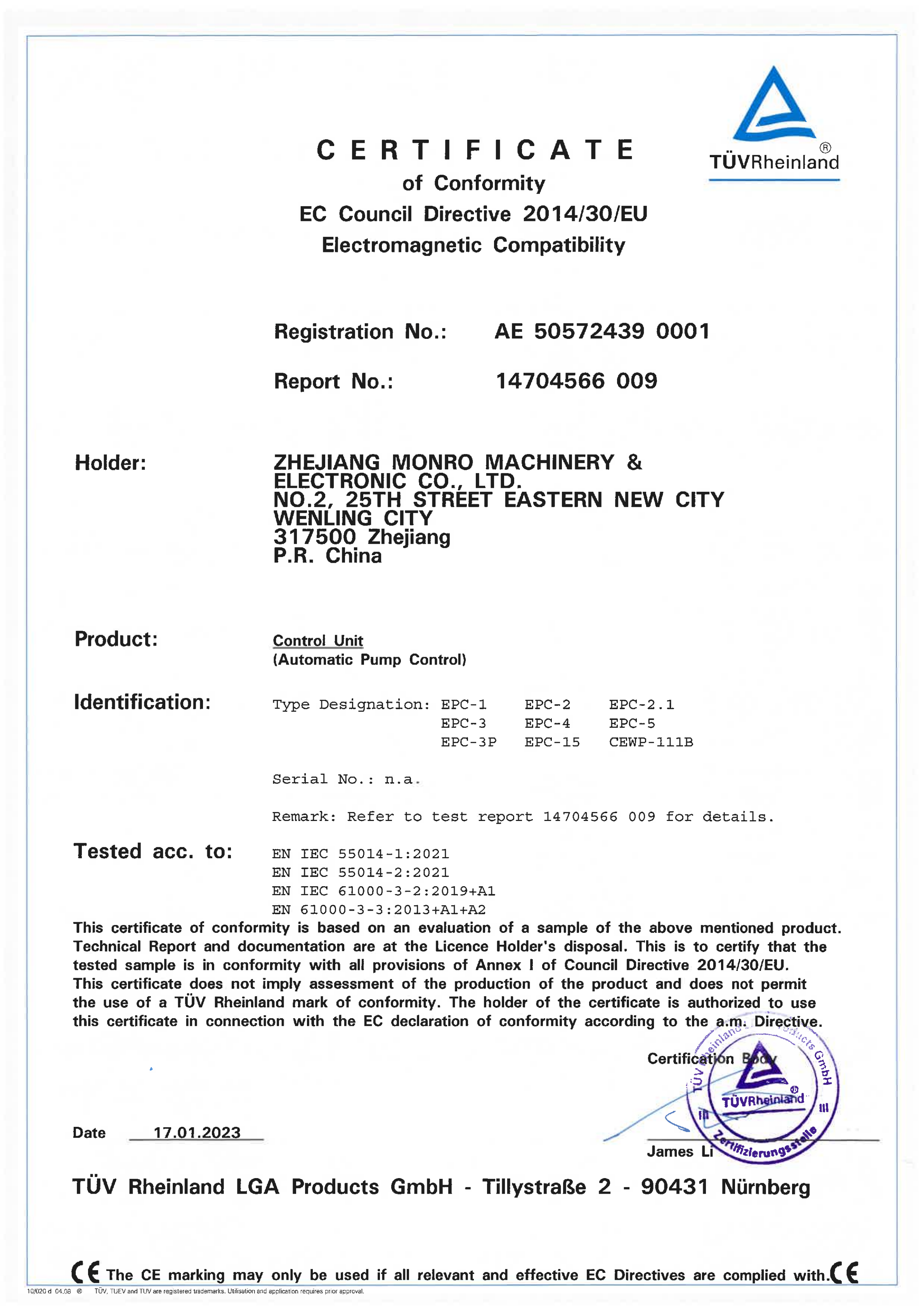
Compliance questions in a long-term programme are usually about scope rather than existence. Monro holds a CE-EMC Certificate of Conformity, AE505724390001, issued by TÜV Rheinland LGA Products GmbH on 17 January 2023 and valid to 17 January 2099, covering automatic pump control units including EPC-1, EPC-2, EPC-2.1, EPC-3, EPC-3P, EPC-4, EPC-5 and EPC-15 against EN IEC 55014-1:2021, EN IEC 55014-2:2021, EN 61000-3-2:2019+A1 and EN 61000-3-3:2013+A1+A2 under Directive 2014/30/EU. EPC-2.1 and EPC-3 appear on that scope; EPC-1.1 does not, so a CE-EMC requirement written specifically around EPC-1.1 should be confirmed with Monro rather than assumed.
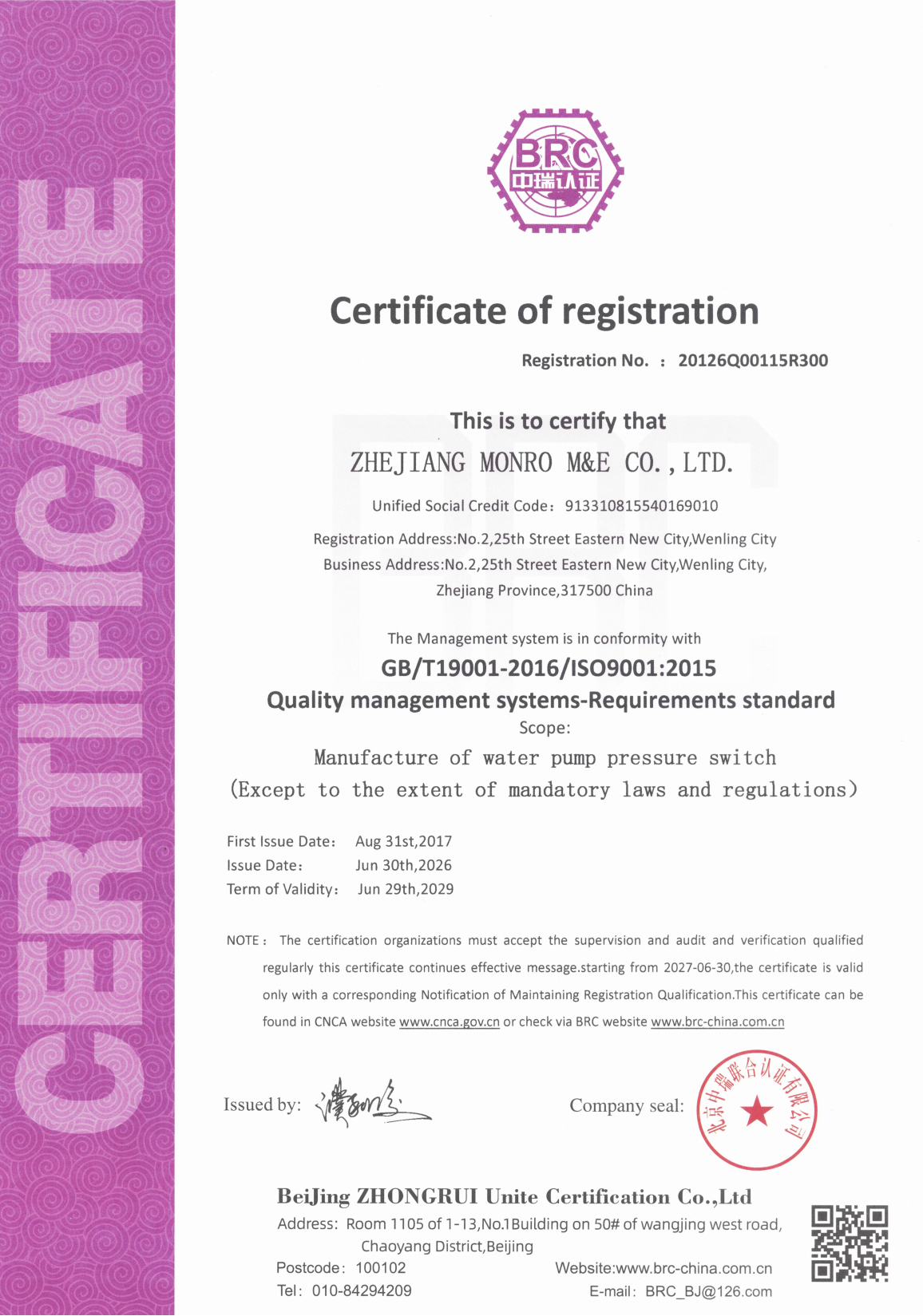
Quality management is covered separately. ISO 9001 certificate 20126Q00115R300, issued by BeiJing ZHONGRUI Unite against GB/T19001-2016/ISO9001:2015 for the manufacture of water pump pressure switch, is valid from 30 June 2026 to 29 June 2029, and EPC-1.1 is among the products listed under it. Other models in the range carry further certification — for example the TÜV Rheinland safety certificate R 50175890 covers EPC-10, EPC-12, EPC-14 and EPC-16, and UL listing E316396 covers the mechanical model KRS-4 — which underlines the same rule: match the certificate to the model, not to the brand.
Step-by-step: building a repeatable supply programme
The sequence below turns the parameters above into a working partnership record. It is written for a buyer preparing a specification file, not for a first-time shopper.
- Freeze the baseline at variant level. Record model code, the application the model is listed for, thread, voltage, power rating, starting pressure and protection class. For EPC-1.1 that means recording which of the four thread options applies; for EPC-2.1 and EPC-3, which power option applies.
- Re-verify thread and voltage against the site at each new project rather than against the previous purchase order.
- Validate samples before the first bulk order. Confirm voltage, frequency, thread, starting pressure and protection rating on the physical unit, then confirm the acceptance route: Monro applies 100% testing and can support pre-shipment testing and third-party inspection by SGS.
- Agree the customisation scope. Monro provides OEM production services with customisation of cable length, cable material, brand, colour box and colour. These are the items that turn a catalogue model into a private-label SKU, and each one changes the part identity.
- Fix commercial terms in writing. MOQ is 204 pcs; delivery terms are EXW, FOB or CIF; payment is 30% T/T in advance with 70% T/T against copy of B/L.
- Match the order pattern to capacity and lead time. Monthly capacity for the automatic pump control EPC series is 180,000 pcs and the stated lead time is 45 days.
- Plan spares and route after-sales questions. Hold a service stock of the same model and variant rather than a near-equivalent; log technical questions with the model code so answers stay reusable; and use Monro's remote support and 1-year warranty as the after-sales baseline for the programme.
Use cases across domestic water, irrigation, water treatment and construction
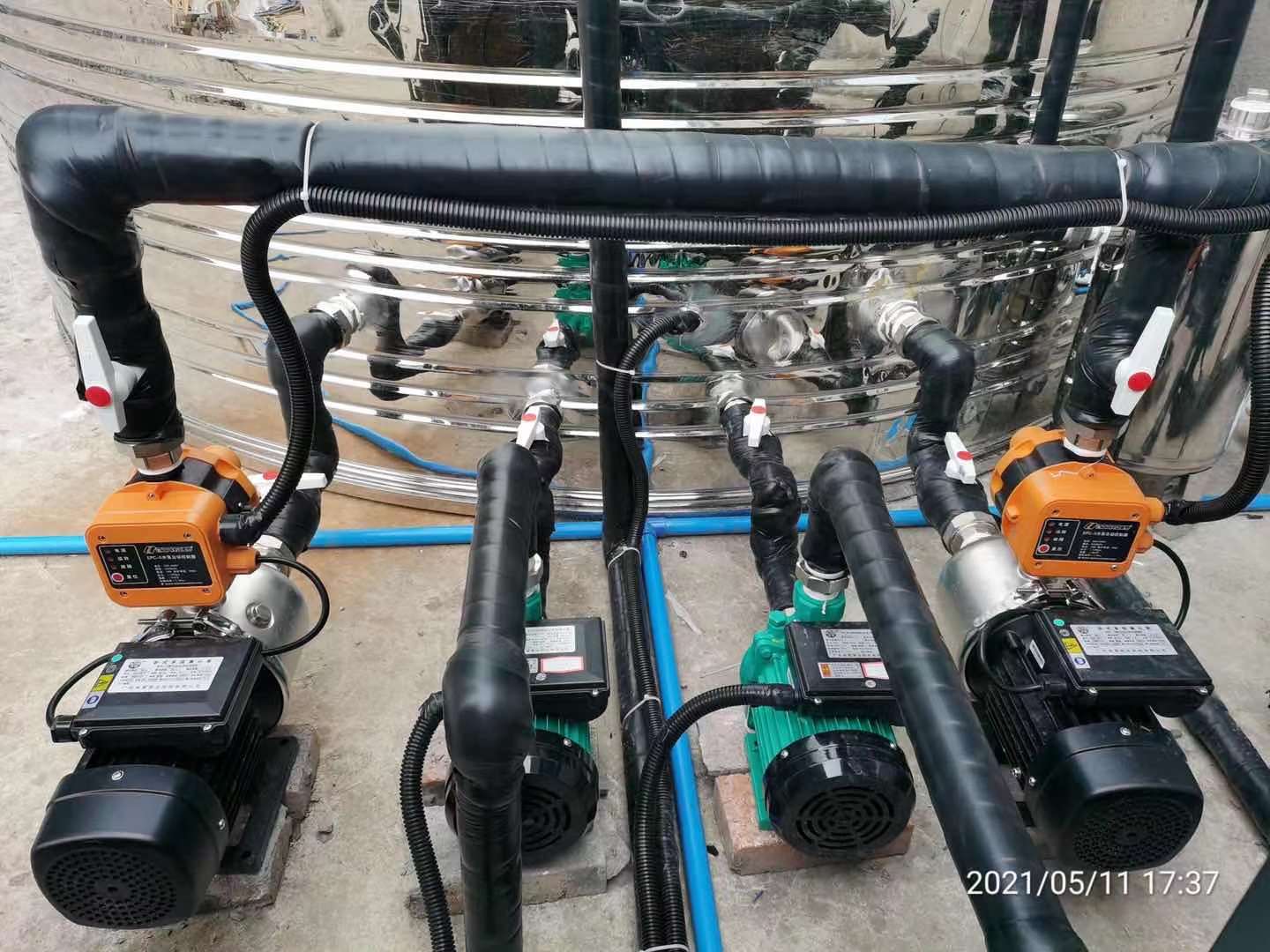
Domestic water supply. EPC-1.1 is listed for domestic applications. Its four thread options and IP65 rating suit booster and tank-fed household systems where the pipe connection varies by market, and the 1.1 kW, 1.5 kW and 0.75 kW power options cover the single-phase pumps typically used in that duty.
Irrigation and water treatment. EPC-2.1 and EPC-3 are both listed for agriculture irrigation and water treatment. EPC-3 adds IP65 and a G1" connection and can be used with surface or submersible pumps; EPC-2.1 uses an R1" connection and IP44, which fits installations where the enclosure is already protected.
Construction and temporary supply. Both EPC-2.1 and EPC-3 are listed for construction. In temporary installations the controller is often moved between locations, so thread and protection class should be recorded on the asset rather than assumed by the next site team.
Lift-critical sites. Where the delivery height is close to the limit, the starting pressure decision dominates: with a 1.2 bar setting the usable height is about 12 m and the required pump lift at least about 20 m.
A retail customer in China ordered 50 pcs of Monro automatic pump control for agriculture irrigation, water treatment and construction use; the supply relationship has run for two years, with the recorded result being reliable automatic pressure control for a water supply system and the highlighted function being automatic pump start/stop control. The volume is small, but it illustrates the continuity point: the value of a partnership on this product type is measured in repeat orders of the same variant, not in the first shipment.
Model comparison for partnership files
| Model | Listed applications | Thread | Protection | Max. power options | Role in a standardised programme |
|---|---|---|---|---|---|
| EPC-1.1 | Domestic | G1", G1 1/4", G1 1/2", NPT1" | IP65 | 1.1 / 1.5 / 0.75 kW | Household and light booster duty where the connection thread varies by market |
| EPC-2.1 | Irrigation, water treatment, construction | R1" | IP44 | 0.55 / 1.1 / 1.5 / 0.75 kW | Protected enclosures where an R1" connection and the 0.55 kW option are required |
| EPC-3 | Irrigation, water treatment, construction | G1" | IP65 | 0.55 / 1.1 / 1.5 / 0.75 kW | Exposed sites and surface or submersible pump duty |
The table below converts the same facts into the documents a partnership actually needs to keep.
| Documentation item | Source of the fact | Why a repeat order needs it |
|---|---|---|
| Model and variant record | Published model parameters | Prevents thread, voltage or power drift between batches |
| Certificate scope note | CE-EMC AE505724390001; ISO 9001 20126Q00115R300 | Shows which model each certificate actually covers |
| Commercial terms sheet | MOQ 204 pcs; EXW / FOB / CIF; 30% + 70% T/T | Keeps repeat orders comparable year to year |
| Capacity and lead-time note | 180,000 pcs per month for the EPC series; 45 days lead time | Aligns production planning with project schedules |
| Customisation list | Cable length, cable material, brand, colour box, colour | Defines exactly what changes the part identity |
| After-sales routing | Remote support; 1-year warranty | Sets the first response path for field questions |
Frequently asked questions
Which certificates cover EPC-1.1, EPC-2.1 and EPC-3?
EPC-2.1 and EPC-3 are listed on the CE-EMC Certificate of Conformity AE505724390001, issued by TÜV Rheinland LGA Products GmbH on 17 January 2023 and valid to 17 January 2099, which covers automatic pump control units including EPC-1, EPC-2, EPC-2.1, EPC-3, EPC-3P, EPC-4, EPC-5 and EPC-15 against EN IEC 55014-1:2021, EN IEC 55014-2:2021, EN 61000-3-2:2019+A1 and EN 61000-3-3:2013+A1+A2 under Directive 2014/30/EU. EPC-1.1 is not listed on that scope, so a CE-EMC requirement built around EPC-1.1 needs confirmation. All three sit under ISO 9001 certificate 20126Q00115R300 for the manufacture of water pump pressure switch, valid 30 June 2026 to 29 June 2029, and EPC-1.1 is among the products listed on that certificate.
Can EPC-1.1, EPC-2.1 and EPC-3 be supplied as OEM builds?
Yes. Monro provides OEM production services with customisation of cable length, cable material, brand, colour box and colour. Monthly capacity for the automatic pump control EPC series is 180,000 pcs, and quality control is 100% testing. Acceptance can include pre-shipment testing and third-party inspection by SGS. For repeat OEM orders, the customisation items should be written into the model record, because each of them changes the part identity even though the base model code stays the same.
What are the MOQ, delivery terms and payment terms?
MOQ is 204 pcs. Delivery terms are EXW, FOB or CIF, and payment is 30% T/T in advance with 70% T/T against copy of B/L. When a programme runs several variants — for example EPC-1.1 in two thread options plus EPC-3 — the commercial sheet should state clearly which terms attach to which model code, so that later quotations remain comparable with the original agreement.
How should samples of EPC-1.1, EPC-2.1 and EPC-3 be validated?
A practical sample check covers five points. First, confirm the rated voltage (220–240 V or 110–120 V) and the 50/60 Hz power frequency against the local supply. Second, confirm the thread callout against the mating fitting — G1", G1 1/4", G1 1/2" or NPT1" on EPC-1.1, R1" on EPC-2.1, G1" on EPC-3. Third, check the starting pressure setting against the pump curve using the rule that usable height equals the setting times 10 m, while pump lift must be at least 0.8 bar above the start-up pressure. Fourth, check the protection rating against the installation location: IP65 on EPC-1.1 and EPC-3, IP44 on EPC-2.1. Fifth, confirm the maximum power option and any customisation items before bulk release.
What lead time and after-sales support apply to repeat orders?
Stated lead time is 45 days, against a monthly EPC series capacity of 180,000 pcs. After-sales support covers remote support and a 1-year warranty, with technical questions routed through Monro at sale@monro-switch.com or +86 13586289715. For a smooth repeat order, keep a service stock of the same model and variant, quote the model code in every technical enquiry, and confirm the specification against the current parameter sheet before the next release — samples can be requested for the model you intend to standardise on, and the full Monro catalogue 2025 is available for download below.
Conclusion
EPC-1.1, EPC-2.1 and EPC-3 are close relatives on paper and clearly separated in practice: domestic duty with four thread options and IP65 on EPC-1.1, an R1" connection with IP44 on EPC-2.1, and a G1" IP65 unit for irrigation, water treatment and construction on EPC-3, including surface or submersible pump duty. What holds a long-term programme together is not the shared family name but the documented variant: the thread, the voltage band, the power option, the starting pressure, the protection rating and the certificate scope that actually covers the model being ordered. Where a specification needs run-dry protection or a built-in check valve, those functions belong to specific models such as EPC-5.1 and EPC-12P rather than to the family as a whole, and should be confirmed before the baseline is fixed.
Next step. Request samples or a quotation for EPC-1.1, EPC-2.1 or EPC-3 and confirm the variant details for your programme.
Email: sale@monro-switch.com · Tel / WhatsApp: +86 13586289715 · Website: www.monroswitch.com
Download the catalogue: Monro catalogue 2025 (PDF)
Have Questions or Need More Details?
Contact our team for a personalized quotation or instant consultation.
Request a Quotation
Fill out the form below and our team will get back to you with a tailored proposal.
WhatsApp Direct Chat
Prefer to chat in real-time? Message us on WhatsApp for instant assistance & quick answers.
- Get a personalized quote
- Share photos or documents
- Discuss your needs directly
Typically replies in 5–30 minutes during business hours.