
Why Did My Pump Stop? Solving Stuck Rotor Issues with Integrated Run-Dry Protection
A pump that stops by itself is usually reporting one of two things: water has stopped reaching it, or the motor can no longer turn. The first is a control problem. The second is the damage that follows when the first one goes unnoticed. Electronic pump controllers with built-in run-dry protection — including the Monro Switch EPC-1.1 and EPC-3 — act on the first case by switching the pump off when water stops arriving, instead of letting the motor run until it overheats and seizes.
Monro Switch (Zhejiang Monro Machinery & Electronic Co., Ltd.) is a manufacturer of pump controllers, pressure switches and float switches based in Wenling City, Zhejiang Province, China, producing the EPC, KRS and FPS series for water pump systems. This article explains the failure chain behind a stopped pump, what integrated run-dry protection actually does inside a pressure control switch, and how to set it so the same failure does not repeat.
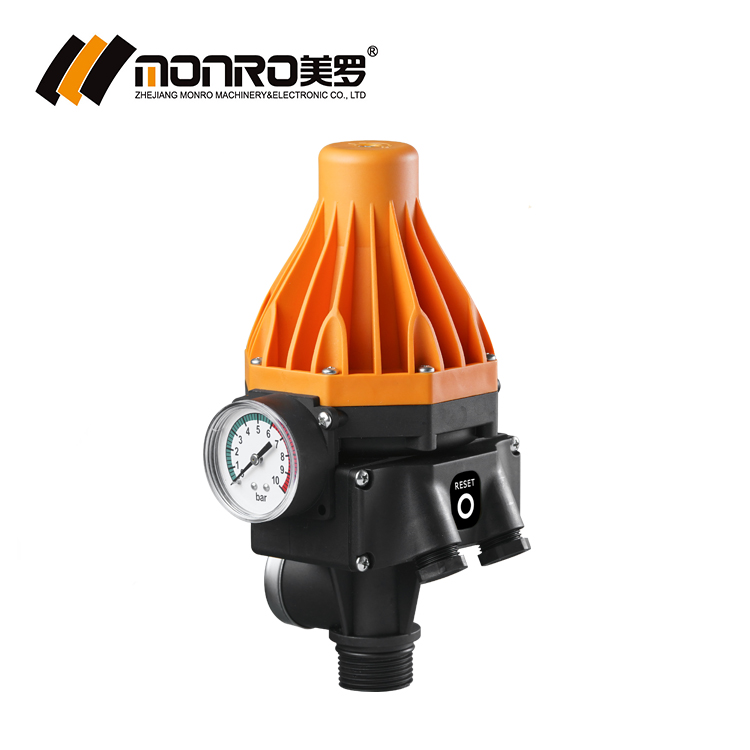
Integrated electronic pump controllers replace a pressure-only switching action with flow and pressure monitoring, which is what makes run-dry detection possible.
Why Your Pump Stopped: Dry Running vs. a Stuck Rotor
Most owners describe both failures the same way: “the pump stopped.” Technically they are different events, they develop at different speeds, and they need different responses.
Dry running: the pump is turning, but nothing is moving through it
Dry running means the pump is energised and rotating with no water, or not enough water, passing through the casing. In a domestic booster set this usually traces back to an empty tank, a closed suction valve, a blocked suction strainer, a lost prime, or a well whose water level has dropped below the intake.
Water inside a pump does two jobs beyond being moved: it lubricates the mechanical seal and it carries heat away from the hydraulic end and the motor. Remove the water and both jobs stop at the same moment. The event is also quiet — there is no leak to see, no visible change at the tap until pressure disappears entirely, and no alarm at all unless the controller provides one.
Stuck rotor: the damage that dry running leaves behind
A rotor that no longer turns is usually the end of a chain rather than the beginning. Once water is absent, friction at the seal faces and bearings rises and heat accumulates inside the pump. If the condition continues, the shaft can become difficult or impossible to rotate: the pump hums, draws current, trips the breaker, and still delivers no water after the supply is restored. Sediment, scale and debris add a second route to the same result, which is why hard-water installations see seizures even without an obvious dry run.
Why Run-Dry Events Are Still Common in Pump Systems
Pressure control is a mature, large category. Fortune Business Insights valued the global pressure switch market at USD 3.2 billion in 2025. Market Research Future reported that electromechanical pressure switches still held approximately 62% of global market share in 2024. The installed base is therefore dominated by devices whose job is defined narrowly: switch at a set pressure, and nothing more.
Regulation has developed in parallel. IEC 60730-2-6:2025 is the current international standard for automatic electrical pressure sensing controls used in, on or in association with household appliances and similar equipment. Products in this category are commonly traded under HS code 853650. In practice, a buyer comparing a mechanical pressure switch with an electronic pump controller is comparing two different scopes of work, not two versions of the same component.
Where Mechanical Controls Stop Detecting
Mechanical pressure controls such as the KRS-1 start and stop a water pump according to the set pressure. The KRS-1 is rated 110-240V at 50/60Hz and 12A, with a minimum cut-in of 20 PSI, a maximum cut-out of 175 PSI, pressure ranges of 20-40, 30-50 and 40-60 PSI, IP20 protection, a maximum working temperature of 55°C, and screw types of 1/4-inch female, 3/8-inch female and 1/4-inch male. It is a proven, widely used device.
Float switches such as the FPS-1 respond to liquid level instead: 250V, 50/60Hz, relay current 16(8)A, IP68 protection, maximum working temperature 55°C. The FPS-5 is rated for 7 bar service pressure, 0.2-6 bar operating pressure, G1-inch, G3/4-inch or G1/2-inch connection threads, and 0-50°C operating temperature.
The gap is not in build quality but in what each device can observe. A float confirms the level where the float is installed; it does not confirm that water is arriving at the pump. A pressure-only control reports pressure at its own port, and run-dry detection is not listed among the KRS-1 or FPS-1 specifications. That leaves a blind spot in the case where the pump loses its water supply while the tank still reads full — a blocked suction strainer, a closed valve, a collapsed suction line, or a well that has run low.
How Integrated Run-Dry Protection Works in the EPC-1.1 and EPC-3
In the Monro Switch EPC series, run-dry protection is integrated into the controller housing rather than added as a separate accessory or a second wiring device. That single design decision removes a common installation error: there is no separate protection module to be left out of the loop, mis-wired, or bypassed during service.
EPC-1.1: run-dry protection in a domestic booster format
The EPC-1.1 is a pump pressure control rated 220-240V or 110-120V, 50/60Hz, with a maximum power of 1.1kW, 1.5kW or 0.75kW. Starting pressure is selectable at 1.2 bar, 1.5 bar or 2.2 bar, with an adjustable starting pressure range of 1.2-2.5 bar. Connection threads include G1-inch, G1 1/4-inch, G1 1/2-inch and NPT1-inch. Protection rating is IP65, maximum working temperature is 55°C, and the applicable industry is domestic water supply.
Its feature set explains why it suits retrofit work: built-in run-dry protection, a built-in check valve, constant pressure at constant flow, triple voltage of 110V, 230V or 110-240V, and a built-in socket that simplifies wiring. It can be used with surface or submersible pumps.
EPC-3: the same protection with visible pressure
The EPC-3 is a pump pressure switch rated 220-240V or 110-120V, 50/60Hz, with a maximum power of 0.55kW, 1.1kW, 1.5kW or 0.75kW and starting pressure settings of 1.2 bar, 1.5 bar or 2.2 bar. It uses a G1-inch connection thread, carries IP65 protection, and has a maximum working temperature of 55°C.
Functionally it matches the EPC-1.1 on the essentials — built-in run-dry protection, a built-in check valve, constant pressure at constant flow, and suitability for surface or submersible pumps — while adding a pressure gauge for real-time pressure monitoring. For an installer who has to prove at handover that the system holds the correct pressure, that gauge shortens the conversation considerably. The EPC-3P extends the same platform with a pressure gauge and switches the pump off automatically when there is a water shortage.
What the controller does when water disappears
Flow-based electronic control watches for movement of water, not only for a pressure threshold. Monro documents this logic explicitly on the EPC-14 and EPC-14A: when there is no water at the inlet and the controller cannot detect water flow, it turns off the water pump and the failure light comes on. The same design intent — detect, stop, indicate — is what “built-in run-dry protection” means on the EPC-1.1 and EPC-3.
Two consequences matter commercially. First, the pump is stopped by the controller rather than by a thermal protector or a tripped breaker, which is a far gentler stop for the motor. Second, the failure becomes visible as an indicator instead of a silent dead pump, so the cause can be corrected rather than guessed at.
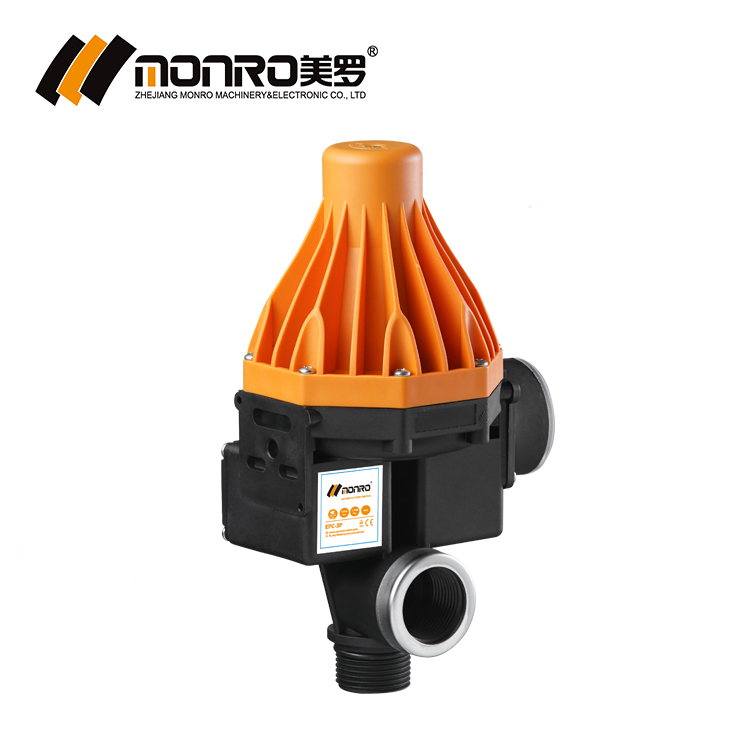
The EPC-3P variant adds a pressure gauge for real-time monitoring and switches off automatically during a water shortage.
If the rotor has already seized once: the EPC-19 anti-blocking cycle
For installations where blockage has already occurred, or where the pump sits idle for long periods — seasonal irrigation, holiday homes, standby sets — the EPC-19 adds rotor anti-blocking protection: the controller runs the pump for 10 seconds after 24 hours of stop. During a water shortage it also restarts automatically on a programmed cycle to test whether supply has returned, and it provides dry-running protection. It is rated 220-240V or 110-120V, 50/60Hz, 1.1kW or 2.2kW, with a starting pressure of 2-6 bar, maximum working pressure of 10 bar, G1-inch thread, IP65 protection and 60°C maximum working temperature.
The anti-blocking cycle is a maintenance behaviour, not a substitute for correct sizing. A pump that seizes repeatedly is usually mis-set, starved, or oversized for its controller — and the controller cannot fix any of those three conditions on its own.
Step-by-Step: Diagnose the Stop, Then Set Protection Correctly
The sequence below follows the same order a field technician should use, and it separates the two failure modes before any parts are ordered.
- Separate cycling from stopping. If the pump restarts whenever a tap is opened and stops when it is closed, the controller is working as designed: it detects no flow and switches off. If the pump hums, trips the breaker, or stays silent with taps open, treat it as a mechanical or supply fault first.
- Confirm water at the inlet. Check tank level, suction valve position, strainer condition and prime before touching the controller. A controller with dry-run protection will keep switching the pump off until the supply is actually restored — that is correct behaviour, not a fault.
- Match motor power to controller rating. The controller maximum power must equal or exceed the pump motor. The EPC-1.1 covers 0.75kW, 1.1kW and 1.5kW; the EPC-3 covers 0.55kW, 0.75kW, 1.1kW and 1.5kW.
- Match starting pressure to the pump curve. Monro guidance gives a worked example: a starting pressure of 1.2 bar supports a maximum water use height of 1.2 × 10 = 12 m, and the pump lift should be at least (1.2 + 0.8) × 10 = 20 m. The pump head must be at least 0.8 bar higher than the start-up pressure of the controller.
- Install in the direction of flow. Fit the controller according to the direction indicated by the arrow on its housing.
- Wire and seal the connections. Connect the controller power cord to a separate plug wire, and seal all wire joints with waterproof insulating tape.
- Commission against an open system. After the electrical work is complete, open the main outlet valve and all faucets first, then connect the power supply and let the controller begin operation.
- Handle a seized shaft with power off. If the rotor is already stuck, isolate the supply before any intervention and follow the pump manufacturer’s procedure for freeing it. Repeated restarts on a seized pump add heat without restoring rotation.
- Retrofit instead of repairing repeatedly. Where a mechanical pressure switch has already allowed one dry run, replace it with a controller that detects the condition: EPC-1.1 for a compact wiring-friendly installation, EPC-3 where a gauge is needed at commissioning.
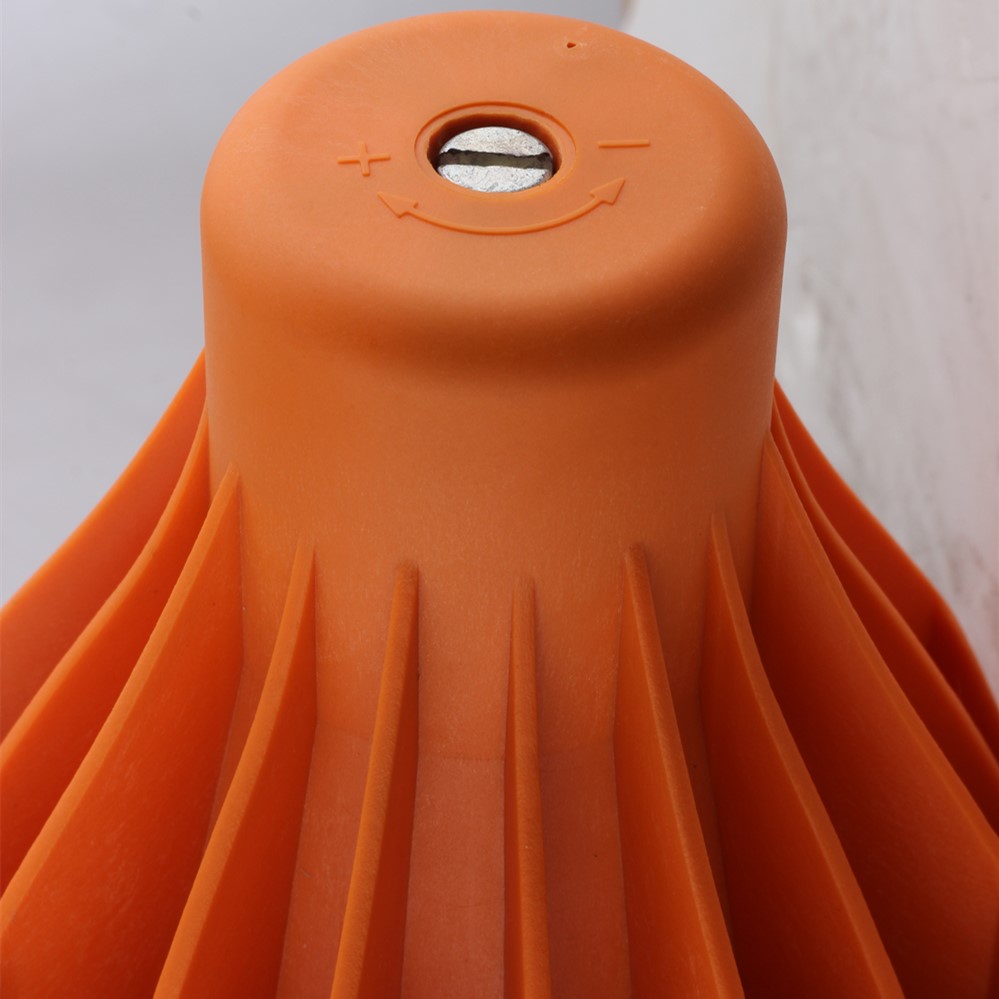
Starting pressure is set against the pump curve: a 1.2 bar setting corresponds to roughly 12 m of usable water height and requires at least 20 m of pump lift.
Where These Controllers Fit
- Domestic and residential water supply. The documented application scenario runs at 220-240V or 110-120V, 0.5-10 bar, maximum working temperature 55°C, IP65 protection, with clean water as the working medium and automatic pump start/stop as the function.
- Non-tower and booster systems. The EPC-14 is described as mainly used for non-tower water supply, with the same conventional electronic pressure switch function; the EPC-1.1 and EPC-3 carry the same run-dry logic into compact housings.
- Surface or submersible pumps. Both the EPC-1.1 and EPC-3 are listed as usable with either pump type, which matters because a submersible set gives no visual warning of a falling water table.
- Agriculture irrigation, water treatment and construction. These are the industries listed for the EPC and KRS ranges, where pumps often run unattended and a dry run is only discovered on the next visit.
- Intermittent-supply and hard-water regions. Dry running is routine where supply is irregular. The residential water supply scenario is documented for markets including Algeria, Egypt and Germany, and Monro exports to Asia, Europe, North and South America, the Middle East and Africa.
Comparison Table: Mechanical Pressure Control vs. Float Switch vs. Electronic Controller
| What you are comparing | Mechanical pressure control (KRS-1) | Float switch (FPS-1 / FPS-5) | Electronic pump controller (EPC-1.1 / EPC-3) |
|---|---|---|---|
| What it responds to | System pressure at its own port; starts and stops the pump at the set pressure | Liquid level at the point of installation | Pressure and water flow through the controller |
| Built-in run-dry protection | Not listed in the KRS-1 specification | Not listed in the FPS-1 or FPS-5 specification | Built-in on both the EPC-1.1 and EPC-3 |
| Protection rating | IP20 | IP68 | IP65 |
| Maximum working temperature | 55°C | 55°C (FPS-1); 0-50°C operating (FPS-5) | 55°C |
| Setting method | Adjustable pressure range, e.g. 20-40, 30-50, 40-60 PSI | Level position, fixed by mounting point | Starting pressure 1.2 bar, 1.5 bar or 2.2 bar; adjustable 1.2-2.5 bar on EPC-1.1 |
| Additional built-in functions | Single and double contacts available (KRS range) | Auto fill, auto drain and combined modes (FPS-1) | Check valve, constant pressure at constant flow, triple voltage, pressure gauge on EPC-3 |
| Typical fit | Simple start/stop control where water supply is reliable | Tank filling, drainage and level alarms | Unattended or intermittent supply where a seized pump is the main risk |
The table is a scope comparison, not a ranking. A KRS-1 or an FPS-1 does exactly what it is specified to do; the question is whether that specification covers the failure you have actually experienced.
What to Confirm Before You Order
For a specification that will survive installation, confirm these points on the quotation rather than after delivery:
- Model, starting pressure and maximum power — for example EPC-3 at 1.5 bar with a maximum power of 1.1kW, or EPC-1.1 at 1.2 bar with a maximum power of 0.75kW.
- Thread and voltage — G1-inch, G1 1/4-inch, G1 1/2-inch or NPT1-inch on the EPC-1.1; 220-240V, 110-120V or, on the EPC-1.1 and EPC-3 platform, triple voltage of 110V, 230V or 110-240V.
- Commercial terms — Monro Switch lists a MOQ of 204 pcs and a lead time of 45 days, with 100% testing and a one-year warranty supported by remote support.
- Customisation scope — OEM options cover cable length, cable material, brand customisation, colour box customisation and colour customisation.
- Capacity behind the order — monthly capacity is 180,000 pcs for automatic pump control (EPC series), 250,000 pcs for pressure switches (KRS series) and 30,000 pcs for float switches and liquid level control (FPS and STSW series).
- Quality and compliance evidence — a complete ISO 9001:2015 quality management system, TUV (Germany) and CE (Europe) certifications, with select models also approved under the CUL standard.
The manufacturing base behind these numbers is a 30,000㎡ facility in Wenling City with 200 employees, 10 engineers and 90% of output exported. A recorded project in the domestic water supply segment installed 50 pressure control switches in China and has run for two years with reliable automatic pressure control.
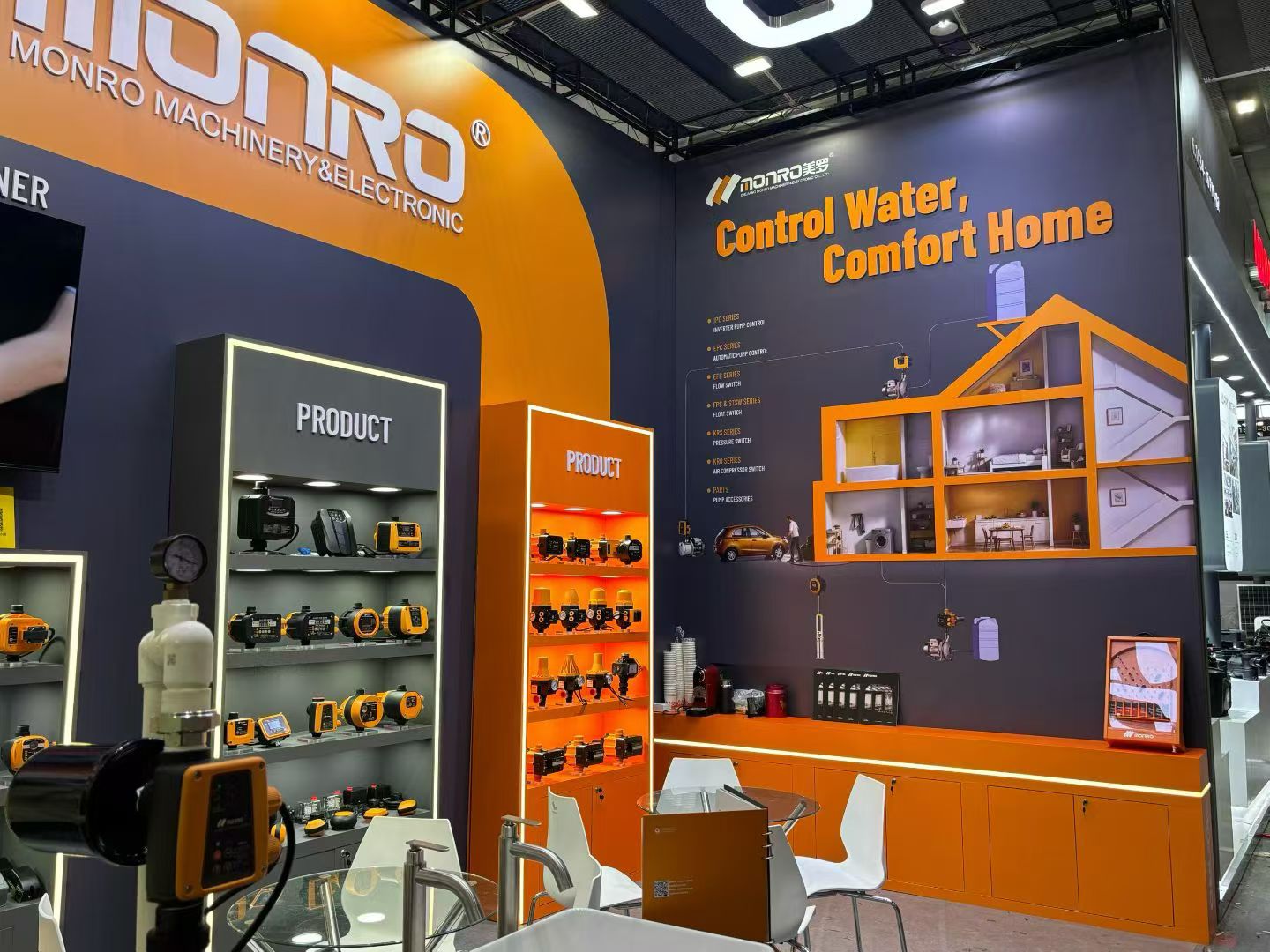
Monro Switch presents its EPC, KRS and FPS ranges at industry exhibitions; the manufacturer was officially established in 2010 and draws on more than 20 years of pressure control manufacturing experience.
FAQ
Does a pump controller with run-dry protection have to meet IEC 60730-2-6?
IEC 60730-2-6:2025 is the current international standard for automatic electrical pressure sensing controls used in, on or in association with household appliances and similar equipment. Monro Switch products hold TUV (Germany) and CE (Europe) certifications, with select models also approved under the CUL standard for the U.S. and Canada. When sourcing, ask for the certification that names the exact model and voltage variant you are buying, not only the series.
Which Monro models include integrated run-dry protection?
Built-in run-dry protection is listed for the EPC-1.1 and EPC-3, and also for the EPC-5, EPC-7, EPC-9 and EPC-19. The EPC-19 adds rotor anti-blocking protection, running the pump for 10 seconds after 24 hours of stop. The EPC-14 and EPC-14A document the operating logic in detail: when there is no water at the inlet and the controller cannot detect water flow, it turns the pump off and the failure light comes on.
What drives the cost difference between an electronic controller and a mechanical pressure switch?
The difference is scope, not marketing. An electronic controller such as the EPC-1.1 or EPC-3 combines pressure switching with flow detection, a built-in check valve, constant pressure at constant flow and IP65 protection in one housing, while a mechanical control such as the KRS-1 provides pressure switching at IP20. Commercial terms also move with the order: Monro lists a MOQ of 204 pcs, a lead time of 45 days, and OEM customisation of cable length, cable material, brand and colour box. Compare the landed cost of one seized pump against the unit difference before deciding.
Can I evaluate a sample before placing a production order?
Monro Switch maintains a sample showroom at its Wenling facility, and the production MOQ is 204 pcs. Sampling is the right stage to verify three things: that the starting pressure setting matches your pump curve, that the thread matches your pipework, and that the IP65 housing suits the installation position. Requests can be sent to sale@monro-switch.com or by phone and WhatsApp on +86 13586289715.
What is the lead time and how much capacity stands behind it?
Monro Switch lists a 45-day lead time, with monthly capacity of 180,000 pcs for automatic pump control (EPC series), 250,000 pcs for pressure switches (KRS series) and 30,000 pcs for float switches and liquid level control (FPS and STSW series). Every unit is 100% tested, and support continues after delivery through remote support and a one-year warranty. To start a sample or quotation request for the EPC-1.1 or EPC-3, contact the sales team with your starting pressure, maximum pump power, thread and voltage.
Conclusion: Stop the Pump Before the Rotor Stops It
A pump that has stopped is rarely a random event. Either water stopped arriving, or the motor has already paid for the time it kept running without it. Integrated run-dry protection in the EPC-1.1 and EPC-3 changes the outcome of the first case: the controller detects the absence of flow, switches the pump off, and indicates the failure, so the supply can be corrected instead of the pump replaced.
For buyers specifying a pressure control switch for unattended or intermittent water supply, the practical rules are short. Match the controller’s maximum power to the motor. Set starting pressure against the pump lift, remembering that the pump head must be at least 0.8 bar above start-up pressure. Choose a controller whose protection covers the failure you have actually experienced — and if the rotor has already seized once, add anti-blocking behaviour rather than another identical replacement.
Sample, Quote and Catalogue
Monro Switch supplies the EPC-1.1, EPC-3, EPC-3P and EPC-19 pump controllers with built-in run-dry protection for domestic, irrigation and water treatment systems. Send your starting pressure, maximum pump power, thread and voltage for a quotation, or request a sample for bench testing.
Email: sale@monro-switch.com · Tel / WhatsApp: +86 13586289715 · Website: www.monroswitch.com
Download the full product catalogue (PDF): Monro catalogue 2025
Have Questions or Need More Details?
Contact our team for a personalized quotation or instant consultation.
Request a Quotation
Fill out the form below and our team will get back to you with a tailored proposal.
WhatsApp Direct Chat
Prefer to chat in real-time? Message us on WhatsApp for instant assistance & quick answers.
- Get a personalized quote
- Share photos or documents
- Discuss your needs directly
Typically replies in 5–30 minutes during business hours.