
Pump Runs Dry? How a Pressure Control Switch with Run-Dry Protection Solves It
A pump that keeps running with an empty suction line will overheat, and in a domestic water system that usually ends with a damaged seal, a stuck rotor or a burnt motor. A pressure control switch with built-in run-dry protection closes that failure path: it starts and stops the pump on pipeline pressure, and when it can no longer detect water flow it switches the pump off and lights a failure signal instead of letting the motor run dry.
Monro Switch builds two models for this job, the EPC-1.1 and the EPC-3. Both combine automatic start/stop control, a built-in check valve and built-in run-dry protection in one housing rated IP65, with starting pressure settings of 1.2 bar, 1.5 bar or 2.2 bar. The EPC-3 adds a pressure gauge for real-time monitoring, which changes how the unit is commissioned and diagnosed on site.
This article explains what dry running does to a water system, why it happens in residential and light commercial installations, and how to specify, install and verify a run-dry protected controller so the protection actually works on the day the tank empties.
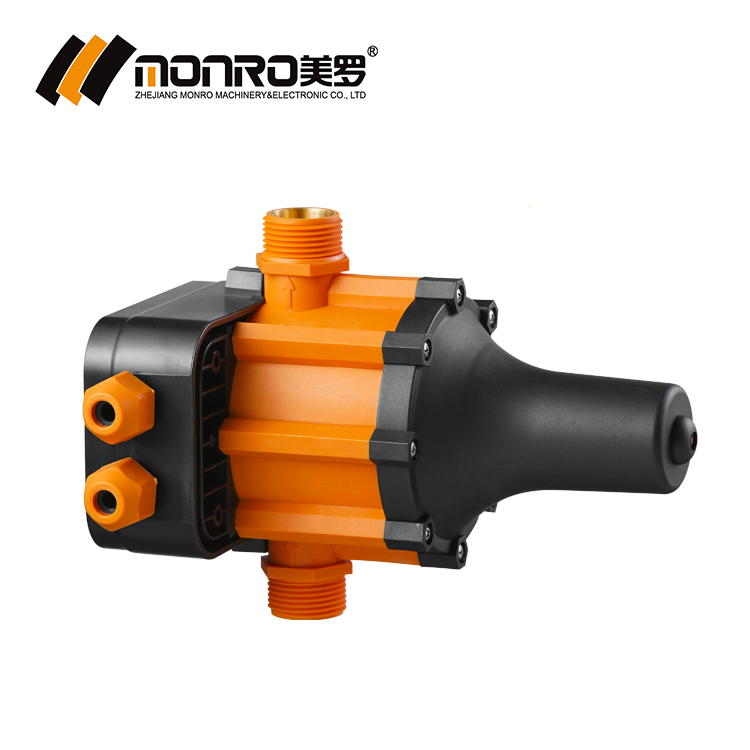
A pressure control switch sits between the pump and the pipeline, where it reads pressure and flow at the same point.
1. The Problem: What a Dry-Running Pump Does to a Domestic Water System
Dry running is not a single event; it is a period of time. A centrifugal pump that loses its water supply keeps turning, but there is nothing inside the casing to carry heat away from the shaft seal or to keep the internal clearances wetted. The longer the motor turns without water, the more heat accumulates in the seal face and the pump body. By the time a homeowner notices that the tap is sputtering, the damage is usually mechanical rather than electrical, and it is rarely covered by goodwill.
Three failure paths put a domestic pump into that condition:
- The source empties. A suction tank, cistern or shallow well falls below the suction inlet while the pump still has power. Nothing in a plain switch tells the motor that the water is gone.
- Air enters the suction line. A leaking joint, a badly seated foot valve or a vortex at low water level allows air into the casing, so the pump runs at reduced flow or no flow while the motor keeps working.
- The discharge closes while the pump still has power. A shut valve or a blocked line leaves the pump running against a closed head, circulating the same water until it heats up.
The protective response is defined by flow, not by pressure alone. Monro's product documentation for its electronic EPC controls describes it plainly: when there is no water at the inlet and the controller cannot detect water flow, it turns the pump off and the failure light comes on. That single behaviour is the difference between a controller that only automates the pump and one that protects it.
It is worth separating two jobs that are often confused. A pressure switch answers the question "is the line below the cut-in pressure?" and closes a contact. A pressure control switch with run-dry protection answers a second question as well: "is water actually moving?" The EPC-1.1 and EPC-3 are built around both questions.
2. Industry Background: Why Run-Dry Protection Is a Specification Item Now
Run-dry protection has moved from a convenience feature to a specification line because the control itself is covered by product standards. IEC 60730-2-6:2025, published by the International Electrotechnical Commission, applies to automatic electrical pressure sensing controls for household appliance and similar use — the category that includes domestic pump pressure switches. A buyer specifying a controller for a residential water system is therefore specifying a control that is assessed against a defined safety standard, not just a component that closes a contact.
For the European market the practical gateway is the EMC Directive. Monro's EPC-1, EPC-2, EPC-2.1, EPC-3, EPC-3P, EPC-4, EPC-5 and EPC-15 are covered by CE-EMC Certificate of Conformity AE505724390001, issued by TÜV Rheinland LGA Products GmbH on 17 January 2023 against Directive 2014/30/EU, listing the harmonised standards EN IEC 55014-1:2021, EN IEC 55014-2:2021, EN 61000-3-2:2019+A1 and EN 61000-3-3:2013+A1+A2. Manufacturing is covered separately by an ISO 9001:2015 certificate, number 20126Q00115R300, issued by BeiJing ZHONGRUI Unite for the manufacture of water pump pressure switch, dated 30 June 2026 and valid to 29 June 2029. The EPC-1.1 appears inside the product scope of that ISO 9001 certificate.
The category itself is large and still dominated by electromechanical designs. Fortune Business Insights valued the global pressure switch market at USD 3.2 billion in 2025. Market Research Future puts electromechanical pressure switches at approximately 62% of global market share in 2024, with solid-state electronic switches holding the remainder. For a residential installation the practical consequence is that both architectures remain on the shelf, and the choice should follow the protection requirement rather than habit: an electromechanical control automates the pump, while an electronic control with flow sensing can also refuse to run it dry.
3. The Solution: How the EPC-1.1 and EPC-3 Handle a Dry Run
3.1 Start, stop and dry-run: three states a controller has to handle
Monro's electronic control logic follows the hydraulic events in the pipeline, which is why it can distinguish a normal stop from a dry run:
- Start. When a tap is opened, the pressure in the pipe drops. When the actual pipeline pressure falls below the controller's starting pressure value, the controller starts the pump.
- Stop. When the tap is closed, the controller can no longer detect water flow, and it switches the pump off. Because the stop decision is based on flow rather than pressure alone, the pump is not held on by a trapped pressure reading.
- Dry run. When there is no water at the inlet and no flow can be detected, the controller switches the pump off and the failure light comes on. This is the state that protects the motor.
Between those states the unit maintains constant pressure at constant flow, which is the behaviour a household actually notices: the same shower pressure whether one tap or three are open. Both models are listed as suitable for surface pumps and submersible pumps, and Monro describes the installation as simple, saving time and space because the check valve and the control sit in one body.
3.2 Why the check valve belongs inside the switch
The built-in check valve is not a side benefit; it is part of how the stop logic stays stable. After the pump stops, the valve holds pressure in the pipeline instead of letting water run back through the pump. Without it, the line would bleed down immediately after every stop, the controller would read a fresh pressure drop, and the pump would be asked to start again for no reason. Holding the line also keeps the pump isolated from the pipeline while it is off, and it protects the suction side from backflow when the source level is low.
In a dry-run scenario the valve does a second job: it keeps whatever water remains in the discharge line where it is, so the controller's flow signal is not confused by reverse movement through the pump body.
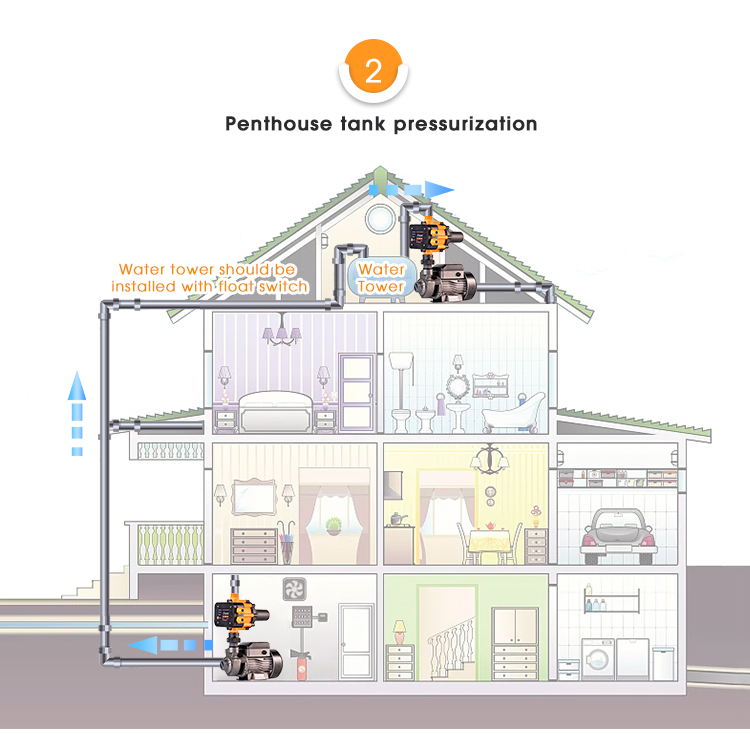
A run-dry protected controller is installed directly on the pump discharge, where pressure and flow can both be sensed.
3.3 EPC-1.1 and EPC-3: the specifications that matter
The two models share the same protection architecture, the same protection rating and the same working temperature limit. The differences that decide an order are the maximum power range, the connection thread options and the readout.
| Parameter | EPC-1.1 | EPC-3 |
|---|---|---|
| Product type | Pump pressure control | Pump pressure control |
| Rated voltage | 220–240 V / 110–120 V; triple voltage 110 V, 230 V or 110–240 V | 220–240 V / 110–120 V; triple voltage 110 V, 230 V or 110–240 V |
| Power frequency | 50/60 Hz | 50/60 Hz |
| Maximum power | 1.1 kW / 1.5 kW / 0.75 kW | 0.55 kW / 1.1 kW / 1.5 kW / 0.75 kW |
| Starting pressure settings | 1.2 bar, 1.5 bar, 2.2 bar | 1.2 bar, 1.5 bar, 2.2 bar |
| Adjustable starting pressure | 1.2–2.5 bar | Set by the 1.2 / 1.5 / 2.2 bar starting pressure options |
| Connection thread | G1", G1 1/4", G1 1/2", NPT1" | G1" |
| Protection rating | IP65 | IP65 |
| Maximum working temperature | 55 °C | 55 °C |
| Run-dry protection | Built-in | Built-in |
| Check valve | Built-in | Built-in |
| Pressure gauge | — | Built-in, for real-time pressure monitoring |
Two specification details deserve attention during evaluation. First, the IP65 rating and the 55 °C maximum working temperature are the same on both models, so the choice between them is not a choice about outdoor resilience. Second, the EPC-1.1 carries four thread options including NPT1", while the EPC-3 is offered with G1" — a difference that matters if the installation must mate with an existing US-thread fitting.
3.4 Matching maximum power and starting pressure to the pump
Run-dry protection only helps if the controller survives the motor it is switching. Monro states the selection rule directly: match the motor power of the water pump to the controller's maximum power rating, and choose a starting pressure that suits the pump lift and the maximum water use height.
For the EPC-1.1 that means a maximum power rating of 1.1 kW, 1.5 kW or 0.75 kW depending on the variant ordered; for the EPC-3 the range extends down to 0.55 kW and up to 1.5 kW. The controller's rating should be at least the pump's rated input, and the voltage variant must match the pump nameplate — 110–120 V, 220–240 V, or a triple-voltage unit covering 110 V, 230 V and 110–240 V.
The starting pressure rule follows the same logic. Monro's stated method is that the maximum water use height equals the starting pressure multiplied by 10 m, while the pump lift must be at least the starting pressure plus 0.8 bar, multiplied by 10 m. Applying that formula to the three preset settings gives a usable planning table:
| Starting pressure setting | Maximum water use height | Minimum pump lift required |
|---|---|---|
| 1.2 bar | 12 m | 20 m |
| 1.5 bar | 15 m | 23 m |
| 2.2 bar | 22 m | 30 m |
Where an installation needs a wider adjustable band than the EPC-1.1's 1.2–2.5 bar, Monro's EPC-2 series is listed with an adjustable starting pressure range of 1.5 to 3.0 bar. That model sits in the same CE-EMC certificate scope as the EPC-3, so a project that moves to a higher pressure band does not have to reopen the compliance question.
4. Step-by-Step: Installing and Commissioning a Run-Dry Protected Controller
The following sequence follows Monro's installation guidance for its automatic pump controllers. The order matters: the dry-run function cannot be verified on a system that has not been proven hydraulically first.
- Test the pump on its own. Run the pump separately to confirm it operates normally, and check that the parameters on the pump nameplate match those of the pressure controller.
- Match the power rating. Confirm that the pump's motor power is within the controller's maximum power rating — 1.1 kW / 1.5 kW / 0.75 kW for the EPC-1.1, 0.55 kW / 1.1 kW / 1.5 kW / 0.75 kW for the EPC-3 — and that the voltage variant matches the supply.
- Check the head relationship. The pump head must be at least 0.8 bar higher than the controller's start-up pressure. A 1.5 bar setting therefore needs a pump capable of roughly 23 m of lift.
- Set the starting pressure. Choose 1.2 bar, 1.5 bar or 2.2 bar to suit the building height and the pump curve. On the EPC-1.1 the starting pressure is adjustable across 1.2–2.5 bar; on both models it is set with a screwdriver on the adjusting screw.
- Install in the direction of the arrow. Mount the controller according to the arrow indicated on its housing, on the pump discharge, so that the built-in check valve sits downstream of the pump.
- Wire with sealed joints. Connect the power cord of the controller to a separate plug wire, and wrap the connection securely with waterproof insulating tape so that the joint stays sealed in a wet plant room.
- Open the line before switching on. After all electrical connections are complete, open the main outlet valve and all water faucets first, then connect the power supply. The controller will then begin operation against an open line rather than a closed one.
- Verify the readings. On the EPC-3, read the built-in gauge to confirm that the pump reaches cut-out pressure and that the line holds after the pump stops. On the EPC-1.1, use an external gauge at the same tapping point.
Verification of the run-dry function is the last step, not the first. Simulating a no-flow condition on a pressurised system can damage a pump if it is done carelessly, so confirm the test method with Monro's technical support before running it — remote support is part of the after-sales arrangement, alongside a one-year warranty.
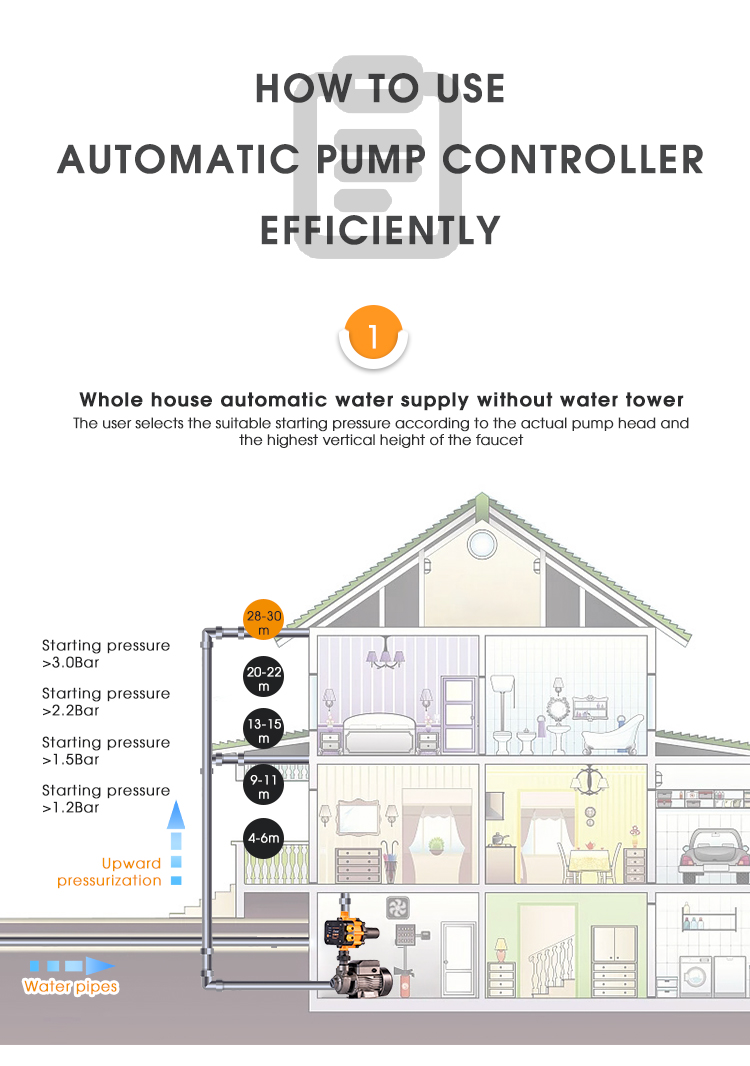
Commissioning follows the hydraulic check, not the other way round: pump, head, starting pressure, wiring, then verification.
5. Use Cases: Where the EPC-1.1 and EPC-3 Fit
Residential water supply from a tank that can run low. The application Monro documents for its pressure controls is domestic and residential water supply with automatic pump start/stop control, working with clean water at 0.5–10 bar. In a house fed from a roof tank or a ground cistern, the tank is emptied by normal use, not by a fault — which is exactly the condition a run-dry protected controller is built for.
Surface pumps with suction lift. A surface pump drawing from a well or a sump is the most exposed to air ingress, because every joint on the suction side is a potential leak. Both the EPC-1.1 and the EPC-3 are listed for surface pumps, and the flow-based stop logic reacts to the loss of flow that follows air entry.
Submersible pumps in low-yield boreholes. Both models are also listed for submersible pumps. Where a borehole recharges slowly, the pump may empty the standing water column before the aquifer recovers; built-in run-dry protection stops the motor instead of letting it spin in air.
Installations that need a visible pressure reading. The EPC-3 carries a pressure gauge for real-time pressure monitoring. On a plant room wall or a skid where a technician has to confirm cut-in and cut-out without unpacking a test gauge, that readout shortens commissioning and makes a slow leak visible before it becomes a dry run.
Export orders with mixed voltage requirements. Because the triple-voltage version covers 110 V, 230 V and 110–240 V, one model family can serve markets with different supply standards — useful for importers and distributors who do not want three separate stock lines. The EPC-1.1 additionally offers G1", G1 1/4", G1 1/2" and NPT1" connections for markets where the fitting standard differs.
6. Comparison Table: EPC-1.1 vs EPC-3 for Dry-Run Protection
Both models solve the same problem. The table below isolates the decision criteria a buyer actually weighs.
| Decision criterion | EPC-1.1 | EPC-3 |
|---|---|---|
| Best fit | Installations needing NPT or larger thread options and adjustable starting pressure up to 2.5 bar | Installations where the operator needs a gauge reading at the controller |
| Maximum power coverage | 0.75 kW to 1.5 kW | 0.55 kW to 1.5 kW |
| Thread flexibility | G1", G1 1/4", G1 1/2", NPT1" | G1" |
| Pressure readout | External gauge required | Built-in gauge |
| Run-dry protection | Built-in | Built-in |
| Check valve | Built-in | Built-in |
| IP rating / max. temperature | IP65 / 55 °C | IP65 / 55 °C |
| EU compliance route | ISO 9001:2015 certificate scope; CE-EMC certificate covers the EPC-1 model | CE-EMC Certificate of Conformity AE505724390001 |
Where the pump is at the smaller end of the range and a gauge is useful, the EPC-3 is the simpler specification. Where the connection must be NPT or 1 1/4" and the starting pressure has to be trimmed across a band, the EPC-1.1 is the more flexible choice.
7. FAQ
Which Monro pressure control switches are CE-certified for EU installation?
The EPC-1, EPC-2, EPC-2.1, EPC-3, EPC-3P, EPC-4, EPC-5 and EPC-15 are covered by CE-EMC Certificate of Conformity AE505724390001, issued by TÜV Rheinland LGA Products GmbH on 17 January 2023 against Directive 2014/30/EU, with the standards EN IEC 55014-1:2021, EN IEC 55014-2:2021, EN 61000-3-2:2019+A1 and EN 61000-3-3:2013+A1+A2 listed in the certificate. The EPC-1.1 falls within the scope of Monro's ISO 9001:2015 certificate 20126Q00115R300. Separately, TÜV Rheinland Safety Certification R 50175890 covers the EPC-10, EPC-12, EPC-14 and EPC-16 against EN 60730-1:2016+A1+A2 and EN 60730-2-6:2016+A1. Buyers should check the exact model listed on the certificate before placing an order.
How does a pressure control switch detect that the pump is running dry?
The controller works from two signals rather than one. It starts and stops the pump according to pipeline pressure, and it uses water flow to decide when to stop. In Monro's electronic EPC controls, when there is no water at the inlet and the controller cannot detect water flow, it turns the pump off and the failure light comes on. Because the stop decision is flow-based, a closed tap and a dry suction line are treated as different conditions — the first is a normal stop, the second triggers the protection.
What drives the cost of a run-dry protected pressure control switch?
Four variables dominate: the model and its maximum power rating, the voltage variant (110–120 V, 220–240 V or triple voltage), the connection thread, and whether a pressure gauge is included as on the EPC-3. Customization adds further variables — Monro offers cable length, cable material, brand customization, colour box customization and colour customization as OEM options. Order quantity matters as well: the minimum order quantity is 204 pcs and the standard lead time is 45 days. A firm quotation therefore needs the model, voltage, thread, starting pressure and quantity together.
Can I evaluate a sample before committing to a production order?
Sample and quotation requests are handled through Monro's sales contact, and the fastest route is to specify the configuration up front: model (EPC-1.1 or EPC-3), voltage variant, connection thread, starting pressure setting and expected quantity. That information allows the configuration to be confirmed against the certificate scope and the power rating before anything is shipped. After-sales support is provided remotely, with a one-year warranty.
What lead time and production capacity should a buyer plan for?
The standard lead time is 45 days, with a minimum order quantity of 204 pcs. Production capacity is stated as 180,000 pcs per month for the EPC automatic pump control series and 250,000 pcs per month for the KRS pressure switch series, with annual output of 2.88 million pcs for the EPC series. For a project schedule, that means the order window should be opened at least six weeks before the installation date. To start a specification or request the full range, send the pump details to sale@monro-switch.com or download the Monro catalogue 2025.
8. Conclusion: Protection Is a Specification, Not an Accessory
A dry run is predictable. The tank empties, the suction line draws air, or a valve closes while the pump still has power — and the motor keeps turning until something fails. A pressure control switch with built-in run-dry protection changes the outcome by adding a flow test to the pressure test: the pump is stopped and a failure light is shown before the seal and the windings take the damage.
The EPC-1.1 and EPC-3 both deliver that protection with a built-in check valve, IP65 protection, a 55 °C maximum working temperature and starting pressure settings of 1.2, 1.5 or 2.2 bar. The selection work then narrows to three checks: match the maximum power rating to the pump's motor, confirm the pump head sits at least 0.8 bar above the starting pressure, and choose the model whose thread options and readout suit the installation — G1", G1 1/4", G1 1/2" or NPT1" with the EPC-1.1, or the EPC-3 with its built-in gauge.
Monro Switch — Zhejiang Monro Machinery & Electronic Co., Ltd. — is a manufacturer of pump controllers, pressure switches and float switches based in Wenling City, Zhejiang Province, China. Officially established in 2010 and drawing on more than 20 years of manufacturing experience in pressure controls and float switches, the company runs a 30,000 m² facility with 200 employees and a 10-engineer R&D team, offers more than 40 models of pressure controllers for water pump systems and air compressors, and exports about 90% of its output to Asia, Europe, North and South America, the Middle East and Africa.
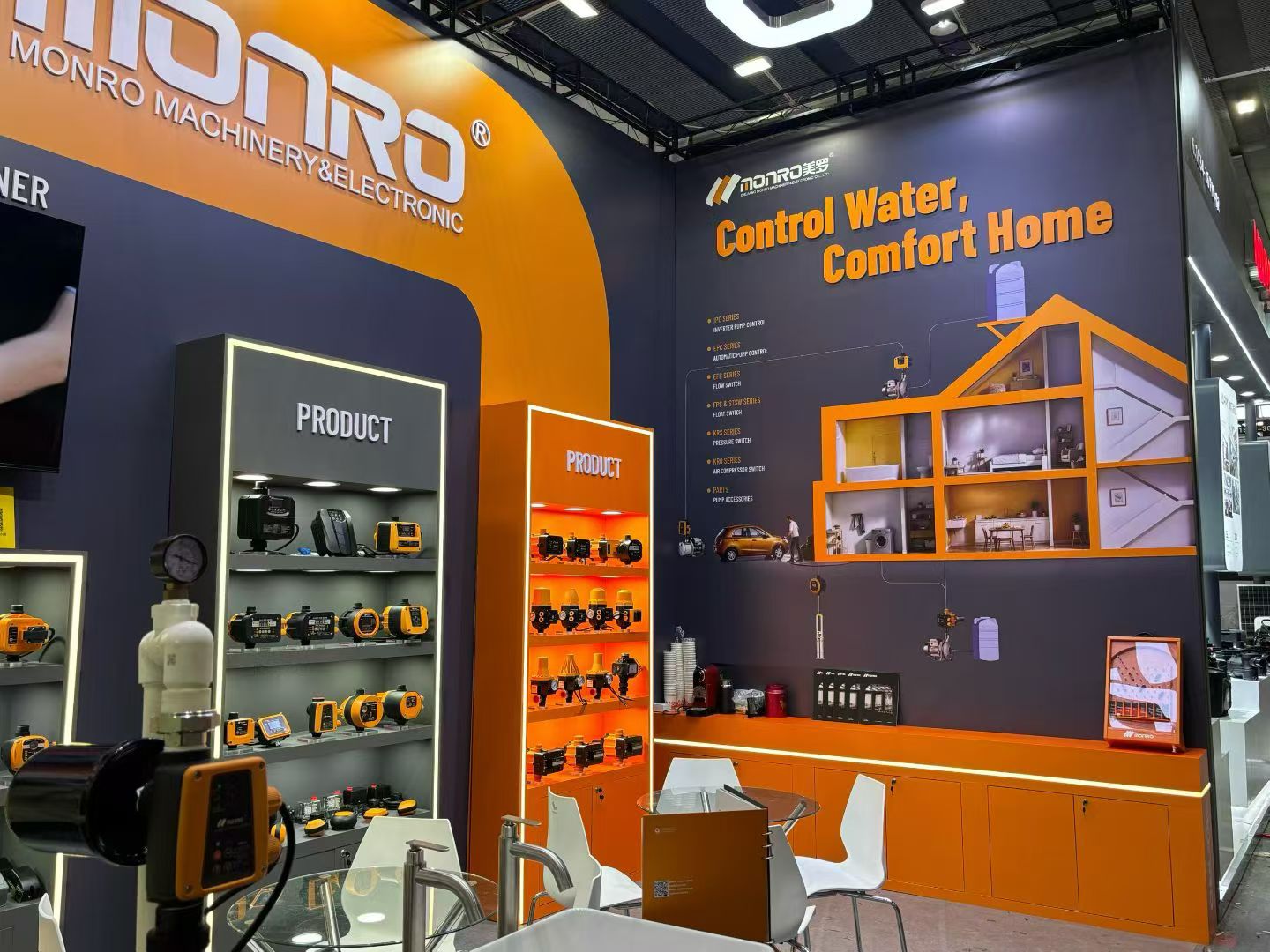
Monro Switch at an industry exhibition — the EPC series is presented alongside the KRS pressure switch and FPS float switch ranges.
Next step: match the controller to the pump
Send the pump nameplate details — motor power, voltage, required starting pressure and connection thread — and Monro will confirm which configuration fits: EPC-1.1 for NPT and multi-thread installations, or EPC-3 where a built-in pressure gauge is needed. Samples, quotations and the full catalogue are available on request.
Contact: Mable · sale@monro-switch.com · Tel / WhatsApp +86 13586289715 · Chat on WhatsApp
Address: No.2, 25th Street Eastern New City, Wenling City, Zhejiang Province, China · www.monroswitch.com
Catalogue:Monro catalogue 2025 (PDF)
Have Questions or Need More Details?
Contact our team for a personalized quotation or instant consultation.
Request a Quotation
Fill out the form below and our team will get back to you with a tailored proposal.
WhatsApp Direct Chat
Prefer to chat in real-time? Message us on WhatsApp for instant assistance & quick answers.
- Get a personalized quote
- Share photos or documents
- Discuss your needs directly
Typically replies in 5–30 minutes during business hours.