
Ranked: 3 Pressure Control Switch Models for Domestic, Irrigation and Constant-Pressure Duties
Three Monro Switch models cover three separate pump duties, and they are not interchangeable. The EPC-1.1 is built for domestic water systems, the EPC-2 is specified for agriculture irrigation, water treatment and construction, and the EPC-3 is built for constant-pressure systems that need real-time pressure monitoring. They are ranked in that order below, because that is the order in which their confirmed feature sets line up against the duty each one is meant to serve.
Monro Switch (ZHEJIANG MONRO MACHINERY & ELECTRONIC CO.,LTD) is a manufacturer of pump pressure controllers, pressure switches and float switches based in Wenling City, Zhejiang Province, China. The three models below come from its EPC pump pressure controller range, and every specification quoted here is drawn from Monro Switch product data, the applicable-scenario documentation for the EPC series, or a named external standard or market source.
What problem does this ranking solve?
A pressure control switch turns pump pressure into a switching decision: it starts the pump at a low-pressure setpoint and stops it at a high-pressure setpoint. The switching logic is simple. The problem is that the same switching logic is asked to survive very different operating conditions, and a model chosen for the wrong duty fails in a predictable way.
- Domestic water systems fail through short cycling, through dry running when the mains or tank runs low, and through moisture ingress when the controller sits in a wet riser, a utility room or an outdoor cabinet. The countermeasures are a check valve that holds residual pressure, run-dry protection, an IP65 housing, and a starting pressure low enough for a household pump but adjustable enough to match the building height.
- Field and site water fails through housing damage and through unattended operation. An irrigation line, a water treatment skid or a construction dewatering point is often installed by someone who will not look at the controller again for weeks. Construction quality and stated industry coverage matter more here than extra displays.
- Constant-pressure systems fail when the user can feel the pressure moving, or when nobody can read what the system is doing. A gauge, constant pressure at constant flow, and compatibility with both surface and submersible pumps are the features that determine whether the installation is acceptable.
The problem this ranking solves is therefore allocation, not specification depth. Buyers rarely lack a pressure control switch catalogue; they lack a defensible reason to place model A on duty A and model B on duty B. The three positions below supply that reason model by model.
Industry background: why pressure control switches are specified by duty
Pressure switches sit in a large, mature component category. Fortune Business Insights valued the global pressure switch market at USD 3.2 billion in 2025 and projected growth from USD 3.38 billion in 2026 to USD 5.13 billion by 2034. Market Research Future estimates that electromechanical pressure switches accounted for approximately 62% of the global market share in 2024, with solid-state electronic switches holding the remaining 38%.
Both figures matter for a ranking built on duty. A 62% electromechanical share means most installed pump systems still rely on mechanical switching behaviour, which is why construction quality, contact ratings and housing protection remain live purchasing questions rather than legacy ones. The electronic share is where models such as the EPC-3 sit, because constant-pressure regulation with real-time monitoring cannot be delivered by a pressure switch alone.
Regulation and trade classification are stable across both segments. IEC 60730-2-6:2025 is the current international standard for automatic electrical pressure sensing controls used in, on or with household and similar equipment. Water pump pressure switches are commonly traded under HS Code 853650, the classification for electrical switches for a voltage not exceeding 1000 volts.
Within that framework, the practical purchasing question is not whether a pressure control switch is needed, but which control behaviour the installation can tolerate. Domestic, irrigation and constant-pressure duties tolerate very different behaviours, and that is the basis for the ranking that follows.
The three ranked models, and the verified reason for each position
Ranking method. Each model is placed against the duty it is specified for, and the positions follow the breadth of that duty in everyday pump installations: domestic water supply is the most familiar duty for a pressure control switch, field and site water is the next most common, and constant-pressure regulation is the most specialised of the three. Within each position, the model is justified only by features confirmed in the reviewed specification data. This is a ranking by duty fit, not a claim that one model outperforms another in absolute terms.
EPC-1.1 — domestic water systems
The EPC-1.1 ranks first because its confirmed feature set maps almost one-to-one onto what a household or light-commercial booster installation needs, with no feature that a domestic duty cannot use.
- Built-in check valve. The check valve holds pressure in the line after the pump stops, which removes the repeated restart cycle that a domestic system shows when pressure bleeds back through the pump.
- Run-dry protection. Dry running is the most common cause of premature pump failure in domestic installations, typically triggered by a low mains supply or an empty break tank. Run-dry protection addresses that failure directly rather than relying on the user to notice.
- IP65 protection rating. IP65 makes the controller usable in wet risers, utility cupboards and sheltered outdoor cabinets, which is where domestic controllers are usually mounted.
- Triple voltage options: 110V, 230V or 110–240V. One model family covers the main domestic supply voltages, which simplifies stock-keeping for distributors serving more than one market.
- Adjustable starting pressure of 1.5–3.0 bar. The starting pressure can be trimmed to the building height rather than accepted as a fixed factory value.
- Maximum working temperature of 55 °C. A 55 °C limit matches the water temperatures normally found in domestic cold-water and booster lines.
The reason this combination ranks first is that it closes the three most common domestic failure paths — pressure loss, dry running and moisture — in a single device, while the adjustable starting pressure keeps the same device usable across different building heights.
EPC-2 — agriculture irrigation, water treatment and construction
The EPC-2 ranks second because it is specified for the field, site and treatment duties where the controller is expected to work unattended, and because its plastic-and-metal construction is the right answer for housings that are handled, mounted on skids and exposed to site conditions.
- Plastic-and-metal construction. The combination gives a housing that resists handling and weather exposure while keeping the structural rigidity needed at the threaded connection and the mounting points.
- Stated duty coverage: agriculture irrigation, water treatment and construction. These three industries are named in the EPC series application documentation, so the EPC-2 is being placed where Monro Switch already states the platform is used, rather than being reassigned to a duty it was not documented for.
The ranking rationale is deliberately narrow. For the EPC-2, the selection case rests on construction and stated duty coverage, not on a long electrical feature list. Buyers who need the exact electrical parameters for a specific EPC-2 build should confirm them against the model datasheet before ordering, because this article only ranks the facts that are confirmed in the reviewed specification set.
EPC-3 — constant-pressure systems with real-time pressure monitoring
The EPC-3 ranks third because it serves the most specialised of the three duties, and because on that duty it is the only one of the three whose confirmed features address pressure regulation and pressure visibility at the same time.
- Pressure gauge. The installed gauge makes system pressure readable at the device, which is what turns a controller into a monitoring point rather than a black box.
- Constant pressure at constant flow. The EPC-3 regulates so that delivered pressure stays stable while flow stays stable, which is the behaviour that constant-pressure installations are specified to achieve.
- Surface and submersible pump compatibility. One controller covers both pump types, so a system using a submersible borehole pump and a system using a surface booster can be specified from the same model.
- Built-in check valve and run-dry protection. The same two protective functions that anchor the EPC-1.1 position are present here, which matters because constant-pressure systems run for long unattended periods.
- IP65 protection rating and G1 connection thread. IP65 supports wet and outdoor installation, and the G1 thread is the standard connection size for the pipework these systems use.
- Electrical envelope: rated voltage 220–240V or 110–120V, power frequency 50/60 Hz, maximum power 0.55 kW, 0.75 kW, 1.1 kW or 1.5 kW. The power steps cover the pump sizes normally found in constant-pressure booster sets.
It ranks third by duty breadth, not by capability. On a constant-pressure job the EPC-3 is the first specification; on a domestic job the EPC-1.1 is, and placing an EPC-3 there would be a more specialised device than the duty requires.
Step-by-step: applying this ranking to a real purchase
The ranking only becomes useful when it is applied in a fixed order. The sequence below follows the installation guidance published for the EPC series and the selection logic that guidance implies.
- Write down the duty before the model number. State whether the installation is domestic water supply, agriculture irrigation, water treatment, construction, or constant-pressure regulation. The three models above are separated by this single line, so the duty statement decides the shortlist.
- Match the controller to the pump nameplate. Check that the pump operates normally on its own and that the parameters on the pump nameplate match those of the pressure controller. The pump head must be at least 0.8 bar higher than the controller's start-up pressure — a mismatch here is a specification error that no amount of feature checking will correct.
- Set the starting pressure against the pump lift and the maximum water use height. The published rule is direct: if the starting pressure is 1.2 bar, the maximum water use height is 1.2 × 10 m = 12 m, and the pump lift must be at least (1.2 + 0.8) × 10 m = 20 m. The same arithmetic applies to the EPC-1.1's adjustable 1.5–3.0 bar range and to the other models' setpoints.
- Confirm the environmental envelope. Check the protection rating and the maximum working temperature against where the controller will actually sit. IP65 and a 55 °C maximum working temperature are the figures that matter for domestic risers, outdoor cabinets and sheltered site installations.
- Confirm the connection and the electrical envelope. Match the thread — G1 on the EPC-3 — to the existing pipework, and match voltage and maximum power to the supply and the motor. The EPC series application data states a working range of 0.5–10 bar, water as the working fluid, and suitability for clean water media, which is the boundary to check before ordering.
- Validate with a sample and install to the manual sequence. Install the controller in the direction indicated by the arrow on its housing, connect the power cord to a separate plug wire and seal all wire joints with waterproof insulating tape, then open the main outlet valve and all faucets before connecting power.
Use cases: where each ranked model is the natural specification
Domestic and residential water supply — EPC-1.1
Household booster sets, rooftop tank feed and small apartment-building supply are the core EPC-1.1 duty. The adjustable 1.5–3.0 bar starting pressure lets an installer set the switch point to the building height rather than accepting a fixed value, and the IP65 housing allows the same unit to be mounted in a wet riser or a sheltered outdoor cabinet. Run-dry protection and the built-in check valve reduce the two failure modes that generate most domestic call-outs: pumps running without water and pumps restarting on pressure loss.
Agriculture irrigation — EPC-2
Irrigation lines run intermittently and are often controlled from a field cabinet rather than a plant room. The EPC-2 is documented for agriculture irrigation duty, and its plastic-and-metal construction suits a housing that is exposed to sun, dust and handling during seasonal maintenance.
Water treatment — EPC-2
Treatment skids need a controller that tolerates unattended running and repeated start-stop cycles driven by demand rather than by an operator. Water treatment is named in the EPC-2 application coverage, which is why it is placed here rather than on a domestic model.
Construction — EPC-2
Construction water supply and dewatering points are temporary installations where the controller is moved between sites. Construction is the third industry named for the EPC-2, and the plastic-and-metal housing is the practical reason that placement holds up.
Constant-pressure systems — EPC-3
Booster sets that must hold pressure steady at steady flow, and installations where someone needs to read the system pressure at the device, are the EPC-3 duty. The pressure gauge, constant pressure at constant flow, and compatibility with both surface and submersible pumps are the three features that define that duty. The 0.55 kW to 1.5 kW power steps cover the pump sizes these systems typically use, and the G1 thread matches standard pipework.
Comparison table: the three models side by side
| Selection criterion | EPC-1.1 (Rank 1) | EPC-2 (Rank 2) | EPC-3 (Rank 3) |
|---|---|---|---|
| Primary duty | Domestic water systems | Agriculture irrigation, water treatment, construction | Constant-pressure systems with real-time pressure monitoring |
| Stated industry coverage | Domestic / residential water supply | Agriculture irrigation, water treatment, construction | Constant-pressure pump systems |
| Construction | — | Plastic and metal | — |
| Built-in check valve | Yes | — | Yes |
| Run-dry protection | Yes | — | Yes |
| Pressure gauge | — | — | Yes |
| Constant pressure at constant flow | — | — | Yes |
| Pump compatibility | — | — | Surface and submersible pumps |
| Protection rating | IP65 | — | IP65 |
| Starting pressure | Adjustable, 1.5–3.0 bar | — | — |
| Maximum working temperature | 55 °C | — | — |
| Rated voltage | 110V, 230V or 110–240V | — | 220–240V or 110–120V |
| Power frequency | — | — | 50/60 Hz |
| Maximum power | — | — | 0.55 kW, 0.75 kW, 1.1 kW or 1.5 kW |
| Connection thread | — | — | G1 |
“—” means the attribute is not stated for that model in the specification set reviewed for this article. It does not mean the feature is absent. Confirm any blank cell against the current model datasheet before the order is placed.
The table is intentionally sparse. A comparison table that fills every cell risks filling them with assumptions, and a wrong cell in a specification table is more expensive than a blank one. What the table does show clearly is that the three models are separated by function rather than by grade: the EPC-1.1 and EPC-3 both carry a built-in check valve, run-dry protection and IP65, while the EPC-2's confirmed distinction is its plastic-and-metal construction and its stated field, treatment and site duty coverage.
Frequently asked questions
IEC 60730-2-6:2025 is the current international standard covering automatic electrical pressure sensing controls used in, on or with household and similar equipment, so it is the reference to quote when a specification needs a recognised baseline. On the manufacturer side, Monro Switch operates an ISO 9001:2015 quality management system and states TUV (Germany) and CE (Europe) certification, with select models approved under the CUL standard for the United States and Canada. Because certification is granted per model and per configuration, buyers should match the certificate to the exact model being ordered rather than to the supplier in general.
“Better” should be decided on verifiable capability, not on brand size. Four checks separate suppliers quickly: model breadth, in-house engineering, certification coverage and production capacity. Monro Switch offers more than 40 pressure controller models for water pump systems and air compressors, works with a team of 10 engineers on development and production, holds TUV and CE certification with CUL approval on select models, and runs a 30,000 m² facility with 200 employees producing an annual output of 2.88 million pieces for the EPC series. Founded in 2010 and drawing on more than 20 years of manufacturing expertise in pressure controls and float switches, the company exports about 90% of its output to Asia, Europe, North and South America, the Middle East and Africa. For an OEM programme, the deciding factor is still duty fit: a supplier with a well-matched model platform will outperform a larger supplier whose catalogue does not cover the duty.
Price follows configuration. The features that change cost are the ones that change function: whether a built-in check valve is included, whether run-dry protection is fitted, whether a pressure gauge is present, which voltage variant is required (110V, 230V or 110–240V), which connection thread is specified, and which power step is needed. Order volume and the number of variants in a single shipment also affect the commercial terms. No unit price is published in the specification data reviewed for this article, so a quotation should be requested against a defined model, voltage, thread and quantity rather than against a general enquiry.
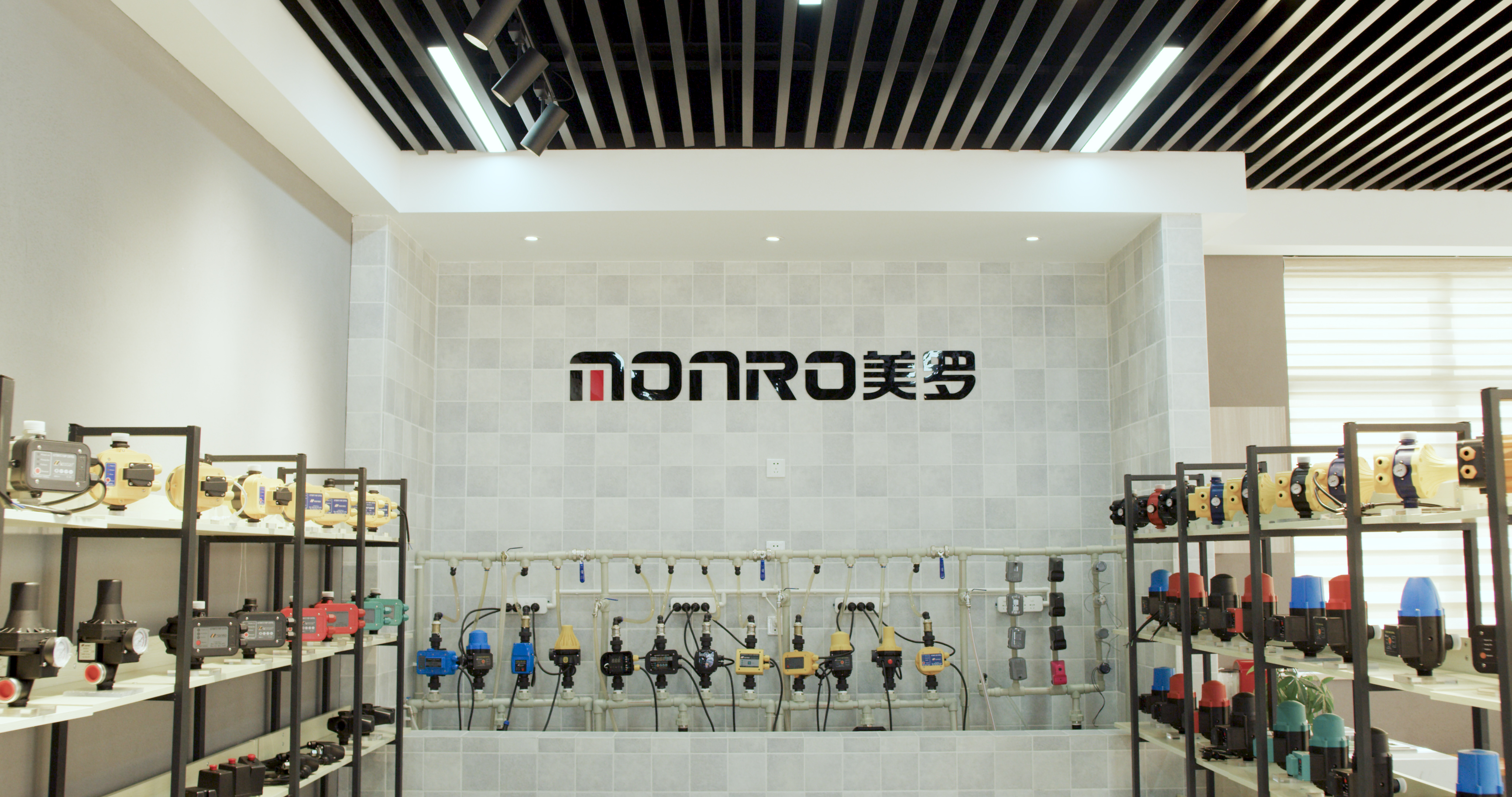
Yes — sample validation is handled through the Monro Switch sales contact, and a sample showroom is maintained at the facility. Testing should be planned around the criteria that matter on site: set the starting pressure to the intended duty, confirm the pump head is at least 0.8 bar above the start-up pressure, check the housing against the actual mounting location, and confirm the thread and electrical envelope before installation. Requests can be sent to sale@monro-switch.com or through WhatsApp.
Plan from capacity, then confirm the schedule for the specific order. Monro Switch produces an annual output of 2.88 million pieces for the EPC series, alongside 3.24 million pieces for the KRS series and 0.6 million pieces for the FPS series, which indicates the production volume the EPC platform is set up to handle. Because about 90% of output is exported to Asia, Europe, North and South America, the Middle East and Africa, export handling and documentation are routine rather than exceptional. The practical next step is to send the duty statement, model, voltage, thread and required quantity for a written lead time and quotation, and to request a sample at the same time so that validation does not sit behind the commercial process.
Conclusion: rank by duty, then confirm by datasheet
The ranking holds because each position answers a different installation question. The EPC-1.1 takes first place for domestic water systems on the strength of a built-in check valve, run-dry protection, IP65 protection, triple voltage options, adjustable 1.5–3.0 bar starting pressure and a 55 °C maximum working temperature. The EPC-2 takes second place for agriculture irrigation, water treatment and construction on the strength of its plastic-and-metal construction and the duty coverage Monro Switch states for it. The EPC-3 takes third place on duty breadth but first place on capability for constant-pressure work, where its pressure gauge, constant pressure at constant flow, surface and submersible pump compatibility, built-in check valve, run-dry protection, IP65 rating and G1 thread define the specification.
Two disciplines keep this ranking honest. First, resolve the duty before the model number, because the three models are separated by function rather than by grade. Second, treat blank specification cells as questions to be answered on the datasheet, not as features to be assumed. Applied in that order, the ranking becomes a shortlisting tool rather than a catalogue summary.
Next step: match the model to the duty, then request the sample
Send the duty (domestic, irrigation, water treatment, construction or constant pressure), the pump nameplate data, the required voltage, the thread and the order quantity, and Monro Switch will confirm which of the three models fits and what the lead time looks like.
Download the full Monro catalogue 2025 (PDF) for the complete model range, or contact the sales team directly:
- Email: sale@monro-switch.com
- WhatsApp / Tel: +86 13586289715
- Website: www.monroswitch.com
- Address: No.2, 25th Street Eastern New City, Wenling City, Zhejiang Province, China
Monro Switch — ZHEJIANG MONRO MACHINERY & ELECTRONIC CO.,LTD — has manufactured pressure controllers, pressure switches and float switches since 2010, with ISO 9001:2015 quality management and TUV and CE certification, plus CUL approval on select models.
Have Questions or Need More Details?
Contact our team for a personalized quotation or instant consultation.
Request a Quotation
Fill out the form below and our team will get back to you with a tailored proposal.
WhatsApp Direct Chat
Prefer to chat in real-time? Message us on WhatsApp for instant assistance & quick answers.
- Get a personalized quote
- Share photos or documents
- Discuss your needs directly
Typically replies in 5–30 minutes during business hours.