
Pressure Control Switch Technical Guide: Starting Pressure, Power, Voltage, Thread & IP Parameters
Pressure Control Switch Technical Guide: Starting Pressure, Power, Voltage, Thread & IP Parameters
This guide is written for the person who has to convert a pump curve and a site condition into an orderable part number: an importer building a private-label range, a distributor holding stock across 110 V and 230 V markets, or a project buyer specifying a booster set for a residential building. It does not discuss pressure control in general terms. It works parameter by parameter, and it states the values that are actually documented on the models cited.
Monro Switch (ZHEJIANG MONRO MACHINERY & ELECTRONIC CO., LTD) designs and manufactures pump controllers, pressure switches and float switches in Wenling City, Zhejiang Province, China. The company was established in 2010, operates a 30,000 m² facility with approximately 200 employees, and exports around 90% of its output to Asia, Europe, North and South America, and the Middle East and Africa. The EPC pump pressure switch family referenced throughout this guide — including models such as EPC-1.1, EPC-2, EPC-2.1 and EPC-3 through EPC-19 — is the practical source of the parameter values below. Official site: www.monroswitch.com.
Problem Definition: Why Five Parameters Decide the Fit
A pressure control switch does not fail randomly in the field. It fails against a specific parameter that was never checked at the order stage. Four patterns account for most commissioning problems:
- Short cycling. The starting pressure sits too close to the pump's shut-off head, so the pump reaches cut-out almost immediately after start and the controller re-triggers within seconds. The documented rule is simple: the pump head must be at least 0.8 bar higher than the controller's start-up pressure.
- Overload trips. The controller's maximum power rating is below the pump motor's rated power, so the switching path is asked to carry current it was not specified for.
- Thread mismatch and rework. The controller connection does not match the system thread, and the installer compensates with adaptors and sealant rather than the correct specification.
- Moisture ingress or heat failure. The enclosure rating or the maximum working temperature is below what the installation actually demands — a pump house, a pit, or an outdoor cabinet.
The relationship between starting pressure and usable height is arithmetic, not empirical. A 1.2 bar start point corresponds to a maximum water-use height of 1.2 × 10 = 12 m above the pump, and requires a pump head of at least (1.2 + 0.8) × 10 = 20 m. The same rule gives 15 m of usable height and a 23 m minimum head at 1.5 bar, and 22 m of usable height and a 30 m minimum head at 2.2 bar. Those three figures — 1.2 bar, 1.5 bar and 2.2 bar — are the fixed starting-pressure settings documented on Monro pump pressure control models such as EPC-2, EPC-3 and EPC-5.
Industry Background: Mechanical, Electronic and the Standards Layer
Pressure control remains a largely electromechanical category. Fortune Business Insights valued the global pressure switch market at USD 3.2 billion in 2025, and Market Research Future estimated that electromechanical pressure switches still held approximately 62% of the 2024 market, against 38% for solid-state electronic switches. That split is visible inside a single pump controller catalogue: mechanical controls such as the KRS series are specified by cut-in and cut-out pressure ranges, while electronic controllers such as the EPC series add run-dry protection, a built-in check valve, and on some models a pressure gauge or digital readout.
Two references belong in any specification file. IEC 60730-2-6:2025 is the current international standard for automatic electrical pressure sensing controls for household and similar use, and water pump pressure switches are commonly traded under HS Code 853650. At manufacturer level, Monro Switch operates an ISO 9001:2015 quality management system, holds TUV (Germany) and CE (Europe) certification, and has selected models approved to the CUL standard for the United States and Canada.
For a buyer, the practical consequence is that the mechanical-versus-electronic decision is usually secondary to the parameter decision. A correctly parameterised mechanical control outperforms a badly specified electronic controller in the same installation, and the reverse is equally true.
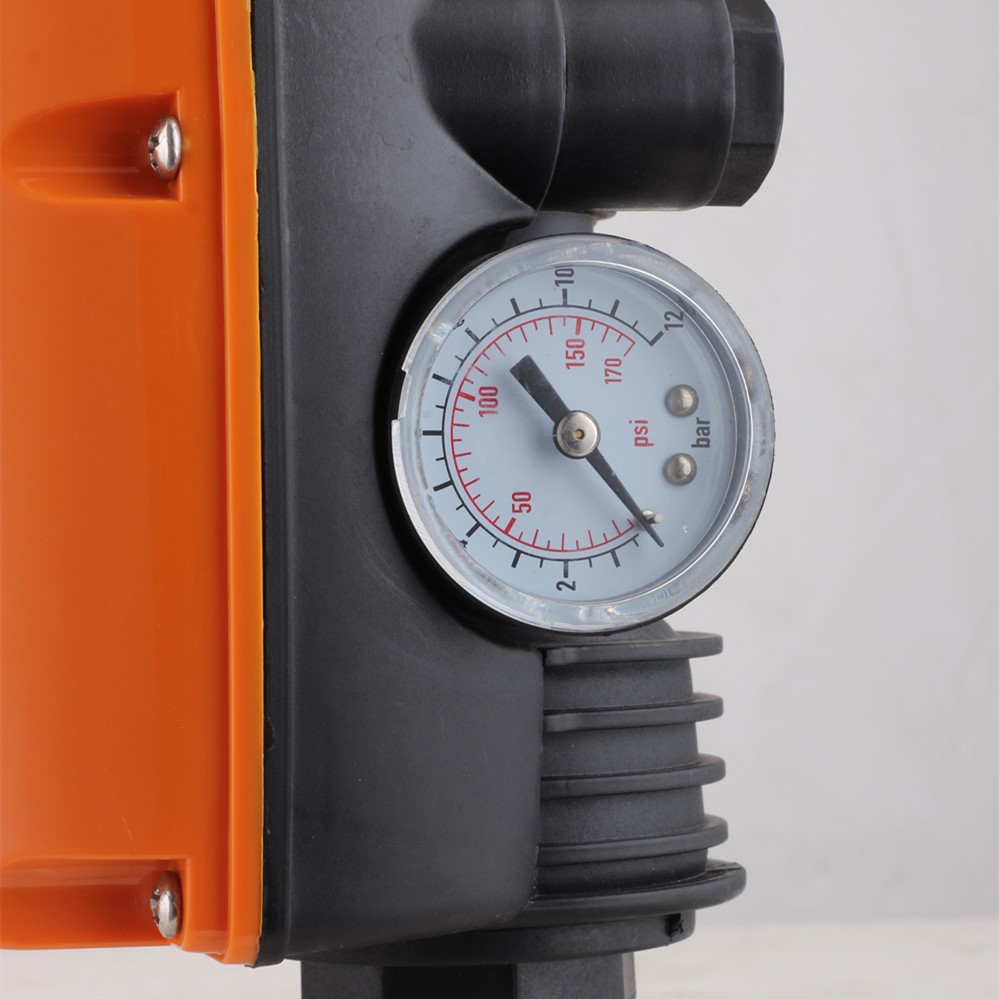
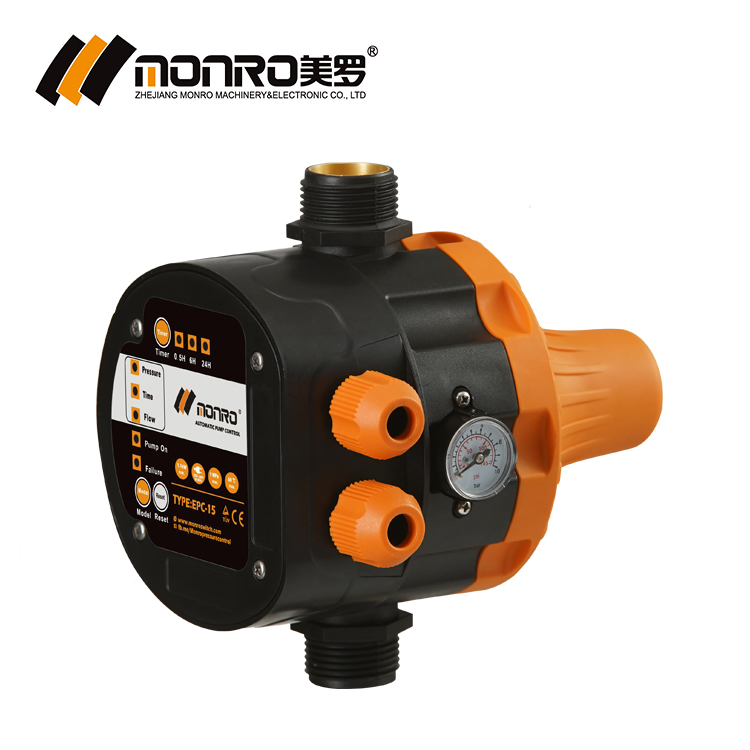
Pump pressure control with a built-in pressure gauge — the gauge makes starting and cut-out pressure verifiable at commissioning rather than assumed from the datasheet.
Detailed Solution: The Five Parameters, One at a Time
1. Starting Pressure: Fixed Set Points or an Adjustable Range
Starting pressure determines when the pump is allowed to run. Fixed-setting models are built around one of three documented values: 1.2 bar, 1.5 bar, or 2.2 bar. Monro documents these three settings on EPC-2, EPC-3 and EPC-5, which means a distributor can cover most residential duties with a single fixed-setting family and no field adjustment.
Adjustable models replace the fixed set point with a dial range, so the installer tunes the start point to the actual building height instead of selecting between three options. Monro documents an adjustable starting-pressure range of 1.2–2.5 bar on EPC-5, EPC-9 and EPC-4. When a project needs a start point outside the fixed values, the correct path is an adjustable model — but the range on the model datasheet governs, not an assumed figure, because the usable range is a mechanical property of the spring and diaphragm assembly.
Two consequences follow from adjustability. First, commissioning takes longer, because someone has to set and verify the point on site. Second, stock becomes simpler: one adjustable part number serves several building heights, which matters when a distributor cannot predict which fixed setting will sell.
2. Maximum Power: Match the Motor, Not the Cable
The maximum power rating is the switching capacity of the controller, expressed in kW, and it must be at least the rated power of the pump motor. Across the documented EPC range, the available ratings are 0.55 kW, 0.75 kW, 1.1 kW and 1.5 kW, with some models extending to 2.2 kW. EPC-15 is documented at 1.1 kW / 1.5 kW / 0.75 kW / 0.55 kW; EPC-14A is documented at 1.5 kW / 0.75 kW; EPC-4 is documented at 0.55 kW / 1.1 kW; EPC-12 and EPC-19 are documented at 2.2 kW / 1.1 kW.
In practice, the four ratings below 2.2 kW cover the domestic and light-commercial pump sizes that dominate residential booster and irrigation duties. The specification error to avoid is choosing a controller on the basis of the cable or the socket: a 1.1 kW pump connected to a controller rated at 0.75 kW will work at commissioning and then trip under sustained load, which reads as a controller fault rather than a specification fault.
3. Voltage: Single Market or Triple Voltage
Rated voltage is where export ranges usually fragment. Two configurations dominate the documented EPC models. The first is a triple-voltage build covering 110 V, 230 V or 110–220 V, documented on EPC-13, EPC-14, EPC-14A and EPC-15. The second is a single broad range such as 100–240 V, documented on EPC-12, or a dual range such as 220–240 V / 110–120 V on EPC-19. All EPC models operate at 50/60 Hz.
A triple-voltage controller reduces the number of SKUs a distributor has to hold, because one part covers both the 110 V and 230 V markets. The trade-off is that the installer must still confirm the supply voltage and connect accordingly; triple voltage is a build option, not an autoranging guarantee for every wiring error.
4. Thread: G1" as the Documented EPC Connection
The connection thread is the parameter most often left to the installer, and it is the one that produces visible rework. Monro EPC pump pressure switches are documented with a female G1" connection thread — that is the standard connection on EPC-9, EPC-12, EPC-14A and EPC-15. Mechanical controls in the KRS series use a different connection family, documented as 1/4" female, 3/8" female or 1/4" male on KRS-6.
Because thread standards are regional, the order checklist should always name the system-side connection explicitly rather than assuming the controller side. Confirm whether the mating connection on the pump, tank tee or pipework is G1", G1 1/4, G1 1/2 or NPT1, and treat any deviation from the documented model thread as a specification item to be agreed at order stage. This single check removes adaptors, sealant and the leak call-backs that follow them.
5. IP Rating and Maximum Working Temperature
Enclosure and temperature ratings decide where the controller can physically be installed. The documented EPC enclosure rating is IP65 on models such as EPC-12, EPC-14A, EPC-15 and EPC-19, with EPC-9 documented at IP54. Mechanical KRS controls are documented at IP44. IP65 is the appropriate specification for pump houses, pits and outdoor cabinets where the controller will see spray or driven water; IP44 covers protected indoor installation.
Maximum working temperature follows the same logic. The pump pressure switch class documented in this guide carries a 55 °C maximum working temperature, and several EPC models — including EPC-9, EPC-12, EPC-14A and EPC-15 — are documented at 60 °C. The 55 °C to 60 °C band is adequate for domestic hot-water-adjacent and irrigation duty, but it is a hard ceiling: a controller mounted in an unventilated metal cabinet next to a hot pump body can exceed it even when the water temperature is well within range.
6. Hydraulic Features: Built-In Check Valve and Run-Dry Protection
Two hydraulic features change the technical fit more than their size suggests. The first is a built-in check valve. EPC-3 is documented with a built-in check valve, and EPC-12 includes it as well. A check valve inside the controller prevents back-flow through the pump when the pump stops, which holds residual pressure in the line and stops the pump from re-triggering on a falling column of water.
The second is run-dry protection. EPC-3 is documented with built-in run-dry protection, and so is EPC-12. This matters on suction-lift installations, on tanks that can empty, and on any system where a foot valve or a municipal supply can fail: without run-dry protection, a pump can run against no water and fail mechanically before anyone notices.
A third, softer feature is pressure feedback. EPC-3 includes a pressure gauge for real-time pressure monitoring and maintains constant pressure at constant flow, which turns commissioning from an estimate into a measurement. On models without a gauge, the same verification requires a temporary test gauge on the outlet.
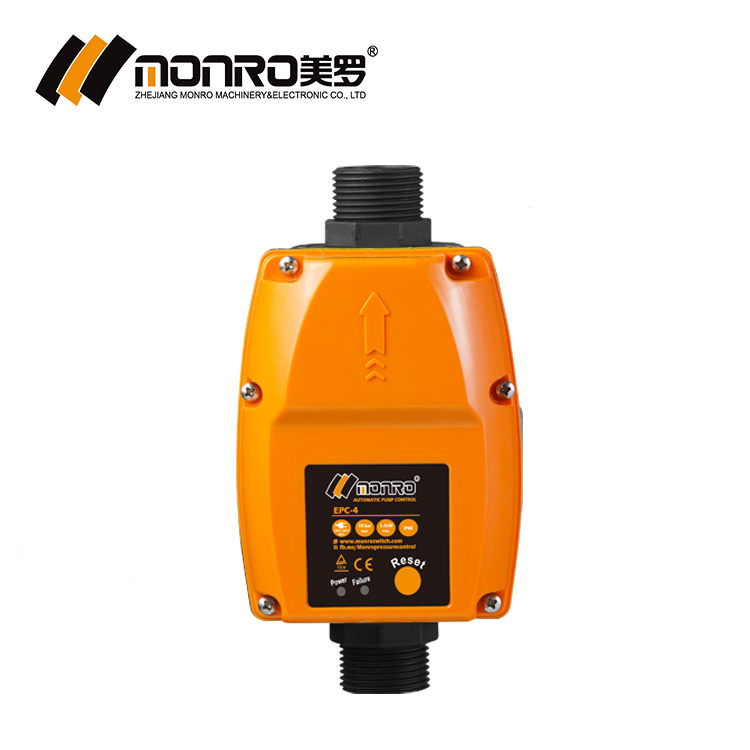
Electronic EPC controllers combine adjustable start pressure, built-in check valve and run-dry protection in one body — the three features that most affect hydraulic fit.
Step-by-Step Breakdown: From Pump Nameplate to Part Number
The sequence below converts a site requirement into a documented parameter set. Each step produces one value that is either accepted or sent back for clarification.
- Read the pump nameplate. Record rated power (kW), rated voltage, maximum head (m) and maximum flow. Every later step depends on these four numbers, and none of them can be inferred from pipe size.
- Set the required water-use height. Measure from the pump outlet to the highest outlet in the building. Divide by 10 to get the corresponding starting pressure in bar: 12 m of height maps to 1.2 bar, 15 m to 1.5 bar, 22 m to 2.2 bar.
- Check the pump head against the 0.8 bar margin. Pump head must be at least the starting pressure plus 0.8 bar. For a 1.2 bar start point this means a minimum head of 20 m; for 1.5 bar, 23 m; for 2.2 bar, 30 m. If the pump cannot meet the margin, the start point must be reduced — not the margin.
- Select the maximum power rating. Take the pump's rated power and select a controller whose documented rating covers it: 0.55 kW, 0.75 kW, 1.1 kW or 1.5 kW, with 2.2 kW models available where the pump requires it.
- Fix the voltage configuration. For a single market, a single-range model is sufficient; for mixed 110 V and 230 V distribution, specify a triple-voltage build such as those documented on EPC-13, EPC-14, EPC-14A and EPC-15, and confirm 50/60 Hz operation.
- Confirm the thread. State the system-side connection explicitly against G1", G1 1/4, G1 1/2 or NPT1, then confirm the controller side against the model datasheet — G1" female is the documented EPC connection.
- Confirm the environment. Specify IP65 for pump pits, outdoor cabinets and wash-down areas; IP44 or IP54 only for protected indoor positions. Confirm the ambient temperature around the controller does not exceed the model's working temperature.
- Decide the protection functions. Add built-in check valve and run-dry protection where back-flow or dry running is a real risk — suction lift, emptying tanks, or unattended irrigation.
- Validate on a sample. Verify the starting pressure and the thread fit on a physical unit before the production order releases.
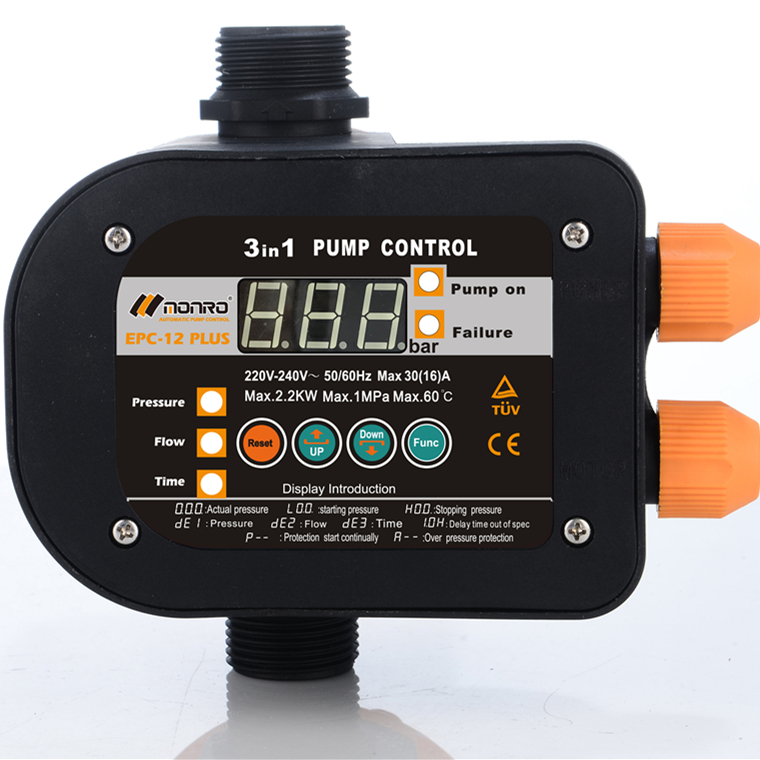
Adjustable and digital models move the starting-pressure decision from the order desk to the commissioning step — useful where building height varies between installations.
Use Cases: Which Parameter Set Fits Which Duty
Domestic and Residential Water Supply
This is the reference duty for the EPC range: clean water, 220–240 V or 110–120 V supply, a working pressure range of 0.5–10 bar, 55 °C maximum working temperature and IP65 protection, with the controller switching the pump on falling pressure and off at the high-pressure set point. A fixed 1.2 bar or 1.5 bar model covers most single-storey and two-storey installations; a 2.2 bar setting is needed once the highest outlet sits more than about 15 m above the pump.
Multi-Storey and Booster Duties
Buildings that exceed 22 m of usable height move out of the fixed-setting range. The specification path is an adjustable-start model, with the start point set during commissioning against a measured column height rather than a chosen fixed value.
Irrigation and Water Transfer
Irrigation duty stresses different parameters: the enclosure matters more than the set point, and run-dry protection matters more than the pressure gauge. A pump that loses prime in a field will run dry unless the controller detects it, so a model with built-in run-dry protection is the technically correct specification even where a simpler mechanical control would be cheaper.
Surface and Submersible Pumps
The controller choice does not depend on whether the pump is surface-mounted or submersible, provided the power, voltage and pressure parameters match. Monro documents EPC-9, EPC-12 and EPC-15 as usable with either surface or submersible pumps, and documents simple installation that saves time and space on EPC-9.
Water Tower and Tank Filling
Filling duty inverts the control logic: the controller runs the pump to fill a tank rather than to hold line pressure. Time-based and flow-based modes exist for this purpose — EPC-12P supports a timing setting of 0.1–1 H and 1–24 H alongside its pressure mode — which is why the mode set belongs in the specification alongside the five core parameters.
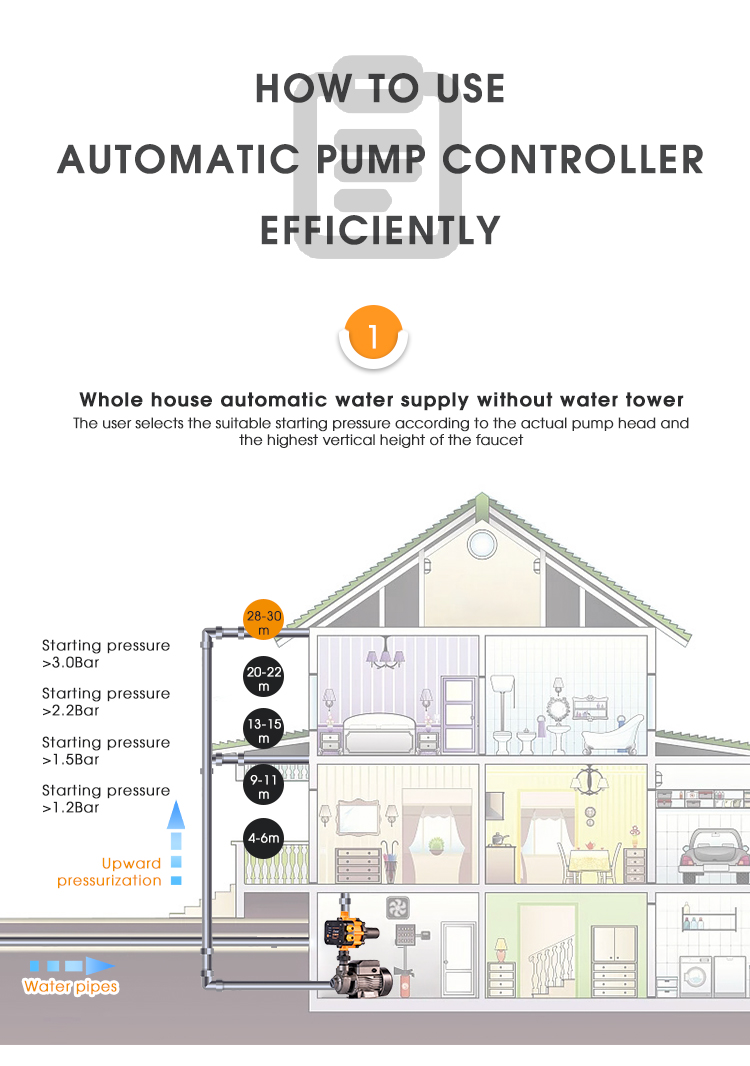
Residential installation: the controller is mounted on the outlet line, and the start point is verified against the highest outlet in the building.
Comparison Table: Documented Parameter Options
The table below maps each parameter to the options documented on Monro models and to the system consequence. It is a specification aid, not a price list: the correct part number is the intersection of all five rows, not the best value in any single row.
| Parameter | Documented options | Model cited | Effect on system fit |
|---|---|---|---|
| Starting pressure — fixed | 1.2 bar / 1.5 bar / 2.2 bar | EPC-2, EPC-3, EPC-5 | Sets usable height (12 m / 15 m / 22 m) and the minimum pump head (20 m / 23 m / 30 m) |
| Starting pressure — adjustable | 1.2–2.5 bar range | EPC-5, EPC-9, EPC-4 | Site tuning to building height; longer commissioning, fewer SKUs |
| Maximum power | 0.55 / 0.75 / 1.1 / 1.5 kW (up to 2.2 kW on some models) | EPC-15, EPC-14A, EPC-4, EPC-12, EPC-19 | Must equal or exceed pump motor rated power; undersizing causes load trips |
| Rated voltage | 110 V / 230 V / 110–220 V; 100–240 V; 220–240 V / 110–120 V | EPC-13, EPC-14, EPC-14A, EPC-15, EPC-12, EPC-19 | Triple-voltage builds reduce SKU count across export markets; 50/60 Hz |
| Connection thread | G1" female; 1/4" F, 3/8" F, 1/4" M on mechanical | EPC-9, EPC-12, EPC-14A, EPC-15, KRS-6 | Must match the system thread; mismatch causes adaptors and leaks |
| Enclosure rating | IP65; IP54; IP44 | EPC-12, EPC-14A, EPC-15, EPC-19 / EPC-9 / KRS-5, KRS-6 | IP65 for pits, outdoor cabinets and wash-down; IP44/54 for protected indoor positions |
| Maximum working temperature | 55 °C; 60 °C | EPC-4, KRS-6 / EPC-9, EPC-12, EPC-14A, EPC-15 | Hard ceiling for cabinet ambient temperature, not only water temperature |
| Hydraulic features | Built-in check valve; built-in run-dry protection; pressure gauge | EPC-3, EPC-12 | Prevents back-flow re-triggering and protects against dry running |
Fixed vs Adjustable Starting Pressure
| Criterion | Fixed setting (1.2 / 1.5 / 2.2 bar) | Adjustable range (1.2–2.5 bar) |
|---|---|---|
| Commissioning effort | None — the set point is built in | Install and verify the set point on site |
| Risk of wrong setting | Low, but the building height must match the chosen value | Low, provided the set point is actually measured |
| Stock and SKU count | Three part numbers to cover three heights | One part number covers a range of heights |
| Best fit | Standardised housing, repeat installations, distributor stock | Projects with variable building heights, retrofit work |
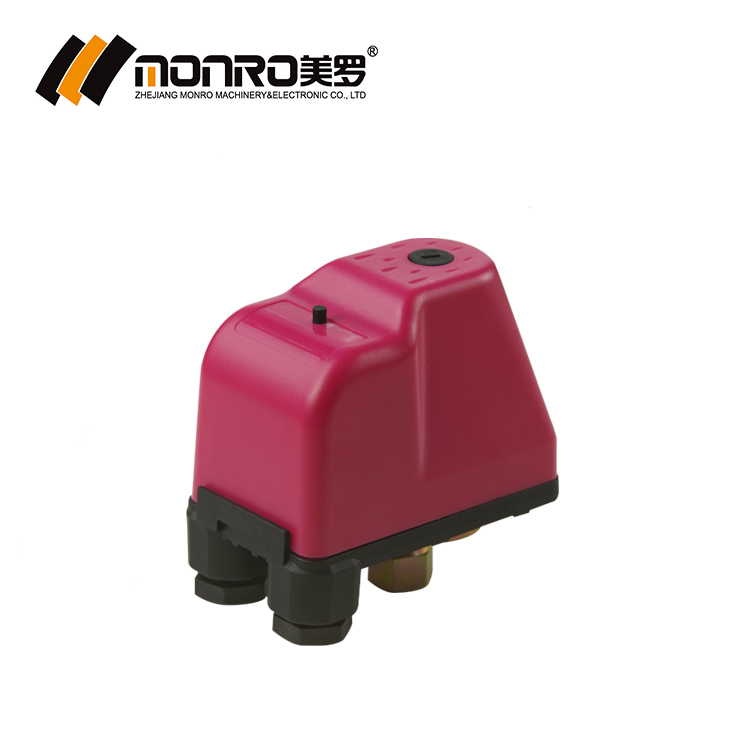
Mechanical controls use a different connection family — KRS-6 is documented with 1/4" and 3/8" male or female hydraulic connections — which is why thread must be confirmed per model, not per brand.
Frequently Asked Questions
Does a pump pressure control switch have to meet IEC 60730-2-6?
IEC 60730-2-6:2025 is the current international standard for automatic electrical pressure sensing controls for household and similar use, so it is the reference a project specification should name. Monro Switch operates an ISO 9001:2015 quality management system, holds TUV (Germany) and CE (Europe) certification, and has selected models approved to the CUL standard for the United States and Canada. Because certification attaches to a model and voltage variant, the buyer should request the certificate that names the exact model and voltage being ordered rather than a general company statement.
Can one controller cover both a surface pump and a submersible pump?
Yes, provided the five parameters match. Monro documents EPC-9, EPC-12 and EPC-15 as usable with either surface or submersible pumps, and EPC-12 is documented with a maximum working pressure of 9.8 bar, IP65 protection, a 60 °C maximum working temperature, a female G1" connection thread and a starting pressure adjustable from 0.5 to 6.7 bar. The pump type changes the installation, not the specification logic: power, voltage, start pressure, thread and enclosure still decide the fit.
What is the minimum order quantity, and what drives the configuration cost?
The documented minimum order quantity for Monro OEM supply is 204 pcs, with a lead time of 45 days. Cost is driven by the configuration rather than by brand tier: model and starting-pressure type, maximum power rating, voltage build (a triple-voltage unit is a different build from a single-range unit), connection thread, cable length and cable material, and whether run-dry protection and a built-in check valve are included. Monro offers OEM customization on cable length, cable material, brand, colour box and product colour, so any of those changes becomes part of the agreed specification before quotation.
Can I validate a sample before placing the production order?
Sample validation is the correct way to close the specification, and it should test three things rather than one: the starting pressure against the measured column height, the thread fit against the actual system connection, and the power rating against the pump nameplate. Installation itself is straightforward — mount the controller in the direction indicated by the arrow on the housing, connect the power cord to a separate plug wire and seal all joints with waterproof insulating tape, then open the main outlet valve and all faucets before energising the controller so it starts against an open system. Monro runs 100% testing on production and maintains a sample showroom; sample requests can be raised through sale@monro-switch.com.
What lead time should I plan for, and how does customization affect it?
The documented lead time is 45 days, supported by monthly capacity of 180,000 pcs for the EPC automatic pump control series, 250,000 pcs for the KRS pressure switch series and 30,000 pcs for the FPS float switch and liquid level control series. Customization — cable length, cable material, brand, colour box or colour — is agreed before the order releases, so the 45-day figure should be read as the production window after specification sign-off, not after first enquiry. Monro provides remote support and a one-year warranty after delivery.
Conclusion: Specify the Parameters, Then the Model
A pressure control switch is not selected by browsing a catalogue; it is selected by resolving five parameters against a pump and a building. Starting pressure sets the usable height and imposes a 0.8 bar margin on the pump head. Maximum power must cover the motor rating, at 0.55 kW, 0.75 kW, 1.1 kW or 1.5 kW on the documented EPC models. Voltage decides whether one triple-voltage part number can serve 110 V and 230 V markets or whether separate builds are needed. Thread must be confirmed against the system connection rather than assumed from the brand. Enclosure and temperature — IP65 and a 55 °C to 60 °C ceiling on the models cited here — decide whether the controller survives the location it is installed in. Built-in check valve and run-dry protection then close the remaining hydraulic risk.
Resolve those five, and the model number follows almost automatically from the EPC family. Resolve them in the wrong order — model first, parameters later — and the installation will find the gap during commissioning.
Next Step: Send the Pump Data, Get the Parameter Confirmation
Send the pump nameplate details — rated power, voltage, maximum head and the required water-use height — and Monro Switch will confirm which EPC model fits and which parameters must be fixed at order stage, including thread, voltage build and protection functions.
Email: sale@monro-switch.com · Tel / WhatsApp: +86 13586289715 · Web: www.monroswitch.com
Model-level parameter tables and the full range are in the 2025 catalogue, available for download here: Monro catalogue 2025 (PDF).
Have Questions or Need More Details?
Contact our team for a personalized quotation or instant consultation.
Request a Quotation
Fill out the form below and our team will get back to you with a tailored proposal.
WhatsApp Direct Chat
Prefer to chat in real-time? Message us on WhatsApp for instant assistance & quick answers.
- Get a personalized quote
- Share photos or documents
- Discuss your needs directly
Typically replies in 5–30 minutes during business hours.