
Pressure Switch by Scenario: EPC-1.1, EPC-2 and EPC-3
A pressure control switch is chosen by scenario before it is chosen by model number. The scenario fixes three inputs: the motor power the switch has to carry, the starting pressure that building height and pump lift require, and the environment the unit must survive. Within the EPC pump pressure control family from Monro Switch, EPC-2 is the general-purpose option for domestic and light construction duty up to 1.5 kW with an R1" connection and IP65 protection, EPC-3 adds a pressure gauge for real-time pressure monitoring and spans 0.55 kW to 1.5 kW, and EPC-1.1 and EPC-2.1 sit in the same family and are specified against the same checks.
This guide maps four applications — domestic water supply, agriculture irrigation, water treatment and construction — onto those four models. It states plainly which parameters are documented for a given model and which still have to be confirmed on the datasheet, because a specification guide that quietly fills gaps is worse than one that marks them.
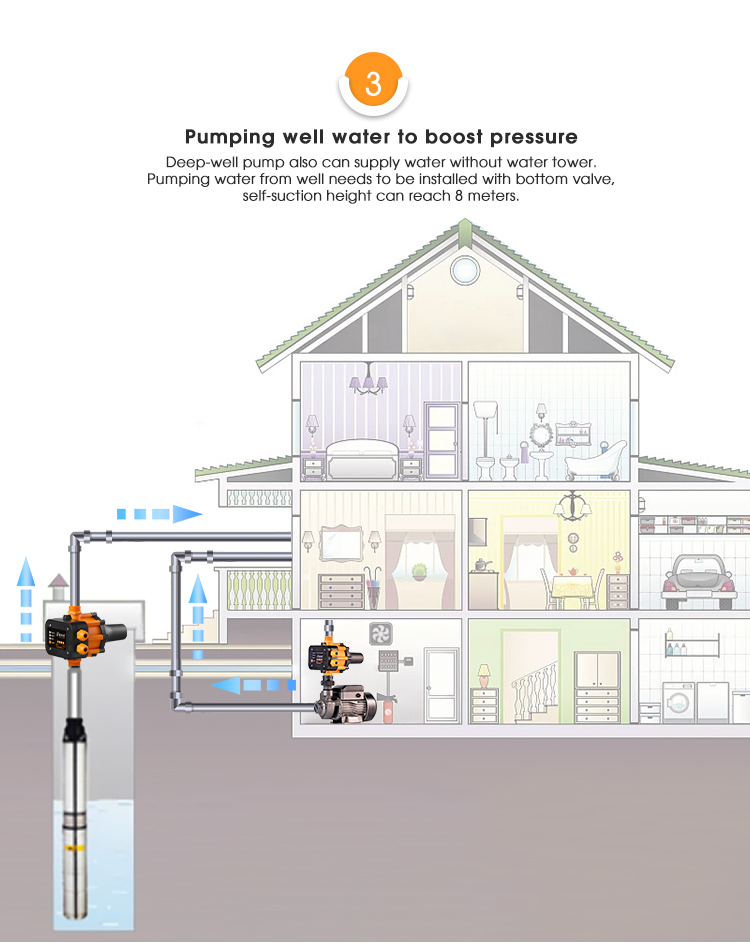
The short answer: model by scenario
The table below is the compressed version of this guide. Each row gives the demand that usually decides the model first, the EPC model that fits that demand on documented evidence, and the verified parameter behind the recommendation.
| Scenario | What decides the model first | Start with | Verified detail |
|---|---|---|---|
| Domestic / residential water supply | Motor power, starting pressure against building height, dry-run risk | EPC-2; EPC-1.1 or EPC-2.1 where the project specifies them | Max power 0.75 / 1.1 / 1.5 kW; settings 1.2, 1.5 or 2.2 bar; R1"; IP65; 55 °C; built-in check valve; run-dry protection |
| Agriculture irrigation | Suction reliability, backflow, outdoor enclosure | EPC-3 where a local pressure reading is wanted, otherwise EPC-2 | EPC-3 spans 0.55–1.5 kW and carries a pressure gauge; both models document run-dry protection and a built-in check valve |
| Water treatment | Steady flow behaviour, clean-water only medium, on-site diagnostics | EPC-3 | Pressure gauge for real-time monitoring; maintains constant pressure at constant flow |
| Construction | Site voltage, portability, wet and dusty conditions | EPC-2 | Rated 220–240 V / 110–120 V; IP65; 55 °C maximum working temperature |
What each scenario actually changes about the switch
Every unit discussed here performs the same basic function: it starts the pump when system pressure falls to the preset cut-in point and stops it when pressure reaches the cut-out point. The application changes which of the surrounding requirements become non-negotiable.
- Motor power. The switch must be rated for the pump motor it controls. EPC-2 is documented at 0.75 kW, 1.1 kW or 1.5 kW; EPC-3 at 0.55 kW, 0.75 kW, 1.1 kW or 1.5 kW. A motor above the selected rating is the wrong pairing however well the pressure settings line up.
- Starting pressure against height and lift. Monro's selection guidance links the two directly: at a 1.2 bar starting pressure the maximum water-use height is 1.2 × 10 m = 12 m, and the pump lift should be at least (1.2 + 0.8) × 10 m = 20 m. The same guidance requires the pump head to sit at least 0.8 bar above the controller's start-up pressure.
- Medium. The domestic water supply application in Monro's documentation is specified for clean water. That single line rules the family out of duties where the pumped fluid is not clean water, and it should be read before any pressure figure.
- Environment. EPC-2 is documented at IP65 and a maximum working temperature of 55 °C. Those two numbers decide whether a unit can sit in a pump house, a field cabinet or on a site board without an additional enclosure.
- Protection features. Built-in run-dry protection and a built-in check valve are documented for both EPC-2 and EPC-3. In irrigation and construction, where suction can be lost or a line can be drained between shifts, these are the features that decide whether the pump survives an operator error.
- Readout. EPC-3 includes a pressure gauge for real-time pressure monitoring. Where commissioning or fault-finding depends on somebody reading the pressure at the unit, that is a functional difference rather than a cosmetic one.
One regulatory anchor is worth stating because it sits above model choice. IEC 60730-2-6:2025, published by the International Electrotechnical Commission on 14 August 2025, applies to automatic electrical pressure sensing controls for use in, on, or in association with equipment for household appliance and similar use. A buyer writing a specification for domestic or light commercial pump control is writing into that standard family, and should ask a supplier which standard and which certification the exact model and voltage variant is approved to.
Where the four models sit in Monro's EPC range

Zhejiang Monro Machinery & Electronic Co., Ltd. (Monro Switch) is a pressure controller and float switch manufacturer based in Wenling City, Zhejiang Province, China. The company was officially established in 2010 and draws on more than 20 years of manufacturing experience in pressure controls and float switches. It operates a 30,000 m² facility with around 200 employees and 10 engineers, produces more than 40 models of pressure controllers for water pump systems and air compressors, runs an ISO 9001:2015 quality management system, holds TUV (Germany) and CE (Europe) certifications with select models approved to the CUL standard, and exports about 90% of output to Asia, Europe, North and South America, the Middle East and Africa.
Within that range, EPC-1.1, EPC-2, EPC-2.1 and EPC-3 are all listed as pump pressure controls. The domestic and residential water supply application unit lists them among the products related to automatic pump start/stop control on clean water systems, with an application envelope of 220–240 V / 110–120 V, a 0.5–10 bar pressure range, a 55 °C maximum working temperature and IP65 protection. That envelope describes the application, not the individual model — a distinction worth keeping when the datasheet is checked.
Market context supports why the electronic end of this category has its own selection logic. Market Research Future puts electromechanical pressure switches at approximately 62% of the global market in 2024, with solid-state electronic switches at 38%. Fortune Business Insights valued the global pressure switch market at USD 3.2 billion in 2025, a figure that uses a broader industrial definition than pump-only research, so it is useful as scale rather than as a forecast for any single product line.
Verified specifications for EPC-2 and EPC-3
The two models in this guide with itemised parameters are EPC-2 and EPC-3. The table records only documented values; where a parameter is not itemised in the specification set used for this guide, the cell says so rather than repeating an assumption.
| Parameter | EPC-2 | EPC-3 |
|---|---|---|
| Rated voltage | 220–240 V / 110–120 V | Not itemised in this specification set |
| Power frequency | 50 / 60 Hz | Not itemised in this specification set |
| Maximum power | 0.75 kW / 1.1 kW / 1.5 kW | 0.55 kW / 0.75 kW / 1.1 kW / 1.5 kW |
| Starting pressure settings | 1.2 bar, 1.5 bar, 2.2 bar | 1.2 bar, 1.5 bar, 2.2 bar |
| Adjustable starting pressure | 1.5–3.0 bar on adjustable versions; fixed versions also offered | Confirm on the datasheet |
| Connection thread | R1" | Confirm on the datasheet |
| Protection rating | IP65 | Confirm on the datasheet |
| Maximum working temperature | 55 °C | Confirm on the datasheet |
| Built-in check valve | Yes | Yes |
| Run-dry protection | Yes, built in | Yes, built in |
| Constant pressure at constant flow | Yes | Yes |
| Pump compatibility / readout | Surface or submersible pumps; no gauge documented | Pressure gauge for real-time pressure monitoring |
Two entries matter more than they look. The adjustable starting-pressure range of 1.5–3.0 bar on EPC-2 is a variant feature, not a standard one, so a project that needs to retune setpoints after installation should specify the adjustable version explicitly. And the blank EPC-3 cells are not a limitation of the product — they are a limit of the documentation supplied here, and the correct next step is a datasheet request, not an assumption that the EPC-2 figures carry across.
Domestic and residential water supply
Domestic duty is intermittent and unpredictable: a tap opens for eight seconds, a washing machine fills for four minutes, a house is empty for ten hours. The controller's job is to convert that erratic demand into clean start/stop cycles without letting the pump run without water. EPC-2 is the documented fit for this pattern up to 1.5 kW, with a starting-pressure setting of 1.2, 1.5 or 2.2 bar, an R1" connection, IP65 protection, a 55 °C maximum working temperature, a built-in check valve and built-in run-dry protection.
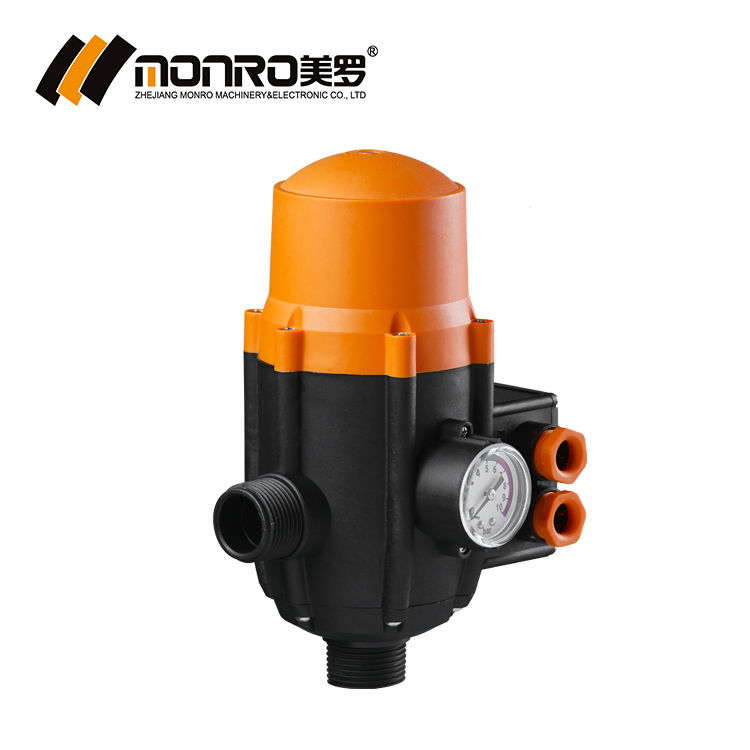
The setpoint is not a preference. Monro's selection rule ties it to the building: a 1.2 bar starting pressure supports a maximum water-use height of 12 m, and requires a pump lift of at least 20 m. Raise the start pressure for a taller building and the required lift rises with it — the 0.8 bar margin between pump head and start-up pressure is the part installers skip and then diagnose as a fault.
EPC-1.1 and EPC-2.1 belong to the same domestic application envelope. They are distinct models in the family, and the specification set used for this article does not itemise their voltage, power, thread or setpoint values, so the honest instruction for a domestic project is this: treat EPC-2 as the benchmark specification, then confirm the EPC-1.1 or EPC-2.1 sheet against the same five checks in the section below before approving the order. In particular, verify whether the adjustable range and the maximum motor power match the pump, because EPC-2 and EPC-2.1 carry different designations and a two-digit difference is not a reliable guide to a parameter difference.
Agriculture irrigation
Irrigation changes the risk profile. Pumps run unattended for long periods, suction can be lost when a source level drops, and lines are drained and refilled between irrigation cycles. Two documented features answer that risk directly: built-in run-dry protection, which stops the pump when no water is detected, and a built-in check valve, which holds the line against backflow. Both EPC-2 and EPC-3 carry them.
Model choice then turns on power and visibility. EPC-3 covers 0.55 kW, 0.75 kW, 1.1 kW and 1.5 kW with the same 1.2, 1.5 and 2.2 bar starting-pressure settings, and adds a pressure gauge for real-time pressure monitoring. In a field installation that gauge is the difference between a fault that is diagnosed in one visit and a fault that is diagnosed by swapping parts: a fitter can read the pressure at the unit, compare it with the expected suction and discharge condition, and decide whether the problem is the controller, a blocked filter or a worn pump.
Where an irrigation project requires seasonal setpoint changes — a lower start pressure for a low-flow drip zone, a higher one for a sprinkler block — the adjustable variant has to be ordered as such. EPC-2 is documented with an adjustable starting-pressure range of 1.5–3.0 bar on adjustable versions and fixed settings of 1.2, 1.5 or 2.2 bar on non-adjustable ones. If EPC-2.1 is being considered for the same duty, its adjustable range should be confirmed in writing rather than inferred from EPC-2.
Water treatment
Treatment duty tends to be steady rather than spiky: a filtration or transfer pump runs at a near-constant flow for long blocks of time, and the control's value lies in holding pressure stable while it does. EPC-3 is documented as maintaining constant pressure at constant flow and includes a pressure gauge for real-time pressure monitoring, which makes it the more informative of the two models in a plant room where somebody walks past the equipment daily.
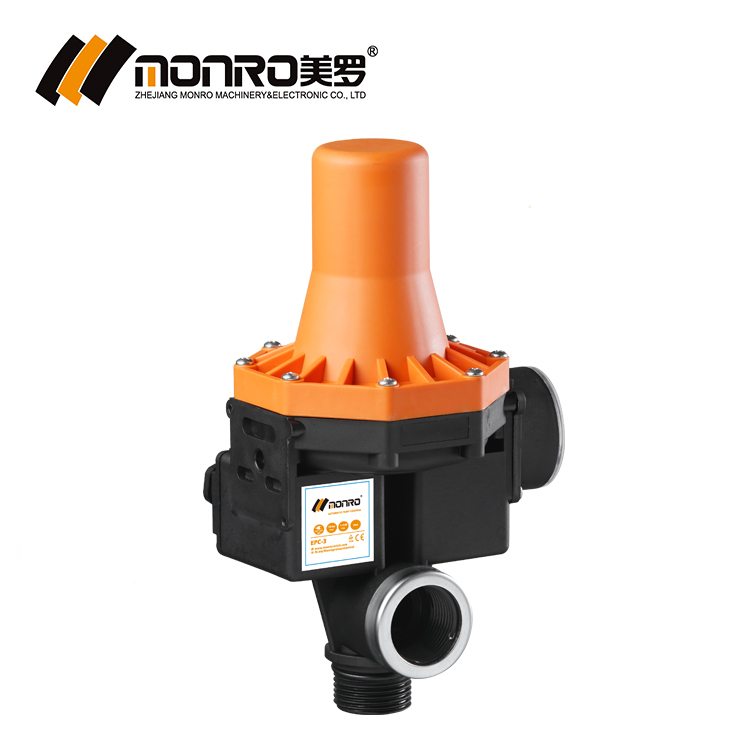
The medium constraint comes first, however. Monro's domestic water supply application is specified for clean water. Where a treatment process moves a fluid outside that description — a dosing line, a chemical transfer, a stream carrying abrasive solids — the EPC models in this guide should not be assumed suitable, and the question belongs with the product engineer rather than in a specification table. That is a boundary of the documented scope, not a judgement about the hardware.
Readout design is the second practical point. The gauge on EPC-3 is a local, visual indication. No remote or connected monitoring is described in the documentation for EPC-1.1, EPC-2, EPC-2.1 or EPC-3, so a project that expects pressure data in a building management system or a SCADA screen is specifying something these models do not claim to provide.
Construction site water supply
Construction duty is portable, temporary and rough. A site controller may be reconnected to a different pump next month, run from a 110–120 V supply on one site and a 220–240 V supply on the next, and sit in a location that is washed down or dust-covered. EPC-2 is rated 220–240 V / 110–120 V at 50/60 Hz, protected to IP65, rated to a 55 °C maximum working temperature, and documented for surface or submersible pumps, which covers the usual mix of a site transfer pump and a dewatering pump.
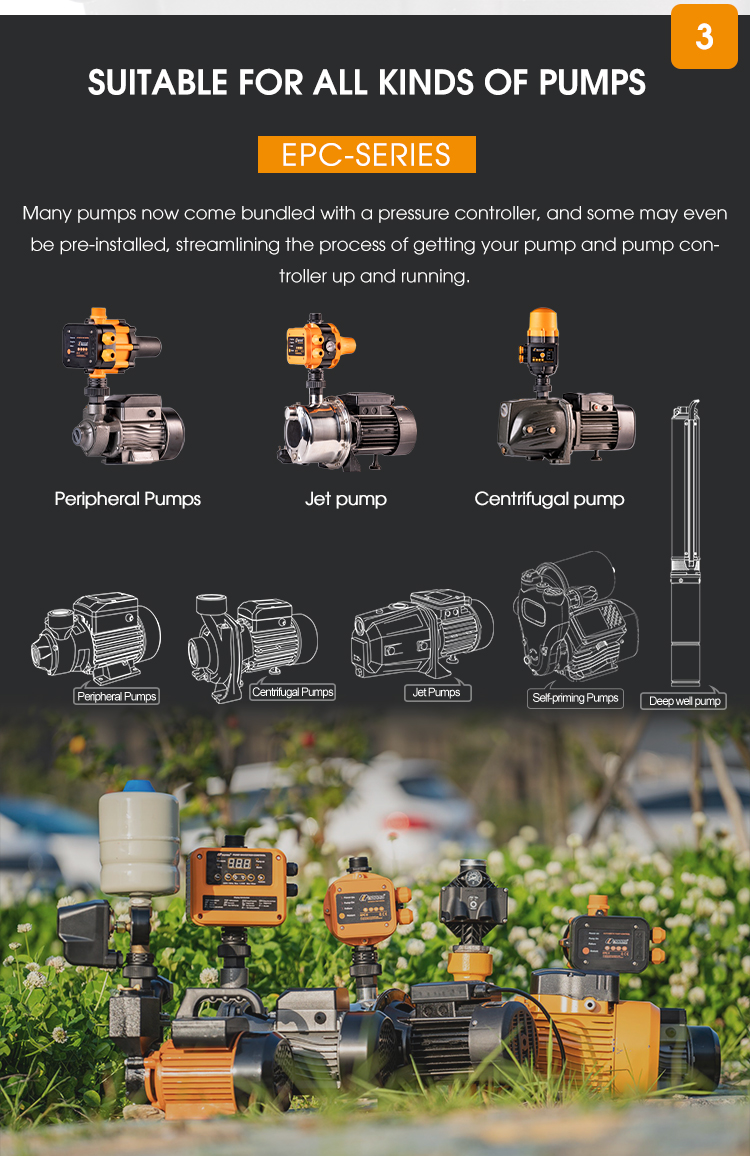
Two documented behaviours matter more on a site than in a home. Built-in run-dry protection stops the pump when water is not detected, which is common on a site where a sump or tank runs low overnight. The built-in check valve holds the line when the pump is switched off, which reduces re-priming on the next shift. And because the unit is portable, the R1" connection on EPC-2 is the practical detail to check against the site's fittings before the unit leaves the store — a thread mismatch is the most common reason a working controller is reported as faulty.
Five checks before you order
The sequence below turns the scenario discussion into a specification. Work through it in order, because each check can eliminate a model before the next one matters.
- Match the motor power. Confirm the pump nameplate first, then compare it with the documented maximum power: EPC-2 at 0.75, 1.1 or 1.5 kW and EPC-3 at 0.55, 0.75, 1.1 or 1.5 kW. A pump above the rating is a safety and reliability issue, not a tuning issue.
- Fix the starting pressure from the building or field layout. Convert the maximum water-use height into a setpoint: 1.2 bar supports 12 m. Then confirm the pump lift clears that setpoint by the documented 0.8 bar margin — 20 m of lift for a 1.2 bar start.
- Confirm the voltage and frequency. EPC-2 is documented at 220–240 V / 110–120 V, 50/60 Hz. Order the variant that matches the site supply rather than adding a transformer to a pump house.
- Confirm the thread and the enclosure. R1" on EPC-2; IP65 and 55 °C maximum working temperature. Anything not itemised for the model you are considering — including several EPC-3 parameters and the EPC-1.1 and EPC-2.1 parameter sets — should be confirmed on the datasheet in writing.
- Decide whether the protection features and the readout are required. Run-dry protection and a check valve are documented on both EPC-2 and EPC-3, so they are not the deciding difference. The pressure gauge on EPC-3 is, whenever someone has to read pressure at the unit.
Installation then follows a documented sequence that protects the controller from the most common start-up error. Check the pump separately to confirm it runs normally and that the nameplate parameters match the controller, with the pump head at least 0.8 bar above the controller's start-up pressure. Install the controller in the direction shown by the arrow on its housing. Connect the controller's power cord to a separate plug wire and seal the joint with waterproof insulating tape. Finally, open the main outlet valve and all faucets before connecting power, so the controller sees flow on its first cycle.
Where these models are not the answer
Three boundaries are worth stating before a quotation is requested. First, power: this guide's model set is documented to 1.5 kW, and a larger motor needs a higher-rated control from the wider EPC range rather than a workaround. Second, medium: the application documentation specifies clean water, so anything else requires a separate engineering answer. Third, data: a local gauge is not a monitoring system, and a project that needs pressure data off-site is buying a different class of product. Naming these limits early usually shortens the selection process, because it removes the options that were never going to work.
Frequently asked questions
Which standard applies to an automatic pump pressure control?
IEC 60730-2-6:2025 is the current international standard for automatic electrical pressure sensing controls for use in, on, or in association with equipment for household appliance and similar use, published by the International Electrotechnical Commission on 14 August 2025. On the manufacturing side, Monro operates an ISO 9001:2015 quality management system and holds TUV (Germany) and CE (Europe) certifications, with select models approved to the CUL standard. A buyer should confirm that the certification covers the exact model and voltage variant being ordered, since a factory-level certificate does not automatically extend to every configuration.
How do I match an EPC pressure control to my pump?
Two matches decide it. The first is motor power: EPC-2 is documented at 0.75 kW, 1.1 kW or 1.5 kW, and EPC-3 at 0.55 kW, 0.75 kW, 1.1 kW or 1.5 kW. The second is starting pressure against height and lift: at a 1.2 bar setting the maximum water-use height is 12 m, and the pump lift should be at least 20 m, calculated as (1.2 + 0.8) × 10 m. The pump head must also sit at least 0.8 bar above the controller's start-up pressure. Both EPC-2 and EPC-3 offer 1.2, 1.5 and 2.2 bar starting-pressure settings.
Which EPC model suits a domestic booster system?
EPC-2 suits a domestic system up to 1.5 kW where the standard setpoints fit the building height; it is documented with an R1" connection, IP65 protection, a 55 °C maximum working temperature, a built-in check valve and built-in run-dry protection. EPC-3 is the alternative when someone needs to read pressure at the unit, because it includes a pressure gauge for real-time pressure monitoring and covers 0.55 kW to 1.5 kW. EPC-1.1 and EPC-2.1 fall within the same domestic water supply application, but their individual voltage, power, thread and setpoint values have to be confirmed on the model datasheet before the order is placed.
What are the minimum order quantity, lead time and warranty?
Monro's documented terms for the pump control range are a minimum order quantity of 204 pieces and a 45-day lead time, with 100% testing of production and a one-year warranty supported by remote after-sales support. Monthly capacity for the EPC series is listed at 180,000 pieces. Pricing is quoted per configuration rather than published, because voltage variant, thread and adjustable or fixed setpoint change the build.
How is the controller installed and started?
Check the pump separately first and confirm that its nameplate parameters match the controller, with the pump head at least 0.8 bar above the controller's start-up pressure. Install the controller in the direction indicated by the arrow on its housing. Connect the power cord to a separate plug wire and seal the connection with waterproof insulating tape. Then open the main outlet valve and all faucets before switching on the power, so the controller begins operation against an open system.
Can the switch be customised for a project?
Monro's documented OEM capabilities for this range cover cable length, cable material, brand, colour box and colour customisation on a 204-piece minimum order with a 45-day lead time. Customisation of the switch itself is a specification conversation rather than a catalogue option, and the practical starting point is a completed parameter list — motor power, required starting pressure, supply voltage and frequency, thread, and whether an adjustable setpoint is needed.
Conclusion
Scenario first, model second. Domestic water supply points to EPC-2 up to 1.5 kW, with EPC-1.1 and EPC-2.1 specified only after their individual parameter sheets are confirmed. Irrigation points to EPC-3 when someone needs to read pressure in the field, or EPC-2 when the setpoints are fixed and the enclosure requirements are met. Water treatment points to EPC-3 for steady-flow duty with local monitoring, within the clean-water scope. Construction points to EPC-2 for its dual voltage rating, IP65 protection and R1" connection.
In every case the same three numbers decide the fit: motor power, starting pressure against height and lift, and the environment the unit lives in. Everything else — the gauge, the adjustable range, the thread — refines a decision that those three numbers have already made. The full EPC and KRS range, including model photographs and parameter tables, is available in the Monro product catalogue (PDF), and specification questions can be sent to the technical team at sale@monro-switch.com for confirmation against the exact model and voltage variant.
Have Questions or Need More Details?
Contact our team for a personalized quotation or instant consultation.
Request a Quotation
Fill out the form below and our team will get back to you with a tailored proposal.
WhatsApp Direct Chat
Prefer to chat in real-time? Message us on WhatsApp for instant assistance & quick answers.
- Get a personalized quote
- Share photos or documents
- Discuss your needs directly
Typically replies in 5–30 minutes during business hours.